



网络流量和旅游活动对居民生活圈行为的非线性影响——以北京老城为例
|
崔喆(1995-), 男, 北京人, 工程师, 注册城乡规划师, 主要研究方向为城市与区域规划。E-mail: cuizhe@bjghy.com |
收稿日期: 2024-09-18
修回日期: 2025-12-08
网络出版日期: 2026-02-05
基金资助
国家重点研发计划(2023YFC3804802)
国家重点研发计划(2021YFA1000304)
Nonlinear impacts of online traffic and tourism activities on residents' life circle behavior: A case study of the Old City of Beijing
Received date: 2024-09-18
Revised date: 2025-12-08
Online published: 2026-02-05
Supported by
National Key R&D Program of China(2023YFC3804802)
National Key R&D Program of China(2021YFA1000304)
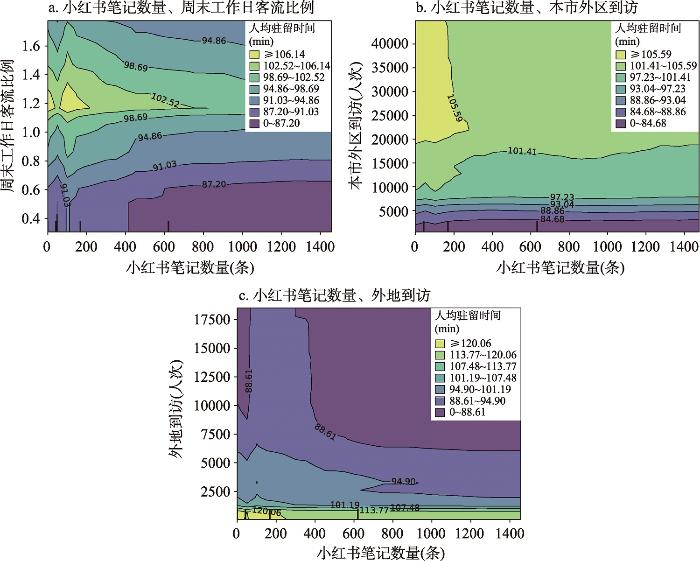
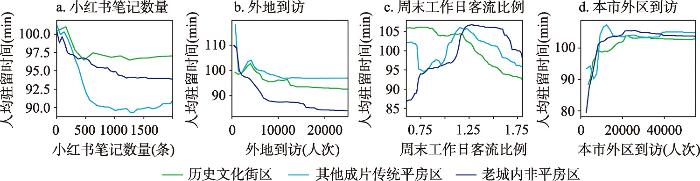
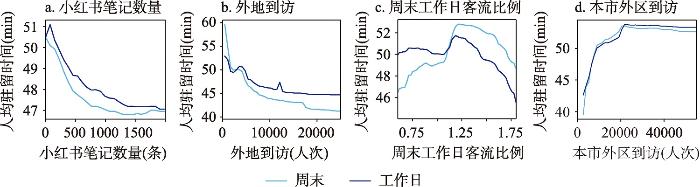
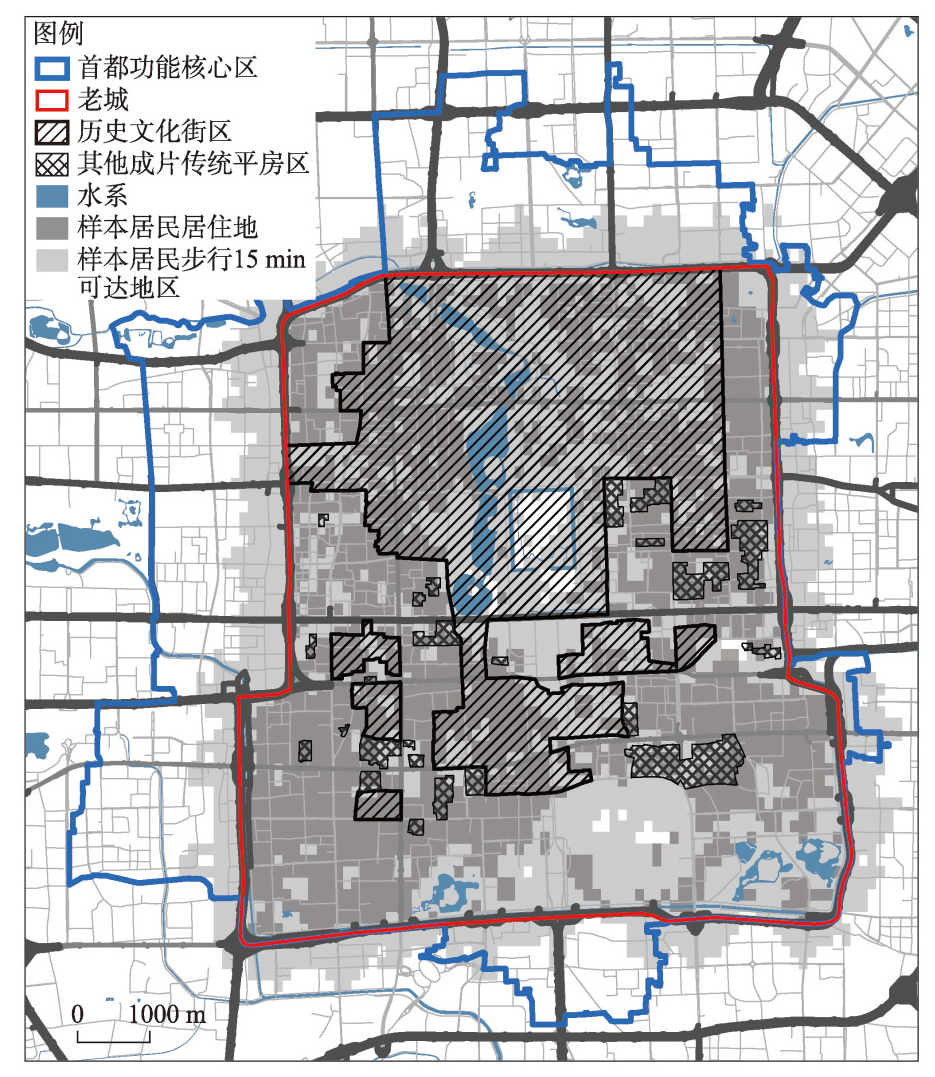
网络流量引导的旅游活动由景区扩散到城市全域,是介入生活圈社会空间的重要客体。本文以北京老城居民为研究对象,实证检验网络流量和旅游活动对居民15 min生活圈行为的非线性影响、中介机理及其时空异质性。本文构建以居民到15 min生活圈内各细分网格的人均驻留时间表征的居民日常行为作为因变量,以网络流量与旅游活动作为解释变量,包含区位特征、居民属性与建成环境等控制变量的机器学习非线性回归模型,使用可解释机器学习算法进行模型分析。研究发现:① 网络流量与旅游活动对居民15 min生活圈驻留的解释力度高于公共服务设施规模;② 网络流量与外地旅游和居民15 min生活圈驻留存在互斥且边际效应递减,本地休闲旅游的影响呈现先升后降的峰值效应;③ 网络流量制约了适当规模的本地休闲旅游的正向作用,其与外地旅游的高值共现是居民驻留极端低值的必要条件;④ 网络流量通过助推外地旅游和大规模的本地休闲旅游,间接制约了居民的驻留;⑤ 网络流量与旅游活动在历史文化街区内的效应量小于其他圈层,周末的效应量大于工作日。综合可判定研究区存在一定程度的过度旅游现象。
崔喆 , 张晓东 , 吴兰若 , 何莲娜 . 网络流量和旅游活动对居民生活圈行为的非线性影响——以北京老城为例[J]. 地理学报, 2026 , 81(2) : 603 -624 . DOI: 10.11821/dlxb202602017
Online traffic-driven tourism activities, which diffuse from scenic spots to the entire urban area, serve as important objects intervening in the social space of life circles. Taking residents in the Old City of Beijing as the research object, this study empirically tests the nonlinear relationship, mediating mechanism, and spatiotemporal heterogeneity between online traffic, tourism activities, and residents' 15-minute life circle behavior. Using the average dwell time per capita in each subdivided grid within the 15-minute life circle to characterize residents' daily behavior as the dependent variable, a machine learning-based nonlinear regression model is constructed, incorporating explanatory variables including online traffic and tourism activities, as well as control variables including locational characteristics, resident attributes, and built environment. Interpretable machine learning algorithms are used for model analysis. The study finds that: (1) Online traffic and tourism activities have a higher explanatory power for residents' dwell time in 15-minute life circles than the quantity of public service facilities. (2) Online traffic exhibits a mutually exclusive relationship with outbound tourism, accompanied by a diminishing marginal effect, while the impact of local leisure tourism presents a peak effect that first increases and then decreases. (3) Online traffic constrains the positive effect of appropriately quantitated local leisure tourism, and its co-occurrence with high-value outbound tourism is a necessary condition for extremely low resident dwell time. (4) Online traffic indirectly constrains residents' dwell time by boosting outbound tourism and large-scale local leisure tourism. (5) The effect size of online traffic and tourism activities in historical and cultural blocks is smaller than that in other areas, and the effect size on weekends is larger than on weekdays. Collectively, it is determined that there is a certain degree of overtourism in the study area.
表1 变量说明与描述性统计Tab. 1 Variable description and descriptive statistics |
| 类型 | 变量名称 | 变量说明 | 平均值 | 标准差 | |
|---|---|---|---|---|---|
| 因变量 | 人均驻留时间 | 居住网格内所有居民前往15 min步行可达范围内另一个网格的总驻留时间与该网格内居民数量之商(min/人) | 99.87 | 193.32 | |
| 解 释 变 量 | 网络流量 | 小红书笔记数量 | 居民驻留网格内小红书笔记数量(条) | 396.61 | 3333.78 |
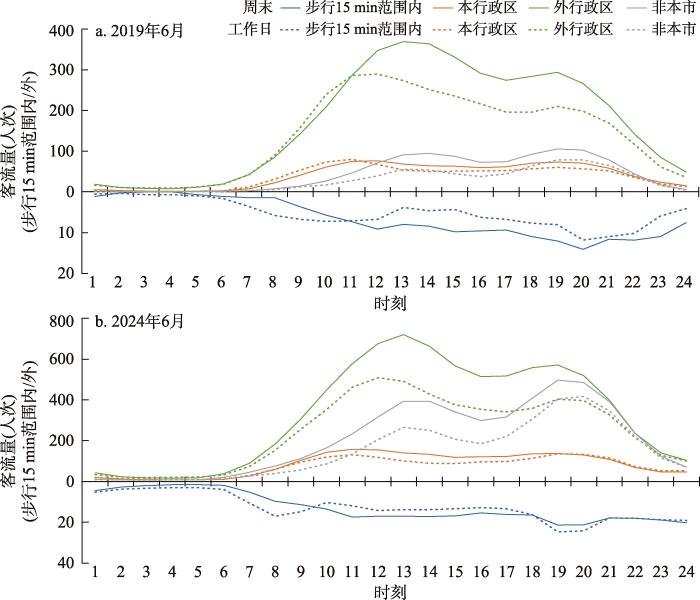
| 旅游活动 | 周末工作日客流 比例 | 居民驻留网格内周末日均客流与工作日日均客流之比(不含节假日) | 1.15 | 0.31 | |
| 本市外区到访人次 | 到访过居民驻留网格,居住地在本市且所在行政区与驻留网格不同,且与驻留网格的直线距离大于3 km的居民总到访次数(人次) | 16205.72 | 21343.91 | ||
| 外地到访人次 | 到访过居民驻留网格的外地到访者(当月在北京市出现少于10 d)的总到访次数(人次) | 5289.24 | 9123.59 | ||
| 控 制 变 量 | 区位属性 | 网格间步行时间 | 居住网格与驻留网格之间的最短步行时间(s) | 598.56 | 198.20 |
| 居住地所属圈层 | 历史文化街区=0;其他成片传统平房区=1;二环内非平房区=2 | 1.20 | 0.95 | ||
| 居住地建成 环境属性 | 居住地平均建筑 层数 | 按建筑基底面积加权的居住网格平均建筑层数(层) | 5.24 | 4.53 | |
| 居民属性 | 男性居民占比 | 居住网格内男性居民占总居民数量的比例 | 0.56 | 0.09 | |
| 平均年龄阶段 | 0~6岁=1;7~12岁=2;13~15岁=3;16~18岁=4;19~24岁=5;25~29岁=6;30~34岁=7;35~39岁=8;40~44岁=9;45~49岁=10;50~54岁=11;55~59岁=12;60~64岁=13;65~69岁=14;70岁以上=15,所有居民的平均值 | 9.89 | 0.67 | ||
| 平均工作时长 | 居住网格内居民在就业地的月均总驻留时长(h) | 55.41 | 19.77 | ||
| 生活圈建成 环境属性 | 大众点评星级 | 居民驻留网格内商铺大众点评星级的平均值 | 3.85 | 0.20 | |
| 零售商业设施 数量 | 居民驻留网格内超市、便利店、菜市场等零售商业设施POI数量(不含家电卖场、家居建材市场等专业市场)(个) | 0.72 | 1.37 | ||
| 文化体育设施 数量 | 居民驻留网格内体育馆、博物馆、图书馆等文化体育设施POI数量(个) | 0.69 | 1.44 | ||
| 餐饮设施数量 | 居民驻留网格内餐馆、饮品店等餐饮设施POI数量(个) | 3.56 | 7.90 | ||
| 教育医疗设施 数量 | 居民驻留网格内中学、小学、幼儿园、医院、社区卫生服务中心等教育医疗设施POI数量(不含高校、培训机构)(个) | 0.34 | 1.06 | ||
| 绿地面积 | 居民驻留网格内公园绿地、防护绿地、广场等绿地的总面积(m2) | 10.63 | 17.12 | ||
表2 模型验证结果Tab. 2 Model validation results |
| 模型 | 平均绝对误差 | R2 |
|---|---|---|
| XGBoost | 72.660 (0.678) | 0.512 (0.009) |
| CatBoost | 72.585 (0.592) | 0.515 (0.006) |
| LightGBM | 72.993 (0.627) | 0.508 (0.007) |
| 随机森林 | 73.573 (0.684) | 0.494 (0.007) |
| OLS | 102.987 (0.389) | 0.224 (0.003) |
注:括号外为验证指标的平均值,括号内为标准差。 |
表3 变量相对重要性Tab. 3 Relative importance of variables |
| 变量 | 相对重要性(%) | 排名 |
|---|---|---|
| 解释变量 | ||
| 驻留地网红旅游属性 | ||
| 小红书笔记数量 | 2.43 | 11 |
| 周末工作日客流比例 | 4.74 | 6 |
| 本市外区到访者数量 | 3.69 | 9 |
| 外地到访者数量 | 4.40 | 7 |
| 控制变量 | ||
| 区位属性 | ||
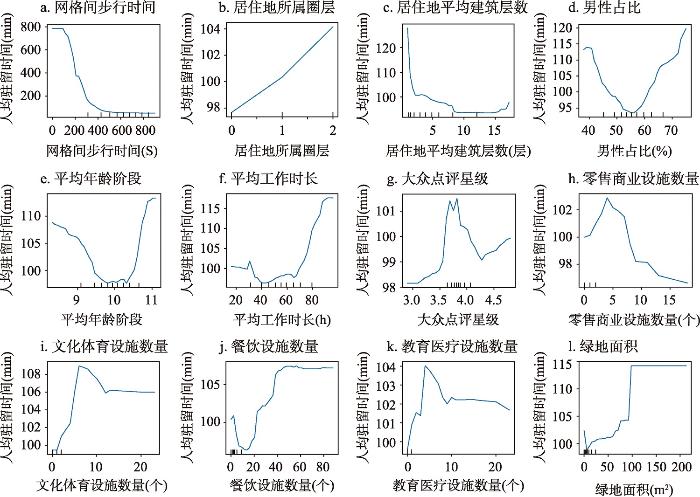
| 网格间步行时间 | 48.20 | 1 |
| 居住地所属圈层 | 1.94 | 12 |
| 居住地建成环境属性 | ||
| 居住地平均建筑层数 | 5.41 | 4 |
| 居民属性 | ||
| 男性居民占比 | 6.52 | 2 |
| 平均年龄阶段 | 4.90 | 5 |
| 平均工作时长 | 5.48 | 3 |
| 驻留地建成环境属性 | ||
| 零售商业设施数量 | 1.29 | 14 |
| 文化体育设施数量 | 1.04 | 15 |
| 餐饮设施数量 | 1.77 | 13 |
| 教育医疗设施数量 | 0.73 | 16 |
| 绿地面积 | 4.13 | 8 |
| 大众点评星级 | 3.33 | 10 |
表4 网络流量(X)—旅游活动(M)—居民行为(Y)的中介效应Bootstrap检验结果Tab. 4 Bootstrap test results for the mediating effect of online traffic (X) - tourism activities (M) - resident behavior (Y) |
| 中介要素(M) | 路径 | 效应量系数 | 标准误 | 95%置信区间 | |
|---|---|---|---|---|---|
| 下限 | 上限 | ||||
| 外地到访人次 | X→Y(总效应) | -0.122*** | 0.022 | -0.165 | -0.079 |
| X→M | 0.365*** | 0.002 | 0.362 | 0.369 | |
| M→Y | -0.147*** | 0.022 | -0.190 | -0.104 | |
| X→M→Y(中介效应) | -0.054** | 0.007 | -0.068 | -0.040 | |
| 中介效应/总效应:37.56% | |||||
| 本市外区到访人次(< 20965) | X→Y(总效应) | -0.253*** | 0.037 | -0.325 | -0.181 |
| X→M | 0.067*** | 0.002 | 0.064 | 0.070 | |
| M→Y | 0.235*** | 0.062 | 0.115 | 0.356 | |
| X→M→Y(中介效应) | 0.016** | 0.004 | 0.008 | 0.024 | |
| 中介效应/|总效应|:6.25% | |||||
| 本市外区到访人次(≥ 20965) | X→Y(总效应) | -0.082*** | 0.026 | -0.133 | -0.031 |
| X→M | 0.189*** | 0.002 | 0.185 | 0.193 | |
| M→Y | -0.235*** | 0.038 | -0.309 | -0.162 | |
| X→M→Y(中介效应) | -0.044** | 0.006 | -0.057 | -0.033 | |
| 中介效应/总效应:53.95% | |||||
| 周末工作日客流比例(< 1.1692) | X→Y(总效应) | -0.152*** | 0.031 | -0.213 | -0.090 |
| X→M | 0.021*** | 0.002 | 0.019 | 0.024 | |
| M→Y | 0.694*** | 0.052 | 0.592 | 0.797 | |
| X→M→Y(中介效应) | 0.015** | 0.002 | 0.012 | 0.018 | |
| 中介效应/|总效应|:9.83% | |||||
| 周末工作日客流比例(≥ 1.1692) | X→Y(总效应) | -0.155*** | 0.029 | -0.213 | -0.098 |
| X→M | 0.177*** | 0.003 | 0.171 | 0.182 | |
| M→Y | -0.338*** | 0.035 | -0.407 | -0.269 | |
| X→M→Y(中介效应) | -0.060** | 0.005 | -0.070 | -0.049 | |
| 中介效应/总效应:38.49% | |||||
注:**表示P < 0.05,***表示P < 0.01。X→M→Y路径的统计显著性根据95%置信区间的下限和上限确定,若下限和上限之间不包含0,则在95%的置信水平上显著,反之则不显著;其他路径的统计显著性根据P值确定。 |
| [1] |
[黄泰, 卫嫚, 席建超. 城市旅游景区舒适性对游客消费差异的影响机制: 以苏州乐园森林世界景区为例. 人文地理, 2025, 40(1): 144-153.]
|
| [2] |
|
| [3] |
|
| [4] |
[周梦, 卢小丽, 朱静敏, 等. 媒介朝圣视角下非景区型网红旅游地的探索性研究. 旅游科学, 2023, 37(1): 59-74.]
|
| [5] |
[棟形祐水. 富士山を隠した黒い幕河口湖コンビニ前に設置 マナー改善まで継続. 2024-05-21. https://www.asahi.com/articles/ASS5N452QS5NUZOB002M.html. 2024-05-21.]
|
| [6] |
|
| [7] |
|
| [8] |
|
| [9] |
|
| [10] |
World Tourism Organization. Making tourism more sustainable: A guide for policy makers. Madrid: World Tourism Organization, 2005. https://www.e-unwto.org/doi/epdf/10.18111/9789284408214.
|
| [11] |
World Tourism Organization. 'Overtourism'? Understanding and managing urban tourism growth beyond perceptions. Madrid: World Tourism Organization, 2018. https://www.e-unwto.org/doi/epdf/10.18111/9789284419999.
|
| [12] |
|
| [13] |
|
| [14] |
[刘俊, 陈佳淇, 冯冰, 等. 基于轨迹数据的遵义市红色旅游者时空行为模式研究. 地球信息科学学报, 2024, 26(2): 424-439.]
|
| [15] |
[陈佳淇, 王胜宏, 王圣斌, 等. 长征沿线红色旅游多尺度空间行为模式挖掘与仿真模拟. 旅游学刊, 2024, 39(4): 124-138.]
|
| [16] |
[刘俊, 王胜宏, 余云云, 等. 基于微博大数据的气候变化对中国赏樱旅游的影响. 地理学报, 2022, 77(9): 2292-2307.]
|
| [17] |
|
| [18] |
[刘俊, 余云云, 胡思可, 等. 大数据在旅游研究中的应用: 研究回顾与未来展望. 旅游科学, 2025, 39(1): 1-23.]
|
| [19] |
[吴必虎. 旅游系统: 对旅游活动与旅游科学的一种解释. 旅游学刊, 1998(1): 20-24.]
|
| [20] |
|
| [21] |
|
| [22] |
[韩增林, 李源, 刘天宝, 等. 社区生活圈公共服务设施配置的空间分异分析: 以大连市沙河口区为例. 地理科学进展, 2019, 38(11): 1701-1711.]
|
| [23] |
[郭嵘, 李元, 黄梦石. 哈尔滨15分钟社区生活圈划定及步行网络优化策略. 规划师, 2019, 35(4): 18-24.]
|
| [24] |
[周弦. 15分钟社区生活圈视角的单元规划公共服务设施布局评估: 以上海市黄浦区为例. 城市规划学刊, 2020(1): 57-64.]
|
| [25] |
[周岱霖, 黄慧明. 供需关联视角下的社区生活圈服务设施配置研究: 以广州为例. 城市发展研究, 2019, 26(12): 1-5, 18.]
|
| [26] |
Sun Daosheng Chai Yanwei. Study on the urban community life sphere system and the optimization of public service facilities: A case study of Qinghe area in Beijing. Urban Development Studies, 2017, 24(9): 7-14, 25, 2.
[孙道胜, 柴彦威. 城市社区生活圈体系及公共服务设施空间优化: 以北京市清河街道为例. 城市发展研究, 2017, 24(9): 7-14, 25, 2.]
|
| [27] |
|
| [28] |
Shimokobe Atsushi. Testimony on Postwar Land Planning. Tokyo: Nihon Keizai Hyoronsha, 1994.
[下河辺淳. 戦後国土計画への証言. 東京: 日本経済評論社, 1994.]
|
| [29] |
[杉浦芳夫. 幾何学の帝国: わが国における中心地理論受容前夜. 地理学評論 Ser. A, 1996, 69(11): 857-878.]
|
| [30] |
[孙道胜. 城市社区生活圈规划研究. 南京: 东南大学出版社, 2020.]
|
| [31] |
|
| [32] |
[沈振江, 林心怡, 马妍. 考察近年日本城市总体规划与生活圈概念的结合. 城乡规划, 2018(6): 74-87.]
|
| [33] |
[罗雪瑶, 张文佳, 柴彦威. 15分钟生活圈的建成环境阈值效应研究. 地理研究, 2022, 41(8): 2155-2170.]
|
| [34] |
|
| [35] |
[柴彦威, 李春江, 夏万渠, 等. 城市社区生活圈划定模型: 以北京市清河街道为例. 城市发展研究, 2019, 26(9): 1-8, 68.]
|
| [36] |
[孙道胜, 柴彦威, 张艳. 社区生活圈的界定与测度: 以北京清河地区为例. 城市发展研究, 2016, 23(9): 1-9.]
|
| [37] |
|
| [38] |
[张艳, 柴彦威. “新”时间地理学: 瑞典Kajsa团队的创新研究. 人文地理, 2016, 31(5): 19-24, 46.]
|
| [39] |
[柴彦威, 李春江, 张艳. 社区生活圈的新时间地理学研究框架. 地理科学进展, 2020, 39(12): 1961-1971.]
|
| [40] |
[柴彦威, 李春江. 城市生活圈规划: 从研究到实践. 城市规划, 2019, 43(5): 9-16, 60.]
|
| [41] |
[刘云刚, 侯璐璐. 基于生活圈的城乡管治理论研究. 上海城市规划, 2016(2): 1-7.]
|
| [42] |
|
| [43] |
|
| [44] |
[肖宁, 杨金华, 徐元诏, 等. 网红博主与网红场景对出游意愿和口碑推荐的影响. 人文地理, 2024, 39(1): 184-192.]
|
| [45] |
[杨莹, 马怡然. 景观社会视角下网红景点形象感知偏差形成机制. 经济地理, 2024, 44(2): 219-227.]
|
| [46] |
|
| [47] |
|
| [48] |
[
|
| [49] |
People's Government of Beijing Municipality. Detailed Regulatory Plan for the Core Area of the Capital (Block-level) (2018-2035). 2020-08-30. https://ghzrzyw.beijing.gov.cn/zhengwuxinxi/ghcg/xxgh/sj/202008/t20200829_1993379.html.
[北京市人民政府. 首都功能核心区控制性详细规划(街区层面)(2018—2035年). 2020-08-30. https://ghzrzyw.beijing.gov.cn/zhengwuxinxi/ghcg/xxgh/sj/202008/t20200829_1993379.html.]
|
| [50] |
|
| [51] |
Ministry of Housing and Urban-Rural Development of the People's Republic of China. Standard for Urban Residential District Planning and Design (GB 50180-2018). Beijing: China Architecture & Building Press, 2018.
[中华人民共和国住房和城乡建设部. 城市居住区规划设计标准(GB50180-2018). 北京: 中国建筑工业出版社, 2018.]
|
| [52] |
People's Government of Beijing Municipality. Configuration index of residential public service facilities in Beijing. 2015-02-19. https://www.beijing.gov.cn/zhengce/gfxwj/201905/t20190522_58262.html.
[北京市人民政府. 北京市居住公共服务设施配置指标. 2015-02-19. https://www.beijing.gov.cn/zhengce/gfxwj/201905/t20190522_58262.html.]
|
| [53] |
|
| [54] |
|
| [55] |
|
| [56] |
|
| [57] |
|
| [58] |
|
| [59] |
|
| [60] |
|
| [61] |
|
| [62] |
|
| [63] |
|
| [64] |
[焦健, 王德, 程英. 上海市时间贫困人群的日常活动模式与特征. 城市规划, 2023, 47(4): 31-44.]
|
| [65] |
|
| [66] |
|
| [67] |
Nycedc, Nychpd, Manhattan Community Board 3. Essex crossing development (Seward Park). 2012-03-21.https://edc.nyc/sites/default/files/2019-06/essex_crossing_ulurp_application_and_filed_modifications.pdf.
|
| [68] |
|
| [69] |
[周琳, 陈晨, 谢苑仪, 等. 上海历史地段城市更新“网红化”的空间生产机制研究: 以长宁区愚园路更新改造为例. 国际城市规划, 2024. DOI: 10.19830/j.upi.2023.463.]
|
| [70] |
[吴良镛. 北京旧城与菊儿胡同. 北京: 中国建筑工业出版社, 1994.]
|
/
| 〈 |
|
〉 |