



广东省新能源汽车跨城出行的空间格局与影响因素
|
李苑君(1995-), 女, 湖北襄阳人, 博士, 助理研究员, 中国地理学会会员(S110011666M), 研究方向为时空大数据与交通流网络。E-mail: geoliyuanjun@gdas.ac.cn |
收稿日期: 2024-10-23
修回日期: 2025-04-22
网络出版日期: 2026-02-05
基金资助
国家自然科学基金项目(42301200)
国家自然科学基金项目(42071165)
广东省科学院打造综合产业技术创新中心行动资金项目(2023GDASZH-2023010101)
Spatial patterns and influencing factors of electric vehicle inter-city travel in Guangdong province
Received date: 2024-10-23
Revised date: 2025-04-22
Online published: 2026-02-05
Supported by
National Natural Science Foundation of China(42301200)
National Natural Science Foundation of China(42071165)
The GDAS' Project of Science and Technology Development(2023GDASZH-2023010101)
李苑君 , 陈嘉璇 , 陈卓 , 吴旗韬 , 芮洋 , 沈堪海 . 广东省新能源汽车跨城出行的空间格局与影响因素[J]. 地理学报, 2026 , 81(2) : 439 -452 . DOI: 10.11821/dlxb202602008
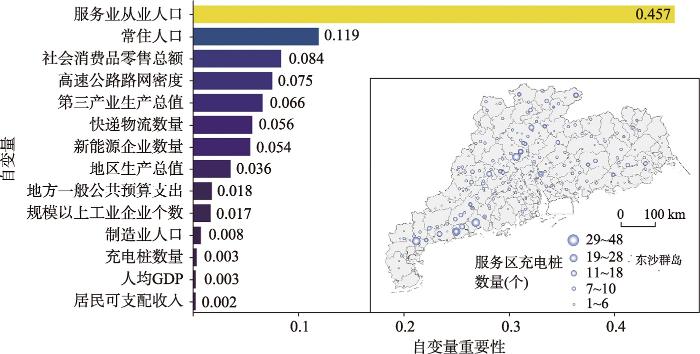
The new energy mode for inter-city travel is crucial for promoting the comprehensive green transformation of the transport industry, among which the first issue to address is identifying the spatial patterns and influencing factors of electric vehicle (EV) inter-city travel. This study takes Guangdong province as a case study and utilizes big data from the expressway online toll collection (OTC) system for March 2024. By integrating complex network analysis, the random forest algorithm, and ridge regression, it explores the spatial patterns of EV inter-city travel and identifies the key influencing factors. The conclusions are as follows: (1) The EV inter-city travel is dominated by pure electric vehicles, which exhibit greater traffic flows and broader coverage compared to hybrid electric vehicles. The dominant flows within the EV networks break the geographical barrier of the Pearl River estuary, resulting in spatial structures that differ from the traditional "dual-core" model centered around Guangzhou and Shenzhen. Instead, a "three-pillar" structure emerges, comprising Guangzhou, Shenzhen and Zhuhai. (2) The scale of EV inter-city travel is closely related to the distribution of transportation hubs. Based on the K-means clustering algorithm, the pure electric vehicle network can be divided into four subgroups, namely the airport county subgroup, the high-speed railway county subgroup, the Pearl River Delta subgroup, and the Guangdong peripheral county subgroup. (3) The differences in reciprocity and convenience of EV inter-city travel on both sides of the Pearl River estuary are minimal. Notably, Xiangzhou district, the Zhongshan City Center Group, Jinwan District, and other key nodes characterized by high reciprocity coefficients and triangle density have also emerged on the west coast. (4) The service industry workforce, permanent population, highway network density, and new energy enterprises are the main factors affecting the scale of EV inter-city travel. This study explores the spatial distribution pattern of electric vehicles from the perspective of inter-city travel, enhancing mobility theory by focusing on the novel traffic flows.
表1 基于英文字母和阿拉伯数字组合的新能源汽车编码规则*Tab. 1 Coding rules for electric vehicles based on the combination of English letters and Arabic numerals |
| 小型新能源汽车 | 大型新能源汽车 | |||||
|---|---|---|---|---|---|---|
| 第一位 | 第二位 | 其他位 | 第六位 | 其他位 | ||
| 纯电车 | A/B/C/D/E | - | 阿拉伯数字 | A/B/C/D/E | 阿拉伯数字 | |
| A/B/C/D/E | 英文字母 | 阿拉伯数字 | ||||
| 非纯电车 | F/G/H/J/K | - | 阿拉伯数字 | F/G/H/J/K | 阿拉伯数字 | |
| F/G/H/J/K | 英文字母 | 阿拉伯数字 | ||||
注:*编码规则获取自广东省交通运输厅。因大型新能源汽车数量较少,本文不区分大型、小型车。 |
表2 新能源汽车跨城出行影响因素岭回归结果Tab. 2 Ridge regression results of factors affecting inter-city travel of new energy vehicles |
| 影响因子 | 非标准化系数 | 标准误 | 标准化系数 | t | p |
|---|---|---|---|---|---|
| 常数 | -13266.158 | 1896.75 | - | -6.994 | < 0.001*** |
| 第三产业生产总值 | 0.535 | 0.653 | 0.025 | 0.819 | 0.015** |
| 新能源企业数量 | 5.593 | 1.23 | 0.144 | 4.548 | < 0.001*** |
| 服务业劳动力数量 | 0.252 | 0.017 | 0.304 | 15.112 | < 0.001*** |
| 常住人口 | 0.008 | 0.001 | 0.251 | 8.825 | < 0.001*** |
| 高速公路路网密度 | 47748.953 | 6405.379 | 0.255 | 7.455 | < 0.001*** |
| [1] |
CPC Central Committee and the State Council. Opinions on accelerating the comprehensive green transformation of economic and social development. 2024-08-11. http://www.scio.gov.cn/zdgz/jj/202408/t20240812_858282.html.
[中共中央、 国务院. 关于加快经济社会发展全面绿色转型的意见. 2024-08-11. http://www.scio.gov.cn/zdgz/jj/202408/t20240812_858282.html/]
|
| [2] |
[张浩然, 刘宇, 谭秀杰, 等. 新能源汽车跨越式发展对城市交通拥堵的影响研究. 中国管理科学, 2024. DOI: 10.16381/j.cnki.issn1003-207x.2024.0110.]
|
| [3] |
|
| [4] |
[赵鹏军, 胡昊宇, 曾良恩, 等. 重探城市群地区跨城移动性的引力模型. 中国科学: 地球科学, 2023, 53(2): 256-266.]
|
| [5] |
[王姣娥, 黄洁. 交通—区域发展交互的理论创新与实践应用. 地球科学进展, 2022, 37(2): 177-186.]
|
| [6] |
|
| [7] |
[张蕾, 孙伟, 宋彦. 世界级机场群航空网络时空演化特征与模式. 地理学报, 2024, 79(6): 1540-1555.]
|
| [8] |
|
| [9] |
[陶卓霖, 戴特奇, 郑清菁, 等. 空间相互作用模型中的目的地竞争效应: 基于中国城市间铁路客流数据的实证研究. 地理科学, 2017, 37(2): 181-189.]
|
| [10] |
|
| [11] |
[焦敬娟, 王姣娥, 金凤君, 等. 高速铁路对城市网络结构的影响研究: 基于铁路客运班列分析. 地理学报, 2016, 71(2): 265-280.]
|
| [12] |
[吴威, 唐昭沛, 梁双波, 等. 空间扩容背景下长三角城市群陆路交通联系时空演化. 人文地理, 2022, 37(3): 163-171, 182.]
|
| [13] |
[陈伟, 刘卫东, 柯文前, 等. 基于公路客流的中国城市网络结构与空间组织模式. 地理学报, 2017, 72(2): 224-241.]
|
| [14] |
[陈卓, 金凤君, 王姣娥. 基于高速公路流的东北大都市区边界识别与结构特征研究. 地理科学, 2019, 39(6): 929-937.]
|
| [15] |
[李苑君, 吴旗韬, 金双泉, 等. 基于联网收费大数据的广东省高速公路交通流时空格局与形成机理. 地理科学进展, 2023, 42(11): 2113-2125.]
|
| [16] |
[柯文前, 陈伟, 陆玉麒, 等. 基于高速公路流的江苏省城市网络空间结构与演化特征. 地理科学, 2019, 39(3): 405-414.]
|
| [17] |
|
| [18] |
|
| [19] |
|
| [20] |
[张凯煌, 千庆兰. 中国新能源汽车产业创新网络特征及其多维邻近性成因. 地理研究, 2021, 40(8): 2170-2187.]
|
| [21] |
|
| [22] |
|
| [23] |
|
| [24] |
[阮逸润, 老松杨, 汤俊, 等. 基于引力方法的复杂网络节点重要度评估方法. 物理学报, 2022, 71(17): 298-309.]
|
| [25] |
|
| [26] |
[郭倩倩, 张志斌, 马晓敏, 等. 西北地区城市网络结构韧性测度及其优化策略. 资源科学, 2024, 46(8): 1636-1650.]
|
| [27] |
|
| [28] |
|
| [29] |
[刘瑜, 姚欣, 龚咏喜, 等. 大数据时代的空间交互分析方法和应用再论. 地理学报, 2020, 75(7): 1523-1538.]
|
| [30] |
[宗会明, 郝灵莎, 梁嘉玲. 重庆市城乡物流末端网点空间布局以及组织运行模式分析. 人文地理, 2024, 39(4): 27-35.]
|
| [31] |
[周欢, 黄金, 邹筱. 流空间视域下城市内部物流联系及其网络结构: 以深圳市为例. 热带地理, 2023, 43(10): 1917-1928.]
|
| [32] |
[王明杰, 颜梓晗, 余斌, 等. 电子商务专业村空间格局演化及影响因素研究: 基于2015—2020年中国淘宝村数据. 地理科学进展, 2022, 41(5): 838-853.]
|
| [33] |
[王欢芳, 张幸, 宾厚, 等. 战略性新兴产业的集聚测度及结构优化研究: 以新能源产业为例. 经济问题探索, 2018(10): 179-190.]
|
| [34] |
[古恒宇, 劳昕, 温锋华, 等. 2000—2020年中国省际人口迁移格局的演化特征及影响因素. 地理学报, 2022, 77(12): 3041-3054.]
|
| [35] |
[樊士德, 沈坤荣, 朱克朋. 中国制造业劳动力转移刚性与产业区际转移: 基于核心—边缘模型拓展的数值模拟和经验研究. 中国工业经济, 2015(11): 94-108.]
|
| [36] |
[张佩, 王姣娥, 马丽. 新基建与区域经济协调发展的时空耦合及影响因素. 地理科学, 2024, 44(4): 562-572.]
|
| [37] |
[李苑君, 吴旗韬, 张玉玲, 等. “流空间”视角下高速公路交通流网络结构特征及其形成机制: 以广东省为例. 地理研究, 2021, 40(8): 2204-2219.]
|
| [38] |
[李涛, 张维阳, 曹小曙, 等. 珠江三角洲城际轨道网络结构: 基于连接、容量和流量的对比. 地理研究, 2019, 38(11): 2730-2744.]
|
| [39] |
[胡昊宇, 黄莘绒, 李沛霖, 等. 流空间视角下中国城市群网络结构特征比较: 基于铁路客运班次的分析. 地球信息科学学报, 2022, 24(8): 1525-1540.]
|
| [40] |
[王少剑, 高爽, 王宇渠. 基于流空间视角的城市群空间结构研究: 以珠三角城市群为例. 地理研究, 2019, 38(8): 1849-1861.]
|
| [41] |
[朱平芳, 马艺瑗. 网约车平台下的劳动参与意愿与运力利用率: 基于上海网约车与巡游车行程大数据的研究. 中国经济问题, 2022(3): 67-83.]
|
| [42] |
[周健, 靳诚, 李平星. 基于高速公路流的江苏省交通网络地域分异及影响因素. 中国科学院大学学报, 2022, 39(1): 64-73.]
|
| [43] |
|
/
| 〈 |
|
〉 |