



全球数据中心扩张的空间特征与区位选择
|
李源(1994-), 男, 北京人, 博士生, 主要从事数字创新与区域发展研究。E-mail: yuanli@stu.ecnu.edu.cn |
收稿日期: 2022-07-27
修回日期: 2023-04-19
网络出版日期: 2023-08-15
基金资助
国家社会科学基金重大项目(21ZDA011)
Spatial characteristics and location selection of global data center expansion
Received date: 2022-07-27
Revised date: 2023-04-19
Online published: 2023-08-15
Supported by
Major Program of National Social Science Foundation of China(21ZDA011)
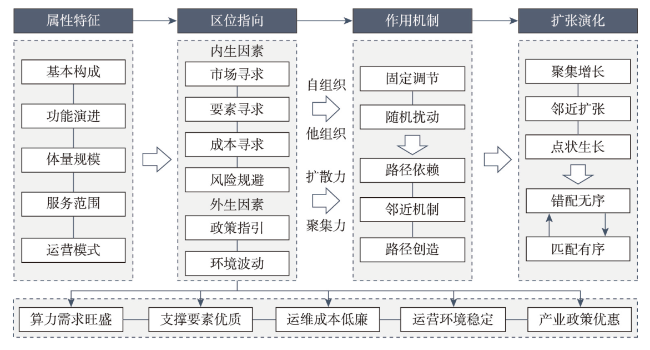
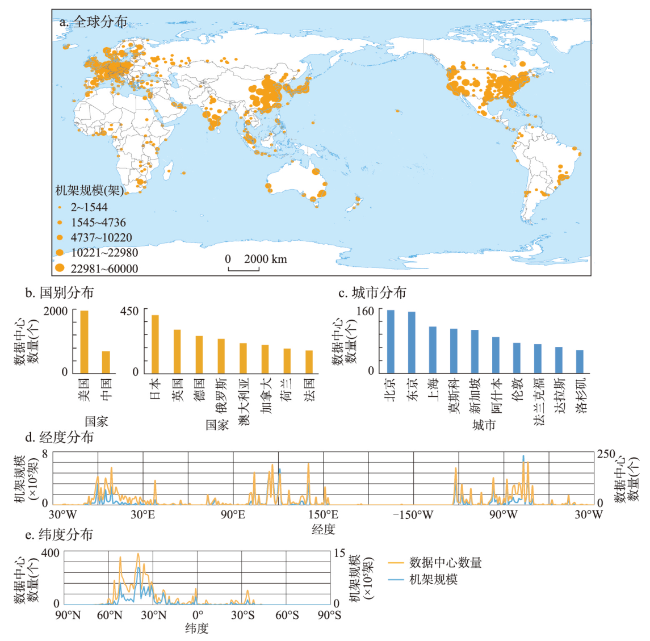
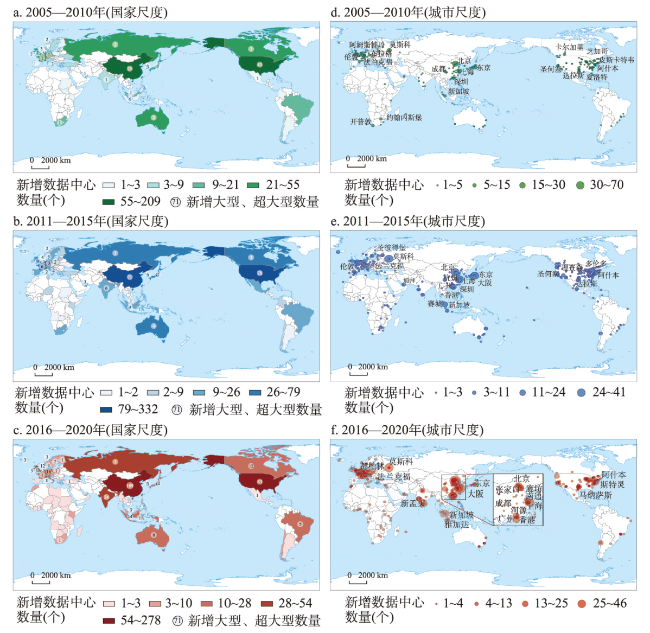
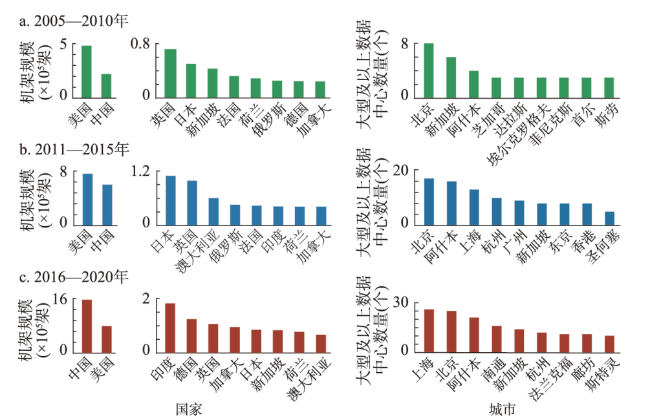
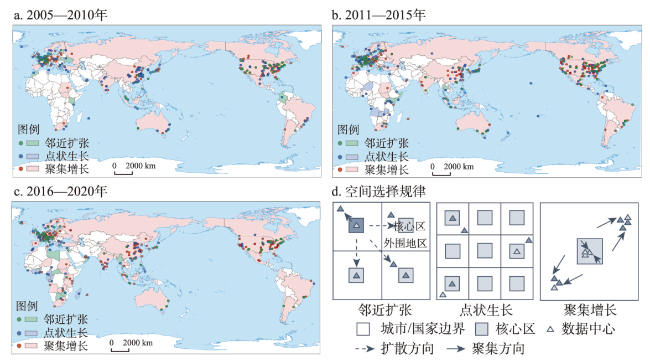
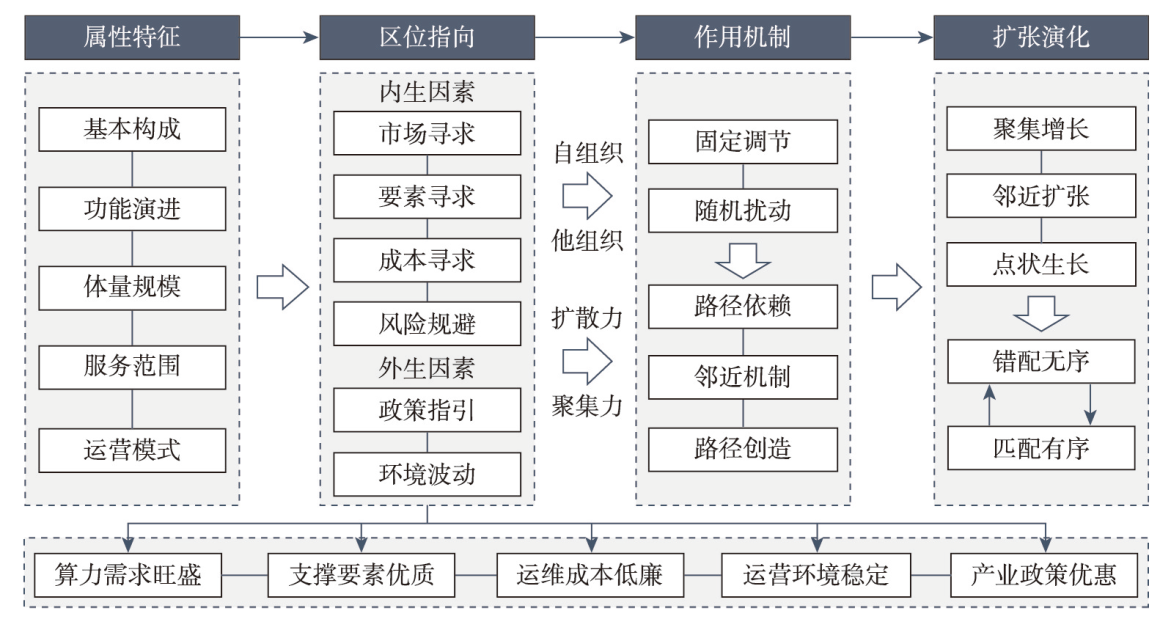
数字经济时代,新一轮信息技术革命对人类生产生活产生了复杂且深刻的影响,数据中心作为数据存储、分析、加工、应用的容器在全球数据价值链中的重要性日益凸显,成为全球数字化发展的有力支撑。在此背景下,厘清全球数据中心多尺度扩张规律及区位选择影响机制,指导数据中心在不同空间尺度下形成合理布局意义显著。为此,融合空间统计、空间分析、计量分析等方法,对2005—2020年全球数据中心扩张的空间特征与影响因素进行实证研究。研究发现:① 全球数据中心空间扩张态势明显,增长重心与经济重心同步系统性东移,全球尺度形成北美、西欧、东亚三大增长核心;城市尺度上,城市群、都市区是数据中心扩张的主要空间载体,形成北京、东京、上海等多个数据中心枢纽城市。② 多尺度空间扩张主要表现为邻近扩张、点状生长和聚集增长3种模式,在全球和城市尺度上形成“核心—边缘”、多核心结构等多种空间形态。③ 数据中心空间扩张的区位选择受市场规模、要素供给、运营环境的共同影响,但由于测量方式和空间尺度因素导致在国别和城市选择上存在一定差异。全球尺度受市场规模影响显著,要素供给和运营环境的影响表现出不同程度的阶段性特征;城市尺度受市场规模和要素供给、安全水平影响显著。
李源 , 刘承良 , 毛炜圣 , 谢永顺 . 全球数据中心扩张的空间特征与区位选择[J]. 地理学报, 2023 , 78(8) : 1936 -1954 . DOI: 10.11821/dlxb202308006
With the coming of digital economy era, the development and application of information technology revolution, such as 5G, cloud computing, big data, Internet of Things and artificial intelligence, production and living of human are being deeply affected. The data center is an important new infrastructure that integrates data storage, analysis, processing and application. It is increasingly important in the global data value chain and plays a strong supporting role in the global digital development. In this context, it is of great significance to clarify the multi-spatial scale expansion laws and location selection mechanism of global data centers, and layout them scientifically and reasonably. This paper integrates spatial statistics, spatial analysis, and spatial measurement methods, and conducts empirical research on the spatio-temporal differentiation and influencing factors of global data center expansion from 2005 to 2020. The results show that: (1) The spatial expansion trend of the global data center is obvious, and the growth center and the economic center move eastward, forming three major growth cores in North America, Western Europe, and East Asia. From the perspective of city scale, city clusters and metropolitan areas are the main spatial carriers of expansion, while a few cities such as Beijing, Tokyo, and Shanghai are the central hubs. (2) The spatial expansion characteristics of the data centers can be divided into contact expansion mode, point growth mode and agglomeration growth mode. (3) The location selection of data center spatial expansion is jointly affected by market size, element supply, and operating environment. However, the measurement method and spatial scale factors in selecting a country or a city are not completely consistent. From the perspective of global scale, market size is the most important factor, and the influence of element supply and operating environment show different stage characteristics; city scale is significantly affected by market size, element supply, and security level.
表1 数据中心区位选择的影响机制指标体系Tab. 1 Index system of influence mechanism of location selection |
| 类别 | 指标(代码) | 国家尺度指标解释 | 城市尺度指标解释 |
|---|---|---|---|
| 市场规模 | 市场规模(IU) | 互联网用户数 | GaWC城市评分 |
| 要素供给 | 网络条件(IB) | 国际带宽 | 互联网宽带价格 |
| 电力条件(ER) | 通电率 | 工业电力平均价格 | |
| 人力条件(HR) | 软科TOP 500高校数量 | 软科TOP 500高校评分 | |
| 交通条件(TI) | 交通基础设施水平 | 航空通航城市数量 | |
| 技术条件(TC) | ITC服务出口额 | 专利申请数量 | |
| 运营环境 | 气候条件(AT) | 平均气温 | 平均气温 |
| 安全水平(SR) | 政治稳定性 | 安全指数 |
表2 数据中心国家选择影响机制的负二项回归结果Tab. 2 Regression result of the negative binomial spatial interaction models of country selection |
| 解释变量 | 回归系数 | ||
|---|---|---|---|
| 2005—2010 | 2011—2015 | 2016—2020 | |
| 市场规模 | 0.566*** (0.136) | 0.482*** (0.089) | 0.520*** (0.074) |
| 网络条件 | 0.311*** (0.108) | 0.194** (0.086) | 0.293*** (0.070) |
| 电力条件 | -0.003 (0.010) | -0.008 (0.005) | -0.025*** (0.006) |
| 人力条件 | 0.002 (0.003) | 0.010** (0.004) | 0.005* (0.003) |
| 交通条件 | 0.083* (0.045) | 0.082*** (0.028) | -0.049 (0.037) |
| 技术条件 | -0.068 (0.098) | 0.001 (0.055) | 0.212*** (0.045) |
| 气候条件 | -0.008 (0.014) | -0.007 (0.012) | -0.012 (0.010) |
| 安全水平 | 0.102 (0.264) | 0.098*** (0.026) | 0.713*** (0.164) |
| 样本量 | 52 | 67 | 71 |
| 伪对数似然值 | -150.9890 | -194.3495 | -159.1356 |
| 伪R2 | 0.1926 | 0.2312 | 0.3017 |
注:***:p < 0.01,**:p < 0.05,*:p < 0.1;括号内为z值。 |
表3 2016—2020年数据中心城市选择影响机制的负二项回归结果Tab. 3 Regression result of the negative binomial spatial interaction models of city selection, 2016-2020 |
| 解释变量 | 回归系数 |
|---|---|
| 市场规模 | 0.088***(0.022) |
| 网络条件 | -0.006**(0.003) |
| 电力条件 | -2.332**(1.082) |
| 人力条件 | 0.006*(0.003) |
| 交通条件 | 0.001***(0.000) |
| 技术条件 | 0.064***(0.024) |
| 气候条件 | -0.011(0.011) |
| 安全水平 | 0.001*(0.005) |
| 样本量 | 322 |
| 伪对数似然值 | -533.4936 |
| 伪R2 | 0.1416 |
注:***:p < 0.01,**:p < 0.05,*:p < 0.1;括号内为z值。 |
感谢3位审稿专家针对本文理论框架、概念界定和方法论证等方面所提出的意见建议。
| [1] |
[刘德学, 吴旭梅. 信息通信技术与制造业全球价值链嵌入: 基于信息通信技术发展数量和质量的研究. 国际经贸探索, 2021, 37(10): 70-85.]
|
| [2] |
|
| [3] |
JPMORGAN. Media consumption in the age of COVID-19. (2020-05-01) [2022-04-25]. https://www.jpmorgan.com/insights/research/media-consumption
|
| [4] |
UNCTAD. Digital Economy Report 2021. (2021-09-29) [2022-04-25]. https://unctad.org/system/files/official-document/der2021_en.pdf
|
| [5] |
|
| [6] |
|
| [7] |
|
| [8] |
[中华人民共和国国家发展和改革委员会. 关于加快构建全国一体化大数据中心协同创新体系的指导意见. (2022-01-12) [2022-02-28]. https://www.ndrc.gov.cn/xwdt/ztzl/dsxs/zcwj2/202201/t20220112_1311852.html?code=&state=123
|
| [9] |
Office of Management and Budget. Data Center Optimization Initiative.(2016-08-01) [2022-04-25]. https://datacenters.cio.gov/policy/m-16-19/
|
| [10] |
[王德文. 基于云计算的电力数据中心基础架构及其关键技术. 电力系统自动化, 2012, 36(11): 67-71, 107.]
|
| [11] |
[王月, 盛凯, 常金凤, 等. 数据中心基础设施关键技术应用及发展. 信息通信技术与政策, 2021, 47(4): 27-31.]
|
| [12] |
[魏祥麟, 陈鸣, 范建华, 等. 数据中心网络的体系结构. 软件学报, 2013, 24(2): 295-316.]
|
| [13] |
|
| [14] |
Northern Virginia Technology Council. The Economic and Fiscal Contribution that Data Centers Make to Virginia. (2016-01-20) [2022-04-25]. http://biz.loudoun.gov/wp-content/uploads/2020/01/2016-Loudoun_DataCenters-NVTC-Report.pdf
|
| [15] |
|
| [16] |
|
| [17] |
[曾坚朋, 王建冬, 黄倩倩, 等. 打造数字湾区: 粤港澳大湾区大数据中心建设的关键问题与路径建构. 电子政务, 2021(6): 29-38.
|
| [18] |
|
| [19] |
|
| [20] |
|
| [21] |
|
| [22] |
[陈帅, 郭启全, 高春东, 等. 地缘博弈中的全球网络空间资源争夺. 科技导报, 2021, 39(22): 85-93.]
|
| [23] |
[宋耀东, 赵鑫, 邓国庆. 陕西省地理空间大数据中心建设运行模式探讨. 地理空间信息, 2020, 18(1): 1-5, 8.]
|
| [24] |
[樊杰, 赵鹏军, 周尚意, 等. 人文地理学学科体系与发展战略要点. 地理学报, 2021, 76(9): 2083-2093.]
|
| [25] |
[刘承良, 闫姗姗. 中国跨国城际技术通道的空间演化及其影响因素. 地理学报, 2022, 77(2): 331-352.]
|
| [26] |
[王涛, 刘承良, 杜德斌. 1948—2018年国际河流跨境水冲突的时空演化规律. 地理学报, 2021, 76(7): 1792-1809.]
|
| [27] |
[刘涛, 彭荣熙, 卓云霞, 等. 2000—2020年中国人口分布格局演变及影响因素. 地理学报, 2022, 77(2): 381-394.]
|
| [28] |
[夏启繁, 杜德斌, 段德忠, 等. 中国稀土对外贸易格局演化及影响因素. 地理学报, 2022, 77(4): 976-995.]
|
| [29] |
[陈江平, 张瑶, 余远剑. 空间自相关的可塑性面积单元问题效应. 地理学报, 2011, 66(12): 1597-1606. ]
|
| [30] |
[刘凯, 秦耀辰. 论地理信息的尺度特性. 地理与地理信息科学, 2010, 26(2): 1-5.]
|
| [31] |
[宋伟轩, 黄琴诗, 谷跃, 等. 宁杭城市多时空尺度居住空间分异与比较. 地理学报, 2021, 76(10): 2458-2476.]
|
| [32] |
[李博, 王建民, 段炎斐. 新基建:大数据中心时代. 北京: 电子工业出版社, 2021.]
|
| [33] |
Ministry of Industry and Information Technology of the People's Republic of China Division for Information and Communication Development. National Data Center Application Development Guide 2020. Beijing: Posts & Telecom Press, 2020.
[工业和信息化部信息通信发展司. 全国数据中心应用发展指引2020. 北京: 人民邮电出版社, 2020.]
|
| [34] |
|
| [35] |
[王伟玲, 王宇霞, 高婴劢. 基于“新基建”情境的大数据中心: 意义、困境和进路. 行政管理改革, 2020(10): 68-74.]
|
| [36] |
[廖茂林, 张明源. 新冠肺炎疫情对中国经济增长的影响. 福建论坛(人文社会科学版), 2020(4): 25-33.]
|
| [37] |
[韩会然, 杨成凤, 宋金平. 北京批发企业空间格局演化与区位选择因素. 地理学报, 2018, 73(2): 219-231.]
|
| [38] |
[王士君, 浩飞龙, 姜丽丽. 长春市大型商业网点的区位特征及其影响因素. 地理学报, 2015, 70(6): 893-905.]
|
| [39] |
[陈修颖, 苗振龙. 数字经济增长动力与区域收入的空间分布规律. 地理学报, 2021, 76(8): 1882-1894.]
|
| [40] |
[侯经川, 吕想, 严玉丽. 上海证券交易系统的建设进展及对策研究: 基于上海建设国际金融中心的战略视角. 中国软科学, 2012(5): 10-21.]
|
| [41] |
[邓维, 刘方明, 金海, 等. 云计算数据中心的新能源应用: 研究现状与趋势. 计算机学报, 2013, 36(3): 582-598.]
|
| [42] |
|
| [43] |
|
| [44] |
|
| [45] |
|
| [46] |
[李伊祺, 余建辉, 张文忠. 机场设施邻避效应对北京市住宅价格空间影响研究: 以北京首都国际机场为例. 地理研究, 2021, 40(7): 1993-2004.]
|
| [47] |
[魏道江, 康承业, 李慧民. 自组织与他组织的关系及其对管理学的启示. 系统科学学报, 2014, 22(2): 45-48.]
|
| [48] |
[刘承良. 城乡路网系统的空间复杂性. 上海: 上海科学普及出版社, 2017 ]
|
| [49] |
[王博云, 刘天禹, 李露凝, 等. 中国COVID-19疫情扩散的时空模式及影响因素. 地理学报, 2022, 77(2): 443-456.]
|
| [50] |
[刘承良, 桂钦昌, 段德忠, 等. 全球科研论文合作网络的结构异质性及其邻近性机理. 地理学报, 2017, 72(4): 737-752.]
|
| [51] |
[段德忠, 杜德斌, 刘承良. 上海和北京城市创新空间结构的时空演化模式. 地理学报, 2015, 70(12): 1911-1925.]
|
| [52] |
[刘承良, 余瑞林, 熊剑平, 等. 武汉都市圈路网空间通达性分析. 地理学报, 2009, 64(12): 1488-1498.]
|
| [53] |
[黄晓东, 杜德斌, 刘承良. 全球跨境并购网络的空间格局演化及形成机制. 地理学报, 2021, 76(10): 2536-2550.]
|
| [54] |
[段德忠, 杜德斌, 谌颖, 等. 中国城市创新网络的时空复杂性及生长机制研究. 地理科学, 2018, 38(11): 1759-1768.]
|
| [55] |
[刘承良, 牛彩澄. 东北三省城际技术转移网络的空间演化及影响因素. 地理学报, 2019, 74(10): 2092-2107.]
|
| [56] |
|
| [57] |
[李向阳. 全球经济重心东移的前景. 国际经济评论, 2011(1): 7-16, 3.]
|
| [58] |
|
| [59] |
[安虎森. 新区域经济学. 3版. 大连: 东北财经大学出版社, 2015]
|
| [60] |
[周游, 张敏. 经济中心城市的集聚与扩散规律研究. 南京师大学报(社会科学版), 2000(4): 16-22.]
|
| [61] |
[王姣娥, 杜德林, 魏冶, 等. 新冠肺炎疫情的空间扩散过程与模式研究. 地理研究, 2020, 39(7): 1450-1462.]
|
| [62] |
[吴康敏, 张虹鸥, 王洋, 等. 广州市多类型商业中心识别与空间模式. 地理科学进展, 2016, 35(8): 963-974.]
|
| [63] |
[范秀成, 王莹. 生产性服务业区位模式选择的国际比较. 国际经贸探索, 2007, 23(5): 4-8.]
|
| [64] |
[杜德斌. 跨国公司R&D全球化的区位模式研究. 上海: 复旦大学出版社, 2001.]
|
| [65] |
[盛维. 生产者服务业国际化扩张区位选择研究[D]. 上海: 上海社会科学院, 2010.]
|
| [66] |
|
/
| 〈 |
|
〉 |