



城市虚实活动系统的理论构建
|
李春江(1995-), 男, 广西南宁人, 博士, 研究方向为时间地理学、城市时空间行为规划。E-mail: lcjiang@pku.edu.cn |
收稿日期: 2022-10-26
修回日期: 2023-12-20
网络出版日期: 2024-04-18
基金资助
国家自然科学基金项目(42071203)
国家自然科学基金项目(42271199)
Theoretical construction of urban physical-virtual activity system
Received date: 2022-10-26
Revised date: 2023-12-20
Online published: 2024-04-18
Supported by
National Natural Science Foundation of China(42071203)
National Natural Science Foundation of China(42271199)
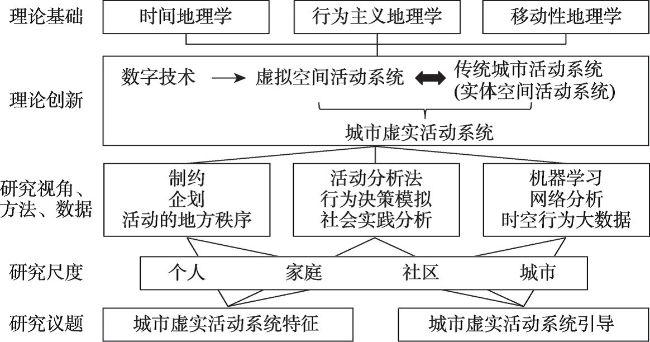
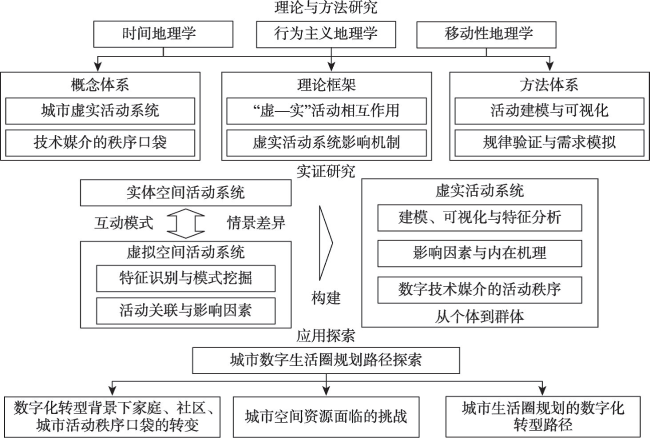
人类社会正处于显著的数字化转型阶段,人类活动系统的基本特征与内在机理正在发生重大变化,特别是虚拟空间中的活动日渐多元化与自我体系化,并更加主动和频繁地与实体空间活动产生着十分复杂的互动。目前关于人类活动系统数字化转型的研究愈发重视虚拟空间中行为的多样性与复杂性,强调超越虚实二元的对立视角,将技术使用作为活动系统不可分割的一部分。本文提出城市虚拟空间活动系统与城市虚实活动系统的概念,一方面强调城市虚拟空间活动已逐渐形成相对独立系统的趋势,另一方面则聚焦于城市虚实空间活动系统的互动关系,并且从理论上构建城市虚实活动系统,以便深化理解城市活动系统的数字化转型并提出相关的政策建议。本文从理论和方法创新、实证议题创新以及应用实践创新等侧面,系统论述城市虚实活动系统的概念体系与研究内容框架,为数字化转型下的城市空间提供新的理论与方法,为智慧城市生活圈规划与数字生活治理提供科学参考。
李春江 , 柴彦威 . 城市虚实活动系统的理论构建[J]. 地理学报, 2024 , 79(4) : 837 -853 . DOI: 10.11821/dlxb202404002
Human society is currently in the stage of significant digital transformation. The basic characteristics and internal mechanisms of human activity systems are undergoing major transitions. In particular, activities in virtual space are becoming diversified and self-systematical, and they more actively and frequently interact with the activities in the physical space in a complex way. At present, research on the digital transformation of human activity system increasingly emphasizes the variation and complexity of the behavior in virtual space. The research also highlights the necessity to go beyond the duality of physical and virtual space and to integrate technological use with activity system. This paper innovatively proposes the concepts of urban virtual space activity system and urban physical-virtual activity system. On the one hand, the new concepts emphasize the characteristics of urban virtual space activity that it increasingly becomes an independent activity system (of urban physical space activity). On the other hand, the concepts focus on the interaction relationships between urban physical and virtual activity systems. The theoretical construction of urban physical-virtual activity system can deepen the understanding of the digital transformation of urban activity system and further provide policy implications. This paper systematically states and discusses the conceptual and research frameworks of urban physical-virtual activity system in the dimensions of theoretical and methodological innovation, empirical topics innovation, and practical innovation. The concept and elements of urban physical-virtual activity system can provide new theories and methods to analyze urban space in digital transformation, and scientific support for urban life circle planning in smart cities and governance of digital life.
| [1] |
|
| [2] |
|
| [3] |
|
| [4] |
|
| [5] |
[王波, 卢佩莹, 甄峰. 智慧社会下的城市地理学研究: 基于居民活动的视角. 地理研究, 2018, 37(10): 2075-2086.]
|
| [6] |
[席广亮. 城市流动性与智慧城市空间组织. 北京: 商务印书馆, 2021.]
|
| [7] |
|
| [8] |
|
| [9] |
|
| [10] |
|
| [11] |
|
| [12] |
|
| [13] |
|
| [14] |
|
| [15] |
[孙斌栋. 科学预判信息化对城市空间形态的影响. 人民论坛·学术前沿, 2021(9): 74-81.]
|
| [16] |
[秦萧, 甄峰. 大数据与小数据结合:信息时代城市研究方法探讨. 地理科学, 2017, 37(3): 321-330.]
|
| [17] |
[杨喜平, 方志祥. 移动定位大数据视角下的人群移动模式及城市空间结构研究进展. 地理科学进展, 2018, 37(7): 880-889.]
|
| [18] |
|
| [19] |
[孔宇, 甄峰, 张姗琪. 智能技术对城市居民活动影响的研究进展与展望. 地理科学, 2022, 42(3): 413-425.]
|
| [20] |
[龙瀛, 张恩嘉. 数据增强设计框架下的智慧规划研究展望. 城市规划, 2019, 43(8): 34-40, 52.]
|
| [21] |
|
| [22] |
|
| [23] |
[柴彦威, 沈洁. 基于活动分析法的人类空间行为研究. 地理科学, 2008, 28(5): 594-600.]
|
| [24] |
[李春江, 张艳. 日常生活数字化转向的时间地理学应对. 地理科学进展, 2022, 41(1): 96-106.]
|
| [25] |
|
| [26] |
|
| [27] |
|
| [28] |
|
| [29] |
|
| [30] |
|
| [31] |
|
| [32] |
|
| [33] |
|
| [34] |
|
| [35] |
|
| [36] |
|
| [37] |
|
| [38] |
|
| [39] |
|
| [40] |
|
| [41] |
|
| [42] |
|
| [43] |
|
| [44] |
|
| [45] |
|
| [46] |
|
| [47] |
|
| [48] |
|
| [49] |
|
| [50] |
|
| [51] |
|
| [52] |
|
| [53] |
|
| [54] |
|
| [55] |
|
| [56] |
|
| [57] |
|
| [58] |
|
| [59] |
|
| [60] |
|
| [61] |
|
| [62] |
|
| [63] |
|
| [64] |
|
| [65] |
|
| [66] |
|
| [67] |
|
| [68] |
|
| [69] |
|
| [70] |
|
| [71] |
|
| [72] |
[塔娜, 柴彦威. 行为地理学的学科定位与前沿方向. 地理科学进展, 2022, 41(1): 1-15.]
|
| [73] |
|
| [74] |
|
| [75] |
|
| [76] |
|
| [77] |
|
| [78] |
|
| [79] |
|
| [80] |
|
| [81] |
|
| [82] |
|
| [83] |
|
| [84] |
|
| [85] |
|
| [86] |
|
| [87] |
|
| [88] |
|
| [89] |
|
| [90] |
|
| [91] |
|
| [92] |
|
| [93] |
|
| [94] |
|
| [95] |
|
| [96] |
|
| [97] |
|
| [98] |
|
| [99] |
|
| [100] |
|
| [101] |
|
| [102] |
|
| [103] |
|
| [104] |
|
| [105] |
|
| [106] |
|
| [107] |
|
| [108] |
|
| [109] |
[
|
| [110] |
[
|
| [111] |
|
| [112] |
|
| [113] |
|
| [114] |
|
| [115] |
|
| [116] |
|
| [117] |
|
| [118] |
|
| [119] |
[柴彦威, 申悦, 陈梓烽. 基于时空间行为的人本导向的智慧城市规划与管理. 国际城市规划, 2014, 29(6): 31-37, 50.]
|
| [120] |
[牛强, 易帅, 顾重泰, 等. 面向线上线下社区生活圈的服务设施配套新理念新方法: 以武汉市为例. 城市规划学刊, 2019(6): 81-86.]
|
| [121] |
[肖作鹏, 韩来伟, 柴彦威. 生活圈规划嵌入国土空间规划的思考. 规划师, 2022, 38(9): 145-151.]
|
/
| 〈 |
|
〉 |