



清代自然灾害所致极端人口死亡事件的识别及特征
|
陈思宇(1998-), 女, 重庆人, 硕士生, 主要从事历史气候变化及历史灾害研究。E-mail: siyuchen@mail.bnu.edu.cn |
收稿日期: 2022-02-16
修回日期: 2023-02-22
网络出版日期: 2023-05-27
基金资助
中央高校基本科研业务费专项资金(20XNL011)
中国科学院战略性先导科技专项(XDA19040101)
Identification and characteristics of extreme events with mass deaths caused by natural disasters in the Qing Dynasty
Received date: 2022-02-16
Revised date: 2023-02-22
Online published: 2023-05-27
Supported by
Fundamental Research Funds for the Central Universities(20XNL011)
Strategic Priority Research Program of the Chinese Academy of Sciences(XDA19040101)
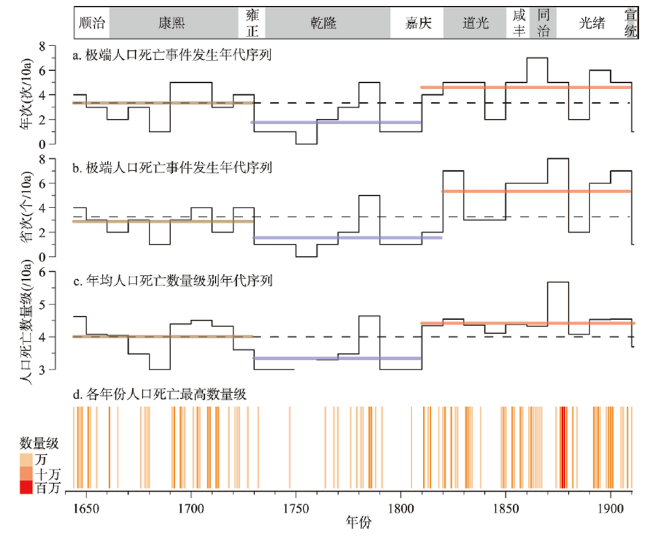
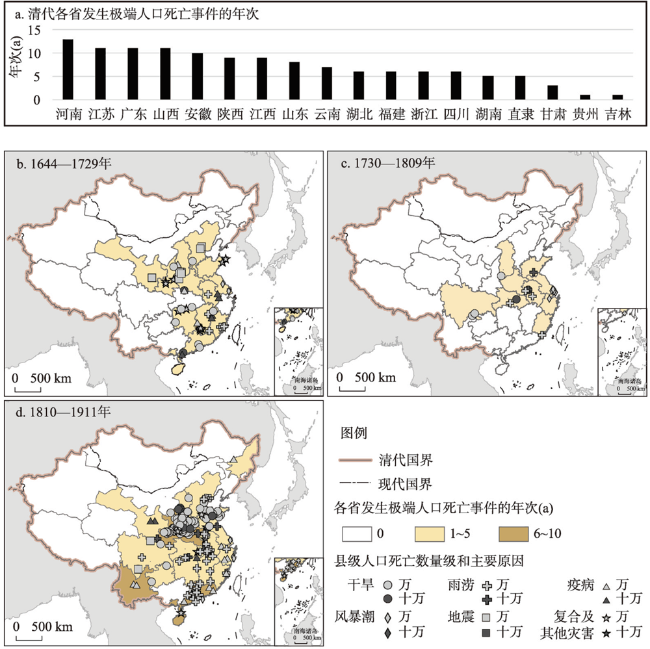
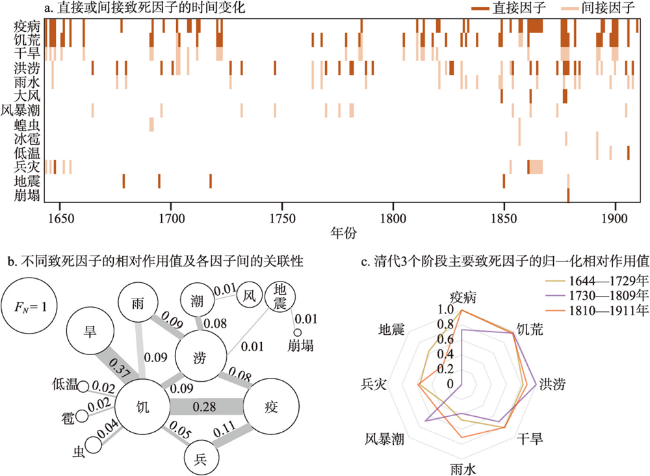
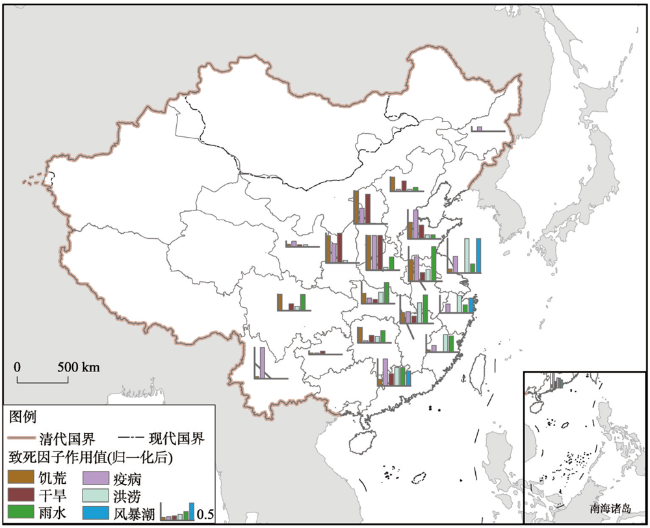
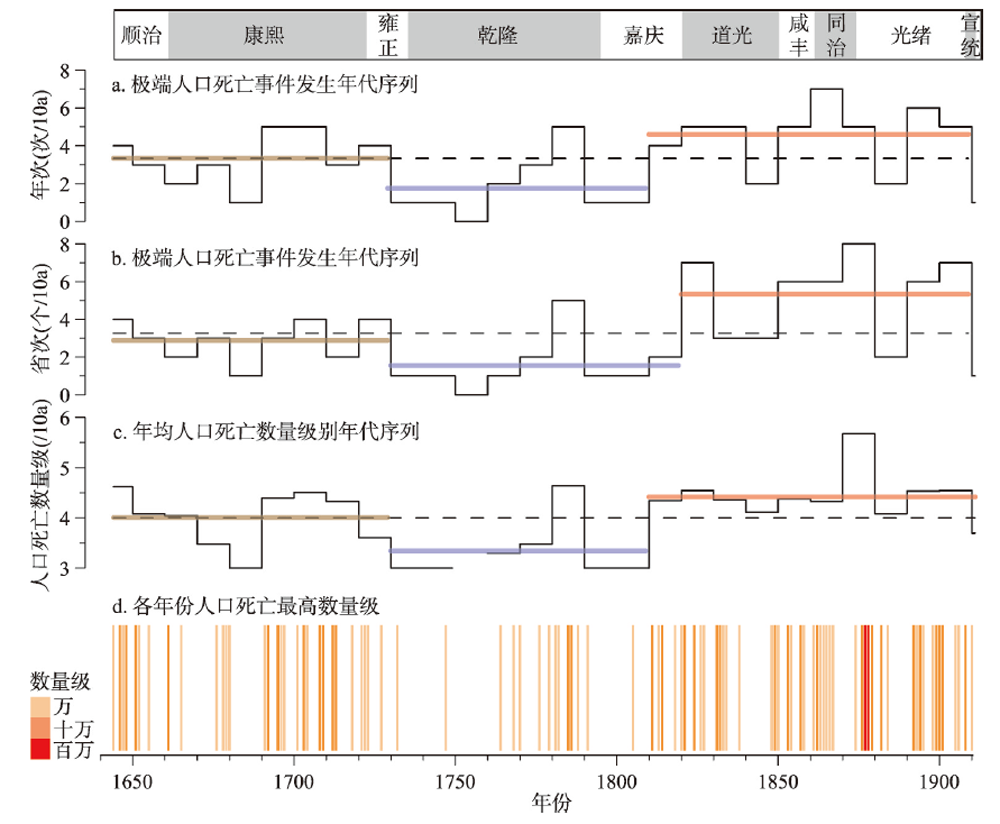
大规模的人口死亡受到自然系统和社会经济系统的共同影响,是自然灾害对人口系统造成的主要威胁之一。基于从“清代自然灾害信息集成数据库”中提取的人口死亡记录,识别并分析了清代发生的极端人口死亡事件特征,重建了清代极端人口死亡强度、年次及省次的10 a序列,并分析其空间分布和发生原因。结论表明:① 清代共有91年发生过极端人口死亡事件,平均约每3 a发生一次。极端人口死亡事件发生的频率和强度存在一定的阶段性变化,1644年—18世纪20年代为与清代总体平均值接近的阶段,18世纪30年代—19世纪初是清代极端人口死亡事件发生频率和强度均最低的时期,19世纪10年代—1911年为事件发生的稳定高值期。② 清代共有18个省级政区发生过极端人口死亡事件,1644年—18世纪20年代极端事件分布较广但主要为较低强度的事件,18世纪30年代—19世纪初极端事件的分布范围最小,19世纪10年代—1911年事件分布广、强度高,致死因子出现明显的南涝北旱分异。③ 疫病、饥荒和洪涝在各阶段均是造成极端人口死亡事件的主要因子,干旱、雨水和风暴潮则是主要的间接致死因子。
陈思宇 , 方修琦 , 叶瑜 , 赵琬一 . 清代自然灾害所致极端人口死亡事件的识别及特征[J]. 地理学报, 2023 , 78(5) : 1074 -1087 . DOI: 10.11821/dlxb202305002
Mass mortality is one of the major threats posed by natural disasters to the population system, which consists of interactions between natural and socio-economic systems. Based on records of deaths extracted from the Integrated Natural Disaster Information System of the Qing Dynasty, events with mass deaths caused by natural disasters are identified, and the decadal deaths index series from 1644 to 1911 is reconstructed. The spatio-temporal characteristics and causes of these extreme events with mass deaths are also analyzed. The main results show the following. First, from 1644 to 1911, historical China suffered a high frequency of extreme events with mass deaths that occurred in 91 years, with events occurring once every three years on average. Second, the deaths index series varies significantly in three phases: Phase Ⅰ is from 1644 to the 1720s with a frequency and intensity close to the average over the entire Qing Dynasty; Phase Ⅱ is from the 1730s to the 1800s with a low frequency of events occurring in two years and in two provinces per decade; and Phase Ⅲ is from the 1810s to 1911 with a high frequency of events occurring in five years and in five provinces per decade. The maximum frequency and intensity appeared in the 1870s, whereas no extreme events with mass deaths occurred in the 1750s. Third, a total of 18 provinces experienced extreme events, and the spatial distribution of extreme events during the three phases differs. During Phase Ⅰ, extreme events were widely distributed but of relatively low intensity; such events occurred in fewer provinces during Phase Ⅱ. During Phase Ⅲ, extreme events occurred in 18 provinces with high intensity and their spatial distribution showed a significant pattern of floods in southern China and droughts in northern China. Finally, epidemics, famine, and flood were the main contributors to extreme events with mass deaths throughout the entire Qing Dynasty, with drought, heavy rain, and storm surges being the main indirect factors.
表1 历史文献中不同类型人口死亡数量信息的关键词及示例Tab. 1 Keywords and examples of information on population deaths in historical documents |
| 类型 | 关键词 | 示例 |
|---|---|---|
| 数量型 | 十、百、千、万、十万、百万 | “淹死万七千余人” |
| 比例型 | 十之一二、十之八九、十死一二等 | “人死十分之七”“死亡过半” |
| 语义型 | 少、不少、多、甚多、载道、遍野、不可计数、不可胜计等 | “间有溺毙人口”“尸横遍野”“死者不可计数” |
表2 直接和间接因子示例Tab. 2 Examples of direct and indirect factors |
| 记录情况 | 历史记录原文 | 直接因子 | 第一间接因子 | 第二间接因子 |
|---|---|---|---|---|
| 单条记录 | “辛巳,邑民半罹水死。” | n = 1,x = 1 (洪涝) | - | - |
| 多条记录 | “康熙三十年大旱,飞蝗蔽天,民饥死者大半。” | n = 1,x = 1 (饥荒) | n = 2,x = 2 (干旱、蝗虫) | - |
| 原因缺失记录 | “岁道光己酉,邑大饥,城内外偃仆者,日数十人,谷一石值二金有奇……是岁人民大抵十损三四……” 补充同年同地记录:“道光二十九年,雨潦,斗米千钱,民无所得,食至飱泥……” | n = 1,x = 1 (饥荒) | n = 1,x = 2 (洪涝) | n = 1,x = 3 (雨水) |
表3 1856年各省份发生不同人口死亡数量级事件的县次Tab. 3 Number of counties with events with different magnitudes of population deaths in 1856 |
| 省份 | 灾害类型 | 县次 | |
|---|---|---|---|
| ≥1000 | <1000 | ||
| 广西省 | 兵灾 | 6 | 13 |
| 贵州省 | 兵灾 | 1 | 2 |
| 湖北省 | 干旱、地震 | 0 | 8 |
| 江苏省 | 干旱、虫灾、疫病、兵灾 | 0 | 5 |
| 福建省 | 洪涝 | 0 | 3 |
| 广东省 | 洪涝、低温 | 0 | 3 |
| 安徽省 | 干旱 | 0 | 2 |
| 山东省 | 干旱 | 0 | 2 |
| 河南省 | 干旱、虫灾 | 0 | 2 |
| 四川省 | 冰雪 | 0 | 2 |
| 山西省 | 洪涝 | 0 | 1 |
| 奉天省 | 洪涝 | 0 | 1 |
| 浙江省 | 兵灾 | 0 | 1 |
| 江西省 | 动物灾害 | 0 | 1 |
| [1] |
[ 赵映慧, 郭晶鹏, 毛克彪, 等. 1949—2015年中国典型自然灾害及粮食灾损特征. 地理学报, 2017, 72(7): 1261-1276.]
|
| [2] |
|
| [3] |
|
| [4] |
[ 赵宇莲, 殷淑燕, 刘静, 等. 明清时期导致人口大量死亡的疫灾时空分布及灾害链研究. 干旱区资源与环境, 2021, 35(2): 73-80.]
|
| [5] |
[ 谢美娥. 自然灾害、生产收成与清代台湾米价的变动(1738—1850). 中国经济史研究, 2010(4): 110-127.]
|
| [6] |
[ 文彦君, 方修琦, 刘洋, 等. 18—19世纪之交华北平原的气候变化与粮价异常. 中国科学: 地球科学, 2020, 50(1): 122-133.]
|
| [7] |
|
| [8] |
[ 黄冠佳, 温思美. 自然灾害、人口压力与清代农民起义. 华南农业大学学报(社会科学版), 2018, 17(5): 126-140.]
|
| [9] |
|
| [10] |
[ 高建国. 中国巨灾的演变及警示. 中国减灾, 2008(6): 33.]
|
| [11] |
[ 张卫星, 史培军, 周洪建. 巨灾定义与划分标准研究: 基于近年来全球典型灾害案例的分析. 灾害学, 2013, 28(1): 15-22.]
|
| [12] |
[ 余新忠. 清代江南瘟疫对人口之影响初探. 中国人口科学, 2001(2): 36-43.]
|
| [13] |
[ 夏明方. 也谈“丁戊奇荒”. 清史研究, 1992(4): 83-91.]
|
| [14] |
[ 郝平. 山西“丁戊奇荒”的人口亡失情况. 山西大学学报(哲学社会科学版), 2001, 24(6): 10-13.]
|
| [15] |
[ 焦润明. 1910—1911年的东北大鼠疫及朝野应对措施. 近代史研究, 2006(3): 106-124.]
|
| [16] |
[ 李文海, 程歗, 刘仰东, 等. 中国近代十大灾荒. 上海: 上海人民出版社, 1994.]
|
| [17] |
[ 陈玉琼, 高建国. 中国历史上死亡一万人以上的重大气候灾害的时间特征. 大自然探索, 1984(4): 157-166.]
|
| [18] |
[ 刘毅, 杨宇. 历史时期中国重大自然灾害时空分异特征. 地理学报, 2012, 67(3): 291-300.]
|
| [19] |
[ 刘静, 殷淑燕. 中国古文献记载中“死者万计”事件的时空特征与原因分析. 浙江大学学报(理学版), 2017, 44(2): 243-252.]
|
| [20] |
[ 王洋, 殷淑燕, 徐潇悦, 等. 气候变化背景下明代华北地区人口大量死亡事件研究. 干旱区资源与环境, 2020, 34(9): 72-79.]
|
| [21] |
[ 葛全胜. 中国历朝气候变化. 北京: 科学出版社, 2011.]
|
| [22] |
[ 方修琦, 赵琬一, 宋儒, 等. 清代自然灾害信息集成数据库建设. 社会史研究, 2020(1): 29-46.]
|
| [23] |
[ 吴绍洪, 高江波, 韦炳干, 等. 自然灾害韧弹性社会的理论范式. 地理学报, 2021, 76(5): 1136-1147.]
|
| [24] |
[ 夏明方. 大数据与生态史: 中国灾害史料整理与数据库建设. 清史研究, 2015(2): 67-82.]
|
| [25] |
[ 牛平汉. 清代政区沿革综表. 北京: 中国地图出版社, 1990.]
|
| [26] |
[ 葛剑雄, 曹树基. 中国人口史(第五卷):清时期. 上海: 复旦大学出版社, 2001.]
|
| [27] |
[ 杨洁慧. 驻马店“75·8”水灾及救助研究[D]. 开封: 河南大学, 2014.]
|
| [28] |
[ 葛全胜, 郑景云, 方修琦, 等. 过去2000年中国东部冬半年温度变化. 第四纪研究, 2002, 22(2): 166-173.]
|
| [29] |
[ 闫军辉, 葛全胜, 郑景云. 清代华北地区冬半年温度变化重建与分析. 地理科学进展, 2012, 31(11): 1426-1432.]
|
| [30] |
[ 方修琦, 萧凌波, 魏柱灯. 18—19世纪之交华北平原气候转冷的社会影响及其发生机制. 中国科学: 地球科学, 2013, 43(5): 825-838.]
|
| [31] |
[ 史志宏. 清代户部银库收支和库存研究. 北京: 社会科学文献出版社, 2014.]
|
| [32] |
[ 谭其骧. 中国历史地图集(第八册):清时期. 北京: 中国地图出版社, 1996: 5-6.]
|
| [33] |
CHGIS. Version: 6. Fairbank Center for Chinese Studies of Harvard University and the Center for Historical Geographical Studies at Fudan University, 2016. https://chgis.fas.harvard.edu/data/chgis/v6/.
|
| [34] |
[ 龚胜生, 李孜沫, 谢海超, 等. 中国3000年疫灾流行的时空特征及其影响因素. 地理学报, 2021, 76(8): 1976-1996.]
|
| [35] |
[ 方修琦, 何凡能, 吴致蕾, 等. 过去2000年中国农耕区拓展与垦殖率变化基本特征. 地理学报, 2021, 76(7): 1732-1746.]
|
/
| 〈 |
|
〉 |