



喜马拉雅地区传统贸易通道演变过程及动力机制
|
吴仕海(1987-), 男, 云南曲靖人, 博士生, 研究方向为土地利用与生态过程以及全球变化与区域响应。E-mail: wshai2010@126.com |
收稿日期: 2020-07-17
要求修回日期: 2020-12-16
网络出版日期: 2021-11-25
基金资助
第二次青藏高原综合考察研究(2019QZKK0603)
中国科学院战略性先导科技专项(XDA20040201)
国家自然科学基金项目(41761144081)
版权
Exploring the evolution process and driving mechanism of traditional trade routes in Himalayan region
Received date: 2020-07-17
Request revised date: 2020-12-16
Online published: 2021-11-25
Supported by
The Second Tibetan Plateau Scientific Expedition and Research Program(2019QZKK0603)
Strategic Priority Research Program of Chinese Academy of Sciences(XDA20040201)
National Natural Science Foundation of China(41761144081)
Copyright
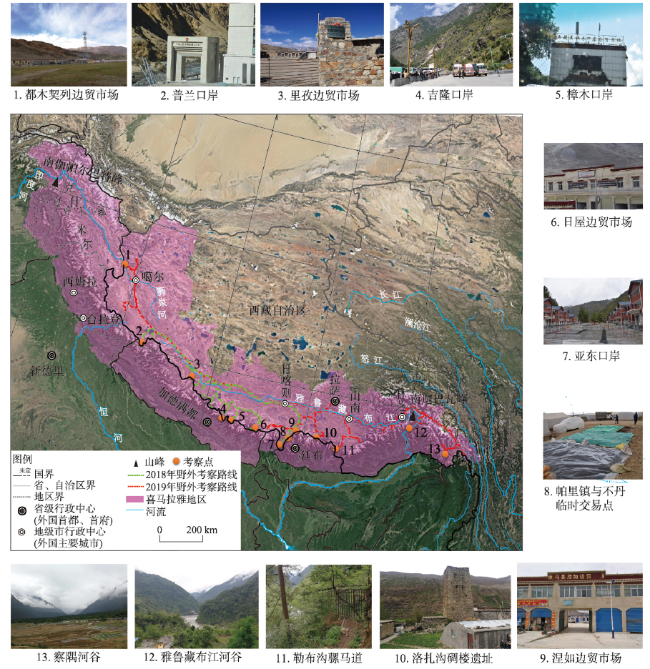
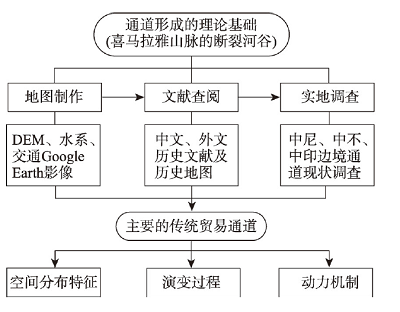
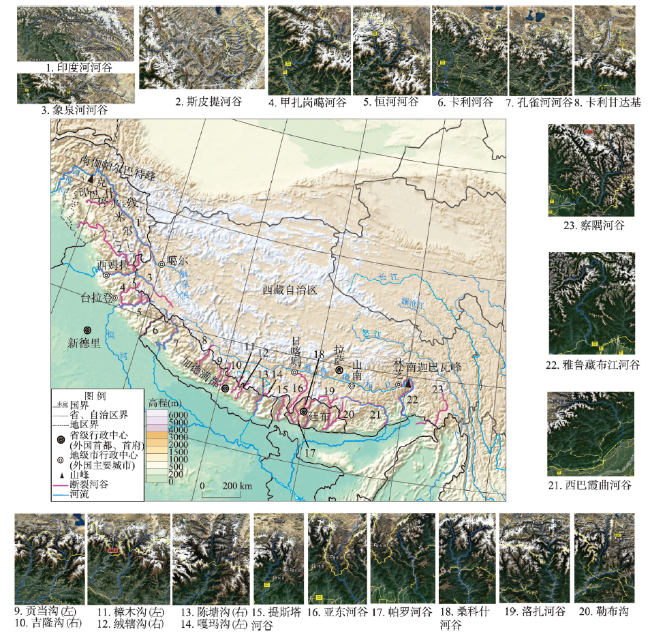
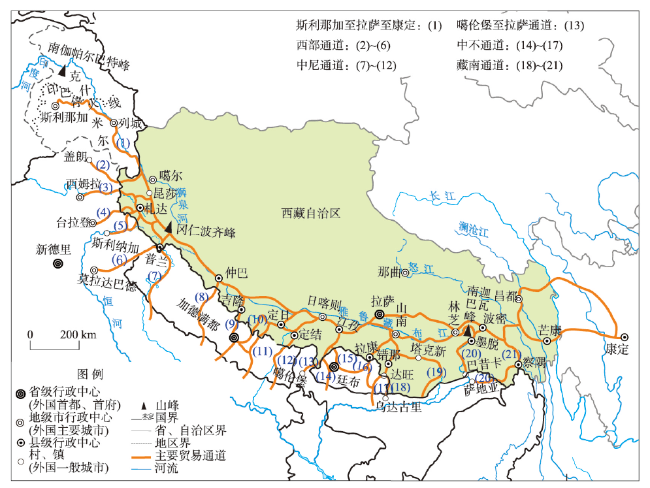
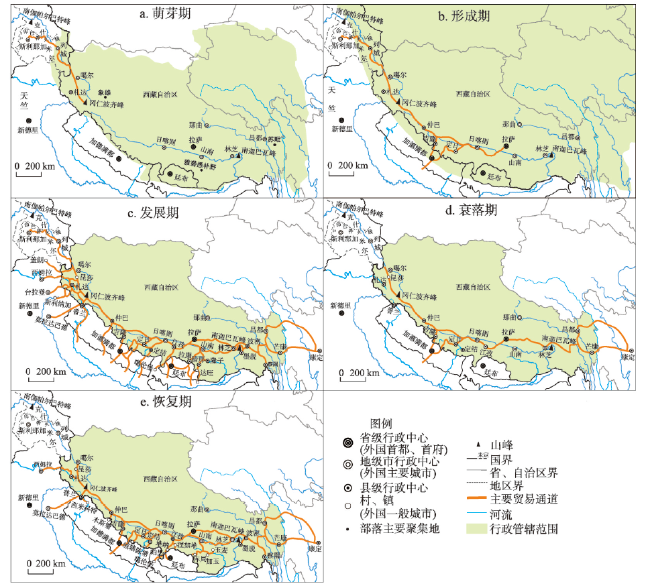
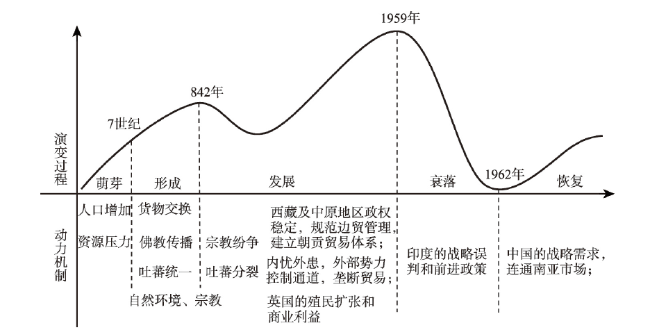
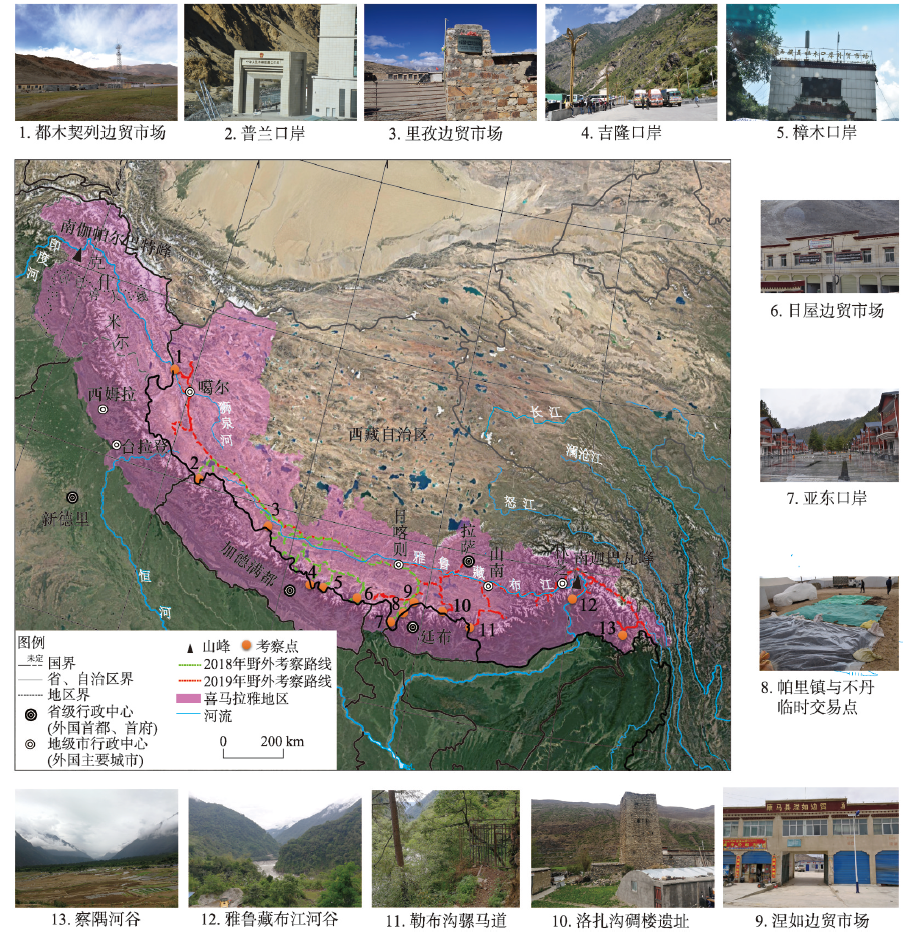
喜马拉雅地区传统贸易通道是突破喜马拉雅山脉天然屏障、连接中国与南亚腹地两大市场的关键,对于南亚大通道建设和跨喜马拉雅互联互通建设具有重要的战略意义。本文以喜马拉雅山脉断裂河谷为出发点,综合历史文献、实地调查及GIS技术手段,分析通道的空间分布特征、演变过程及动力机制。研究表明:① 喜马拉雅地区的传统贸易通道主要有21条,其中中尼通道6条,中不通道4条,中印通道11条,在空间上形成了“一横多纵”的空间格局。② 传统贸易通道的发展经历了萌芽期(7世纪以前)、形成期(7世纪—842年)、发展期(842—1959年)、衰落期(1959—1962年)和恢复期(1962年至今)的演变过程。③ 货物交换和佛教传播促进了通道的萌芽和形成,西藏及中原地方政权稳定和边贸政策、英国的殖民扩张和商业利益推动了通道的发展,印度的战略误判和前进政策导致了通道的衰落,中国的战略需求将推动通道的恢复和建设。④ 战略互信和边界问题是通道恢复和建设面临的主要障碍,未来需要加强对通道的多视角调查和研究,制定通道的建设和管控策略,充分发挥通道的商贸、旅游和文化交流功能,积极服务于南亚大通道建设,促进西藏边疆地区的稳定与发展。
吴仕海 , 阎建忠 , 张镱锂 , 彭婷 , 苏康传 . 喜马拉雅地区传统贸易通道演变过程及动力机制[J]. 地理学报, 2021 , 76(9) : 2157 -2173 . DOI: 10.11821/dlxb202109009
Traditional trade routes that penetrate the natural barrier of the Himalayas are critical for connecting major Chinese and South Asian markets. Research on these trade routes can contribute significantly to facilitating the construction of the South Asia Channel and enhancing trans-Himalayan connectivity. Combining historical literature, field surveys, and Geographic Information System (GIS) techniques, this study examined the spatial distribution characteristics and dynamic mechanisms driving the formation, development, decline, and restoration of the routes, focusing on transverse valleys of the Himalayan arc. The key findings were as follows. First, there are 21 traditional trade routes traversing the Himalayan region: 6 Sino-Nepalese routes, 4 Sino-Bhutanese routes, and 11 Sino-Indian routes. The routes are arranged in a "one horizontal and multiple vertical" spatial pattern. Second, the evolution of the traditional trade routes has entailed five distinct phases: an incipient period (pre-7th century), formation (7th century-842 AD), development (842-1959), decline (1959-1962) and recovery (1962-present). Third, the incipient and formative developmental phases were prompted by the spread of Buddhism and the exchange of goods. The stability of local governments in Tibet and in the Central China Plains and favorable border trade policies along with Britain's colonial expansion and commercial interests stimulated further development of traditional trade routes. However, India's strategic miscalculation and "Forward Policy" instigated the decline phase, while China's strategic needs are currently the key driver of the restoration and construction phase. Finally, a lack of strategic mutual trust and existing border issues are the main obstacles impeding the restorative and construction phases. Future efforts to support the construction of the South Asia Channel and the stability and development of border regions should focus on strengthening multi-perspectival investigations and research on traditional trade routes, formulating strategies for corridor construction and control, and emphasizing the corridor's commerce, tourism, and cultural exchange functions.
| [1] |
[孙鸿烈, 郑度, 姚檀栋, 等. 青藏高原国家生态安全屏障保护与建设. 地理学报, 2012, 67(1): 3-12.]
|
| [2] |
|
| [3] |
|
| [4] |
[仝涛. 西藏西部的丝绸与丝绸之路. 中国国家博物馆馆刊, 2017(2): 6-16.]
|
| [5] |
[伍昆明. 早期传教士进藏活动史. 北京: 中国藏学出版社, 1992.]
|
| [6] |
|
| [7] |
|
| [8] |
[梁俊艳. 论18世纪末至20世纪初英国对华陆路战略: 以西藏为中心. 世界历史, 2008(5): 47-55, 160.]
|
| [9] |
|
| [10] |
[戴超武. 印度对西藏地方的贸易管制和禁运与中国的反应和政策(1950—1962) (上). 中共党史研究, 2013(6): 24-37.]
|
| [11] |
[戴超武. 印度对西藏地方的贸易管制和禁运与中国的反应和政策(1950—1962)(下). 中共党史研究, 2013(7): 57-70.]
|
| [12] |
|
| [13] |
|
| [14] |
[张卫民. 西藏地区边境贸易的发展与海关监管. 西藏研究, 1993(1): 12-20.]
|
| [15] |
[谢延杰, 洛桑群觉. 关于西藏边境贸易情况的历史追朔. 西藏大学学报(汉文版), 1994(3): 48-51.]
|
| [16] |
Tashi,
[扎西, 普布次仁. 西藏边境贸易的历史演进与现实情况分析. 西藏大学学报(社会科学版), 2014, 29(3): 1-7.]
|
| [17] |
[扎洛. 西藏的边境小额贸易与边民增收: 基于洛扎县的田野调查. 中国藏学, 2015(3): 128-137.]
|
| [18] |
[扎洛, 敖见. 中国西藏与不丹之间传统贸易的三种模式. 中国边疆史地研究, 2017, 27(4): 126-135, 182.]
|
| [19] |
[董莉英. 西藏地方与尼泊尔贸易试述. 中国藏学, 2008(1): 218-222.]
|
| [20] |
[梁俊艳. 当代中尼贸易发展述论. 中国藏学, 2017(3): 52-58.]
|
| [21] |
[陈继东. 近代西藏亚东与印度的贸易往来. 南亚研究季刊, 2003(4): 61-64, 80.]
|
| [22] |
[房建昌. 近代西藏麝香之路考: 兼论印度大三角测量局班智达、日本僧人河口慧海和侵藏英军噶大克考察团在沿路的活动等. 西藏研究, 2015(4): 17-37.]
|
| [23] |
[张永攀. 中印日玛线、印藏驮运线与英国的干涉活动. 西藏民族学院学报(哲学社会科学版), 2002, 23(1): 15-20.]
|
| [24] |
[刘妤. 地缘经济视角下西藏边境陆路口岸空间布局、发展效力及对策研究. 西藏大学学报(社会科学版), 2018, 33(2): 195-204.]
|
| [25] |
|
| [26] |
|
| [27] |
|
| [28] |
|
| [29] |
|
| [30] |
[张镱锂, 李炳元, 郑度. 论青藏高原范围与面积. 地理研究, 2002, 21(1): 1-8.]
|
| [31] |
[童立强, 聂洪峰, 李建存, 等. 喜马拉雅山地区大型泥石流遥感调查与发育特征研究. 国土资源遥感, 2013, 25(4): 104-112.]
|
| [32] |
[尹安. 喜马拉雅造山带新生代构造演化: 沿走向变化的构造几何形态、剥露历史和前陆沉积的约束. 地学前缘, 2006, 13(5): 416-515.]
|
| [33] |
[郑度. 喜马拉雅山区与横断山区自然条件对比. 山地研究, 1988, 6(3): 137-146.]
|
| [34] |
[秦大河. 喜马拉雅山冰川资源图. 北京: 科学出版社, 1999: 7.]
|
| [35] |
|
| [36] |
[刘志扬. 青藏高原及其周边地区的民族构成与文化互动. 民族研究, 2017(2): 55-67, 124.]
|
| [37] |
[夏敏. 喜马拉雅山区宗教的生态分布. 西藏民族学院学报(哲学社会科学版), 2004(6): 1-4, 9.]
|
| [38] |
[吕红亮. 西藏之西: 喜马拉雅最早的山民. 西藏人文地理, 2017(3): 56-69.]
|
| [39] |
[多杰才旦. 关于丝路吐蕃道的交通路线问题. 传统文化与现代化, 1995(4): 45-54.]
|
| [40] |
[丰坤元. 浅析近现代中国西藏与尼泊尔边境贸易. 中国国际财经(中英文), 2018(2): 1-2.]
|
| [41] |
Sciences Qinghai-Tibet Plateau Comprehensive Investigation. Tibetan Landscape. Beijing: Science Press, 1983: 7-10.
[中国科学院青藏高原综合考察队. 西藏地貌. 北京: 科学出版社, 1983: 7-10.]
|
| [42] |
Transportation Department of Tibet Autonomous Region. Tibet's Ancient and Modern Transportation History. Beijing: China Communications Press, 2001: 7-19.
[西藏自治区交通厅. 西藏古近代交通史. 北京: 人民交通出版社, 2001: 7-19.]
|
| [43] |
[张力. 历史上的印藏交通. 南亚研究季刊, 1991(1): 41-48.]
|
| [44] |
|
| [45] |
|
| [46] |
[徐近之. 西藏西康国防线上之通路及其重要. 地理学报, 1936, 3(4): 713-726.]
|
| [47] |
[扎西, 刘玉. 西藏边境人口较少民族分布区传统贸易及其特点分析. 西部发展研究, 2014(1): 15-22.]
|
| [48] |
[霍巍. 从考古发现看西藏史前的交通与贸易. 中国藏学, 2013(2): 5-24.]
|
| [49] |
[许肖阳. 西藏与南亚经济交流的历史与现实. 南亚东南亚研究, 2018(4): 63-72, 119.]
|
| [50] |
[张云. 象雄王国都城琼隆银城今地考: 兼论象雄文明兴衰的根本原因. 中国藏学, 2016(2): 5-11, 47.]
|
| [51] |
[霍川, 霍巍. 汉晋时期藏西“高原丝绸之路”的开通及其历史意义. 西藏大学学报(社会科学版), 2017, 32(1): 52-57.]
|
| [52] |
[多杰才旦. 吐蕃研究二三题. 中国藏学, 2016(Suppl.1): 122-132.]
|
| [53] |
[李涛. 曾与“丝绸之路”齐名的食盐之路. 中国盐业, 2017(18): 64-67.]
|
| [54] |
[黄博. 三围分立:11世纪前后阿里王朝的政治格局与政权分化. 中国藏学, 2012(3): 35-42.]
|
| [55] |
[伯戴克, 张长虹. 西部西藏的历史. 藏学学刊, 2012(1): 135-176.]
|
| [56] |
|
| [57] |
阿拉斯泰尔·兰姆, 邓锐龄. 《英属印度与西藏》摘译(二). 西藏民族大学学报(哲学社会科学版), 2016, 37(2): 39-54, 154.]
|
| [58] |
阿拉斯泰尔·兰姆, 邓锐龄. 《英属印度与西藏》摘译(三). 西藏民族大学学报(哲学社会科学版), 2016, 37(3): 47-57.]
|
| [59] |
[吴从众. 英国入侵西藏东南地方史略. 西藏研究, 1988(3): 35-42, 92.]
|
| [60] |
[梅·戈尔斯坦. 喇嘛王国的覆灭. 杜永彬译. 北京: 中国藏学出版社, 2005.]
|
| [61] |
[梁俊艳. 《麦克马洪线》摘译(五). 西藏民族大学学报(哲学社会科学版), 2015, 36(6): 37-48.]
|
| [62] |
|
| [63] |
[李育民. 晚清中外条约关系与朝贡关系的主要区别. 历史研究, 2018(5): 53-70, 190.]
|
| [64] |
[内维尔·马克斯韦尔. 印度对华战争. 陆仁, 译. 北京: 世界知识出版社, 1981.]
|
| [65] |
|
| [66] |
[杜德斌, 马亚华. “一带一路”: 中华民族复兴的地缘大战略. 地理研究, 2015, 34(6): 1005-1014.]
|
| [67] |
[林民旺. 中尼印经济走廊建设: 战略价值及建设思路. 现代国际关系, 2017(2): 31-39, 67.]
|
| [68] |
|
| [69] |
|
| [70] |
|
| [71] |
[陆大道, 杜德斌. 关于加强地缘政治地缘经济研究的思考. 地理学报, 2013, 68(6): 723-727.]
|
/
| 〈 |
|
〉 |