



北极海冰消融情景下东北航道通航性能演变分析
|
黄季夏(1985-), 男, 安徽桐城人, 博士, 副教授, 主要从事空间数据分析。E-mail: huangjx@bjfu.edu.cn |
收稿日期: 2019-07-03
要求修回日期: 2020-11-05
网络出版日期: 2021-07-25
基金资助
中国科学院重点部署项目(ZDRW-ZS-2017-4)
中国科学院先导科技专项(XDA190705)
版权
The evolution of navigation performance of Northeast Passage under the scenario of Arctic sea ice melting
Received date: 2019-07-03
Request revised date: 2020-11-05
Online published: 2021-07-25
Supported by
Chinese Academy of Sciences(ZDRW-ZS-2017-4)
The Strategic Priority Research Program of the Chinese Academy of Sciences(XDA190705)
Copyright
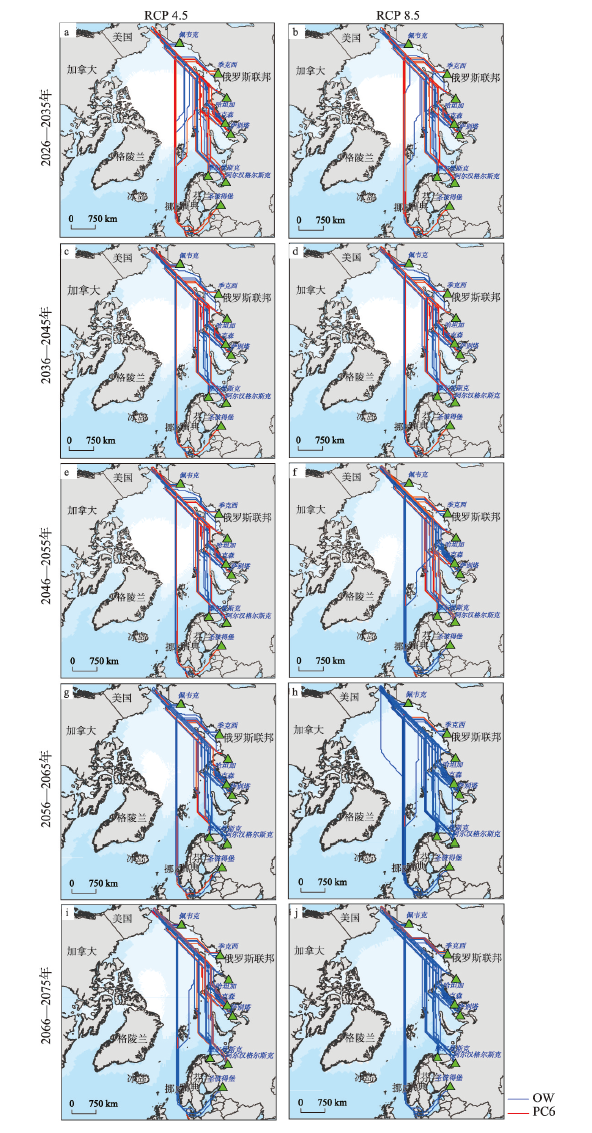
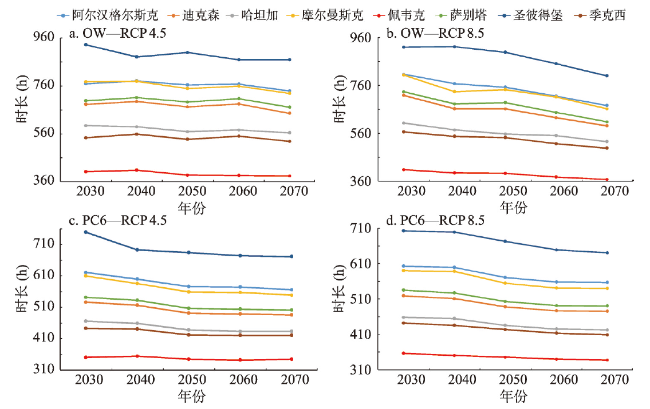
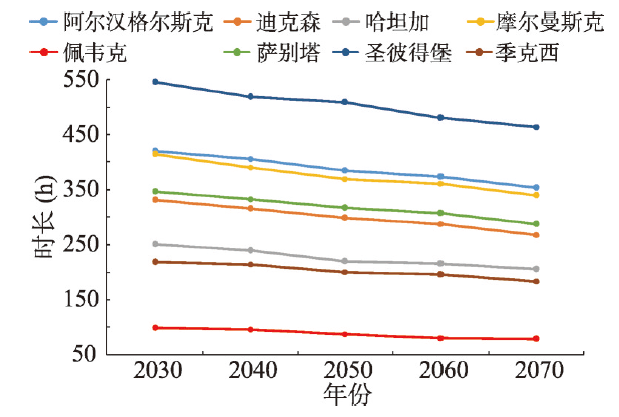
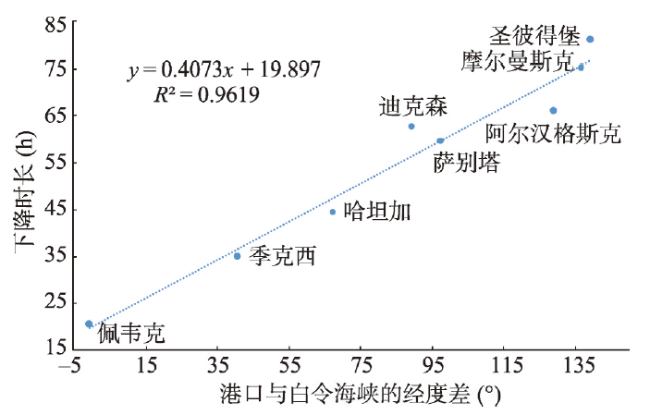
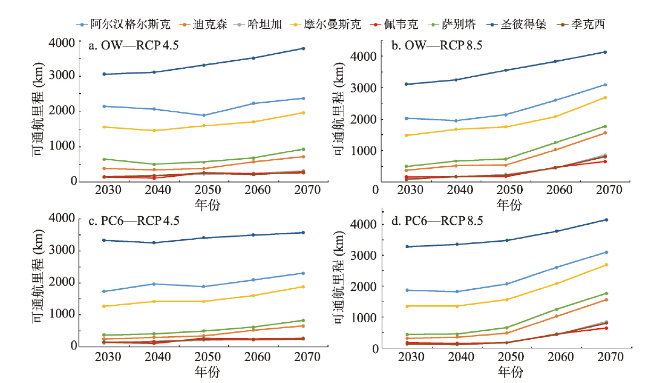
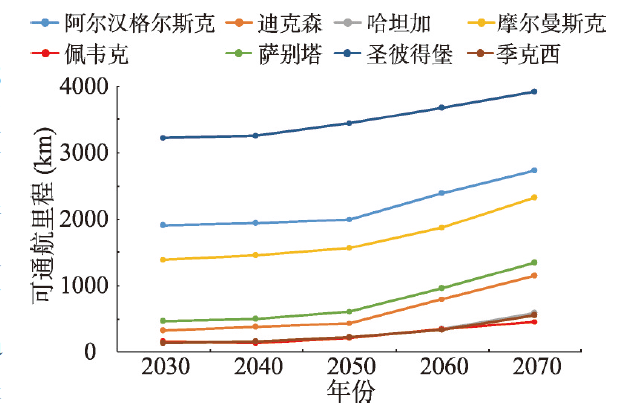
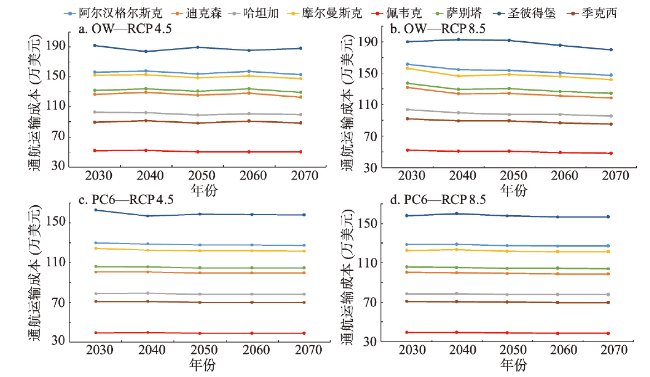
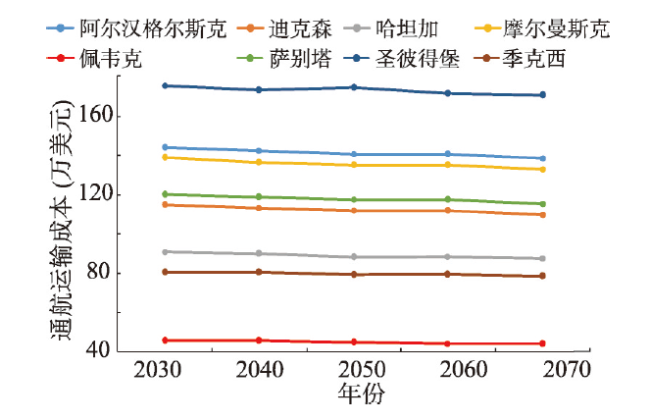
全球气候增暖,导致北极海冰消融加速,冰上丝绸之路的开通逐渐提上日程。本文针对2030—2070年俄罗斯8个重要港口通过东北航道到达白令海峡的通航性能,采用6种CMIP5气候模式在2种排放情景下的海冰数据,以及PC6破冰船和普通商船2种船型,分别对最优航线、通航时长、可通航里程以及通航成本4项要素进行研究。主要结论为:① 随着时间变化,各条最优通航线路逐渐集中有序,普通商船的通航能力显著提高,到2070年拥有和PC6近似相等的通航能力;② 俄港口到白令海峡间的运输时长每过10 a下降14 h,其中圣彼得堡港运输时长下降最为显著。到2070年,俄港口与白令海峡的经度差每增加1°,该港口的运输时长下降0.4 h;③ 未来50 a,东北航道可通航里程平均每隔10 a增加166 km,其中圣彼得堡港可通航里程的变化模式和平均变化模式最为相近;④ 从北冰洋港口出发的航线通航成本每10 a下降1万美元,商船在高浓度排放情景下总通航成本的下降幅度最明显。结合海冰变化情况,俄中西部港口具有巨大的资源运输潜力。本文量化并评估了东北航道在未来海冰消融情景下的通航性能演变态势,为东北航道通航以及北极港口贸易情况提供了理论和数据支撑。
黄季夏 , 张天媛 , 曹云锋 , 葛全胜 , 杨林生 . 北极海冰消融情景下东北航道通航性能演变分析[J]. 地理学报, 2021 , 76(5) : 1051 -1064 . DOI: 10.11821/dlxb202105001
The global warming has led to the acceleration of the melting of Arctic sea ice, and the opening of the Polar Silk Road has gradually been put on the agenda. In this paper, according to the navigation performance of eight important Russian ports reaching the Bering Strait through the Northeast Passage from 2030 to 2070, the sea ice data of six CMIP5 climate models under two RCPs and two ship types of PC6 icebreaker and OW (merchant ship) ship are adopted. Based on the study of the four factors of optimal route, navigation time, navigable mileage and navigation cost, the main conclusions are as follows: (1) With the change of time, the optimal navigation routes are gradually concentrated and orderly. The navigation capacity of merchant ship has been significantly improved, and by 2070 it will have the same navigation capacity as the PC6 icebreaker has. (2) The navigation time between the Russian ports and the Bering Strait has decreased by 14 h every 10 a, of which St. Petersburg Port has the most significant decline. By 2070, when the longitude difference between the Russian port and the Bering Strait increases by 1°, the navigation time of the port decreases by 0.4 h. (3) In the next 50 a, the navigable mileage of Northeast Passage will increase by 166 km every 10 a, among which the change pattern and average change pattern of navigable mileage in St. Petersburg Port are the most similar. (4) The navigation cost of the route from the Arctic port is reduced by $10,000 every 10 a, and the decrease of the total navigation cost of merchant ships is the most obvious under high emission concentration. Combined with the change of sea ice, the ports in central and western Russia have great potential for resource transportation. This study quantifies and evaluates the evolution of the navigation performance of the Northeast Passage under the future sea ice melting situation, which provides theoretical and data support for the navigation of the Northeast Passage and the Arctic port trade.
Key words: global warming; Polar Silk Road; Northeast Passage; navigation performance
表1 俄罗斯重要港口基本信息Tab. 1 Basic information of important ports in Russia |
| 港口中文名称 | 港口英文名称 | 纬度 | 经度 |
|---|---|---|---|
| 阿尔汉格尔斯克 | ARKHANGELSK | 64°32′0″N | 40°31′0″E |
| 迪克森 | DIKSON | 73°30′27″N | 80°23′47″E |
| 哈坦加 | KHATANGA | 71°58′57″N | 102°28′17″E |
| 摩尔曼斯克 | MURMANSK | 68°58′21″N | 33°2′46″E |
| 佩韦克 | PEVEK | 69°42′6″N | 170°16′59″E |
| 萨别塔 | SABETTA | 71°15′0″N | 72°6′10″E |
| 圣彼得堡 | ST. PETERSBURG | 59°55′38″N | 30°13′48″E |
| 季克西 | TIKSI | 71°38′35″N | 128°52′35″E |
表2 6种CMIP5全球气候模式数据基本信息Tab. 2 Basic information of six CMIP5 global climate models data |
| 模式名称 | 所属国家 | 格点数(经向×纬向) |
|---|---|---|
| CNRM-CM5 | 法国 | 362×292 |
| GFDL-CM3 | 美国 | 360×200 |
| HadGEM2-ES | 英国 | 360×216 |
| IPSL-CM5A-LR | 法国 | 182×149 |
| MIROC-ESM | 日本 | 256×192 |
| MPI-ESM-MR | 德国 | 802×404 |
表3 2030—2070年东北航道重要港口通行性能量化指标Tab. 3 Quantitative index of Northeast Passage performance in 2030-2070 |
| 通航性能指标 | 2030年 | 2040年 | 2050年 | 2060年 | 2070年 | 10 a变化 |
|---|---|---|---|---|---|---|
| 航行时间(h) | 327.01 | 313.23 | 297.19 | 286.59 | 271.51 | 13.88 |
| 航行天数(d) | 13.63 | 13.05 | 12.38 | 11.94 | 11.31 | 0.58 |
| 可通航里程(km) | 961.84 | 991.59 | 1083.56 | 1336.05 | 1626.47 | 166.16 |
| 通航成本(万美元) | 113.61 | 112.24 | 111.31 | 110.81 | 109.46 | 1.04 |
| [1] |
[ 王丹, 张浩. 北极通航对中国北方港口的影响及其应对策略研究. 中国软科学, 2014(3):16-31.]
|
| [2] |
[ 李新情, 程晓, 惠凤鸣, 等. 2014年夏季北极东北航道冰情分析. 极地研究, 2016,28(1):87-94.]
|
| [3] |
|
| [4] |
|
| [5] |
|
| [6] |
|
| [7] |
|
| [8] |
[ 王蔓蔓. 1979—2017年北极航道冰情变化研究[D]. 南京: 南京大学, 2018.]
|
| [9] |
[ 马龙, 王加跃, 刘星河, 等. 北极东北航道通航窗口研究. 海洋预报, 2018,35(1):52-59.]
|
| [10] |
|
| [11] |
|
| [12] |
|
| [13] |
[ 李振福, 尤雪, 王文雅, 等. 北极东北航线集装箱运输的经济性分析. 集美大学学报(哲学社会科学版), 2015,18(1):34-40.]
|
| [14] |
[ 史义江. 北极东北航线沿线中转港选取及布局研究[D]. 大连: 大连海事大学, 2018.]
|
| [15] |
[ 张侠, 屠景芳, 郭培清, 等. 北极航线的海运经济潜力评估及其对我国经济发展的战略意义. 中国软科学, 2009(Suppl.2):86-93.]
|
| [16] |
[ 郝增辉. 北极航线航行经济性分析与运输分担率预测[D]. 大连: 大连海事大学, 2017.]
|
| [17] |
[ 高超, 张正涛, 陈实, 等. RCP4.5情景下淮河流域气候变化的高分辨率模拟. 地理研究, 2014,33(3):467-477.]
|
| [18] |
[ 王麟, 刘毅鹏, 汪健, 等. 5个CMIP5模式对低纬高原气温的模拟和预估. 云南大学学报(自然科学版), 2015,37(6):851-860.]
|
| [19] |
[ 宾婵佳, 邱玉宝, 牛静静, 等. EASE-Grid投影对青藏高原雪水当量产品的验证影响分析. 遥感信息, 2015,30(1):96-100, 106.]
|
| [20] |
[ 乐阳, 龚健雅. Dijkstra最短路径算法的一种高效率实现. 武汉测绘科技大学学报, 1999,24(3):209-212.]
|
| [21] |
|
| [22] |
[ 尤雪. 北极东北航线集装箱运输经济性的仿真研究[D]. 大连: 大连海事大学, 2015.]
|
| [23] |
[ 钱作勤, 徐立, 严新平, 等. 北极东北航道通航策略及经济性研究. 极地研究, 2015,27(2):203-211.]
|
| [24] |
[ 王燕舞, 张达勋. 冰级定义的有关分析及建议. 船舶与海洋工程, 2010(4):54-58.]
|
| [25] |
|
| [26] |
[ 李丕学. 北极径流变化的关键气候因子及其对北冰洋海冰变化影响的研究[D]. 青岛: 中国海洋大学, 2009.]
|
| [27] |
[ 潘红, 陈敏, 童金炉, 等. 2003—2012年间白令海峡断面淡水构成的时空变化. 海洋学报, 2015,37(11):135-146.]
|
| [28] |
[ 王颖杰, 刘娜, 林丽娜, 等. 2012年夏季白令海峡附近海域温盐分布特征分析. 海洋科学进展, 2017,35(1):40-52.]
|
| [29] |
[ 高郭平, 赵进平, 董兆乾, 等. 白令海峡海域夏季温、盐分布及变化. 极地研究, 2004,16(3):229-239.]
|
| [30] |
[ 李蔷. 白令海峡水交换及其对北极海冰的影响[D]. 上海: 上海海洋大学, 2017.]
|
| [31] |
[ 王志民, 陈远航. 中俄打造“冰上丝绸之路”的机遇与挑战. 东北亚论坛, 2018,27(2):17-33, 127.]
|
/
| 〈 |
|
〉 |