



基于全球价值链的全球化城市网络分析——以苹果手机供应商为例
|
刘清(1995-), 女, 甘肃华亭人, 硕士生, 研究方向为城市与区域规划。E-mail: liuq18@lzu.edu.cn |
收稿日期: 2020-03-10
要求修回日期: 2020-07-22
网络出版日期: 2021-06-25
基金资助
国家自然科学基金项目(41971198)
国家自然科学基金项目(41571155)
版权
An analysis of the multidimensional globalizing city networks based on global value chain: A case study of iPhone suppliers
Received date: 2020-03-10
Request revised date: 2020-07-22
Online published: 2021-06-25
Supported by
National Natural Science Foundation of China(41971198)
National Natural Science Foundation of China(41571155)
Copyright
本文基于2019年苹果手机供应商数据,从全球价值链视角构建全球化城市网络,将具有全球化职能的专业城市与世界城市纳入同一分析框架,运用社会网络与社区发现方法,研究了研发型、生产型、代工服务型城市网络的节点中心性、整体拓扑结构、社群结构及影响机制。结果发现:① 苹果手机零部件的全球化城市网络均具有多中心与多样化、节点等级化、联系外部化特征,网络中“明星”节点高权力—高声望并存且权力总体高于声望;② 研发型城市网络联系最紧密,趋于首位城市分布,小团体结构与集群发育明显。生产型网络关联性最高,网络趋于均匀结构与位序—规模分布。代工服务型网络中心性最高,权力集中在少数城市节点,众多节点易受核心节点控制与支配。③ 研发型城市社区集群最明显,企业通过知识关联效应形成专业化集群,获取本地化经济益处,并通过链式与轮轴式布局建立基于关系接近的跨国网络社区。生产型城市社区集群次之,企业通过经济关联效应形成一般化集群,获取城市化经济益处,通过网络式布局建立基于地理接近的本国内跨行政区网络社区。代工服务型城市社区未发育出明显集群网络,企业通过低成本关联实现规模经济,世界工厂模式形成散点式网络社区。
刘清 , 杨永春 , 蒋小荣 , 曹宛鹏 , 刘笑杰 . 基于全球价值链的全球化城市网络分析——以苹果手机供应商为例[J]. 地理学报, 2021 , 76(4) : 870 -887 . DOI: 10.11821/dlxb202104007
Based on the data of 197 suppliers of iPhone components and parts in 2019, this paper builds multidimensional world city networks from the perspective of global value chains, integrating specialized cities with global functions and the high-class world cities into the same analytical framework, which enriches the research perspective of world city networks in the era of globalization to a certain extent. The purpose of this paper is to expand the research and investigation scope of the existing field of world city networks. By means of social network analysis (i.e. the analysis of centrality, connectedness and network cohesion), rank-size rule and community detection, we study the power and prestige, the overall topological structure, the community structure and influence mechanism of the city networks of R&D-oriented, production-oriented and OEM service-oriented types. The results show that: (1) All the world city networks are characterized by polycentricity and diversification, differentiation of nodes' status and dependence on external connections. The "star" nodes in the network coexist with high power and high prestige, and the power is generally higher than the prestige. (2) The network cohesion and rank of R&D-oriented cities are the highest, and the network tends to show a primate city distribution, and the growth of small group structure and the phenomenon of R&D clusters are obvious. The production-oriented network has the highest connectedness, and it tends to present a rank-size distribution and an equilibrium structure. Its network scale is large, but the ties of many nodes are sparse and decentralized; OEM service-oriented network has the highest relative centrality, and power and information are concentrated in a few city nodes. (3) The cluster characteristics of R&D-oriented city communities are most noticeable. Moreover, the network has significant long-distance knowledge spillover and cooperation behavior. Enterprises form specialized clusters in R&D-type cities through non-tradable interdependence, and obtain the benefits of localization economies and spatial integrated effects. The cluster tendency of production-oriented city communities are relatively obvious. Geographical proximity and spatial dependence are the main factors incubating community structure. Enterprises form generalized clusters through tradable interdependence to obtain the benefits of urbanization economies and distance attenuation effect. No obvious cluster network has been incubated in OEM serviced-oriented city communities. Polarization phenomenon of the inter-community is extremely significant, that is to say, the core city community in Taiwan, China, radiates to other low-level equilibrium communities, forming a radial community structure. Contract manufacturers seek the cities with low labor costs around the world to carry out standardized production, and realize full competition through scale economies, therefore, a scatter-type city network layout structure is formed.
表1 苹果手机供应商企业内部功能部门联系判断矩阵Tab. 1 Contact judgment matrix of internal functional departments of iPhone suppliers |
| A1 | A2 | A3 | A4 | A5 | A6 | |
|---|---|---|---|---|---|---|
| A1 | 0 | 1 | 1 | 1 | 1 | 1 |
| A2 | 1 | 1 | 0 | 0或1 | 0 | 0或1 |
| A3 | 1 | 0 | 0/1 | 0或0/1 | 0 | 0 |
| A4 | 1 | 0 | 0 | 0/1 | 0或0/1 | 0或0/1 |
| A5 | 1 | 0 | 0 | 0 | 1 | 0 |
| A6 | 1 | 0 | 0或0/1 | 0或0/1 | 0或1 | 1 |
注:1表示一企业内部两功能部门存在有效联系,0表示两功能部门不存在联系,0/1表示同属一个板块业务的两功能部门存在有效联系。 |
表2 全球化城市网络结构的统计特征值Tab. 2 Statistics of complexity of globalizing city network structure |
| 网络特征 | 统计指标 | GCN1 | GCN2 | GCN3 | GCN4 | GCN5 |
|---|---|---|---|---|---|---|
| 网络规模 | 节点数 | 87 | 83 | 106 | 61 | 66 |
| 边数 | 135 | 132 | 194 | 76 | 95 | |
| 密度 | 0.018 | 0.019 | 0.017 | 0.020 | 0.022 | |
| 网络直径 | 5 | 4 | 5 | 2 | 3 | |
| 相对中心性 | 平均度数中心性 | 0.757 | 0.783 | 0.648 | 0.258 | 0.821 |
| 平均中介中心性 | 1.081 | 1.274 | 0.924 | 0.333 | 1.452 | |
| 位序—规模法则 | y=2.897-1.662x R2=0.985 | y=1.563-1.159x R2=0.973 | y=1.633-1.236x R2=0.908 | y=0.492-0.566x R2=0.939 | y=2.654-1.543x R2=0.961 | |
| 关联性 | 关联度 | 0.866 | 0.946 | 0.999 | 0.989 | 0.777 |
| 等级度 | 0.689 | 0.551 | 0.302 | 0.371 | 0.833 | |
| 效率 | 0.985 | 0.862 | 0.984 | 0.970 | 0.387 | |
| 最近上限 | 0.359 | 0.331 | 0.138 | 0.197 | 0.720 | |
| 派系分析 | E-I指数 | -0.975** | -0.991** | -0.913** | -0.535** | -0.736** |
注:**表示0.01的置信水平上显著。 |
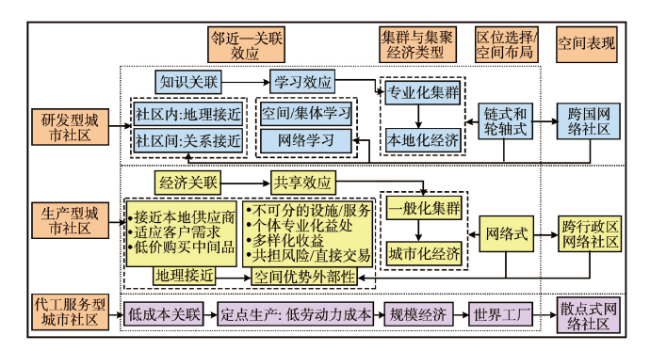
图5 全球化城市网络社群结构的影响机制Fig. 5 The influence mechanism of community structure of globalizing city networks |
| [1] |
[ 李仙德. 基于企业网络的城市网络研究[D]. 上海: 华东师范大学, 2012.]
|
| [2] |
|
| [3] |
[ 王宝平, 徐伟. 城市网络: 价值生产的空间组织. 北京: 科学出版社, 2017: 53-66.]
|
| [4] |
|
| [5] |
|
| [6] |
|
| [7] |
|
| [8] |
|
| [9] |
|
| [10] |
|
| [11] |
|
| [12] |
|
| [13] |
[ 武前波. 企业空间组织和城市与区域空间重塑[D]. 上海: 华东师范大学, 2009.]
|
| [14] |
[ 康江江, 张凡, 宁越敏. 苹果手机零部件全球价值链的价值分配与中国角色演变. 地理科学进展, 2019,38(3):395-406.]
|
| [15] |
|
| [16] |
|
| [17] |
|
| [18] |
|
| [19] |
|
| [20] |
|
| [21] |
|
| [22] |
|
| [23] |
|
| [24] |
|
| [25] |
|
| [26] |
[ 宁越敏, 武前波. 企业空间组织与城市区域发展. 北京: 科学出版社, 2011: 23-25.]
|
| [27] |
[ 杨永春, 冷炳荣, 谭一洺, 等. 世界城市网络研究理论与方法及其对城市体系研究的启示. 地理研究, 2011,30(6):1009-1020.]
|
| [28] |
[ 赵新正, 李秋平, 芮旸, 等. 基于财富500强中国企业网络的城市网络空间联系特征. 地理学报, 2019,74(4):694-709.]
|
| [29] |
|
| [30] |
|
| [31] |
|
| [32] |
|
| [33] |
|
| [34] |
[ 石崧. 从劳动空间分工到大都市区空间组织[D]. 上海: 华东师范大学, 2005.]
|
| [35] |
[ 周韬. 基于价值链的城市空间演化机理及经济效应研究[D]. 兰州: 兰州大学, 2015.]
|
| [36] |
[ 苗长虹, 魏也华, 吕拉昌. 新经济地理学. 北京: 科学出版社, 2011: 209-252.]
|
| [37] |
[ 彼得·迪肯. 全球性转变: 重塑21世纪的全球经济地图. 刘卫东, 等, 译. 北京: 商务印书馆, 2009: 337-364.]
|
| [38] |
|
| [39] |
[ 藤田昌久, 雅克·弗朗斯瓦·蒂斯. 集聚经济学: 城市、产业区位与全球化. 石敏俊, 等, 译. 上海: 格致出版社, 2015: 323-358.]
|
| [40] |
GaWC. The world according to GaWC 2018 [EB/OL]. https://www.lboro.ac.uk/gawc/world2018t.html, 2018-11-19.
|
/
| 〈 |
|
〉 |