



南京内城商业绅士化发育特征研究
|
宋伟轩(1981-), 男, 吉林敦化人, 博士, 副研究员, 研究方向为城市社会地理。E-mail:wxsong@niglas.ac.cn |
收稿日期: 2018-08-30
要求修回日期: 2019-11-01
网络出版日期: 2020-04-25
基金资助
国家自然科学基金项目(41771184)
版权
Commercial gentrification in the inner city of Nanjing, China
Received date: 2018-08-30
Request revised date: 2019-11-01
Online published: 2020-04-25
Supported by
National Natural Science Foundation of China(41771184)
Copyright
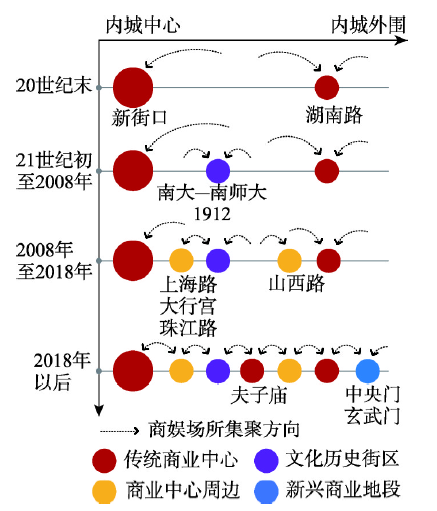
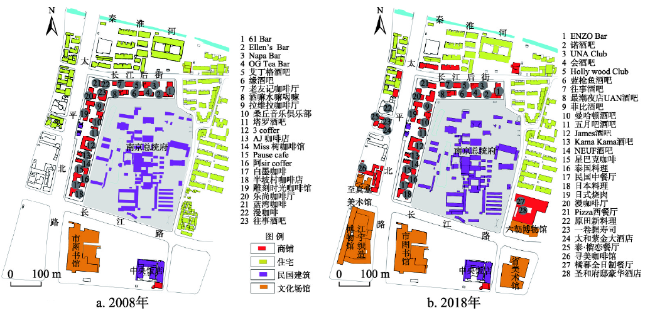
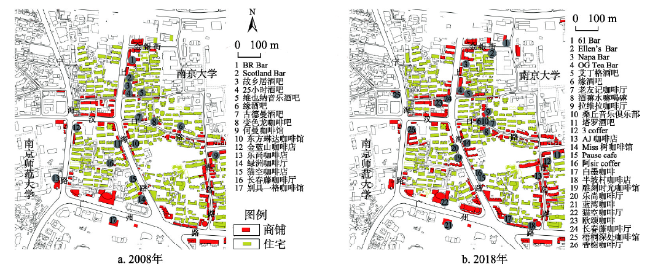
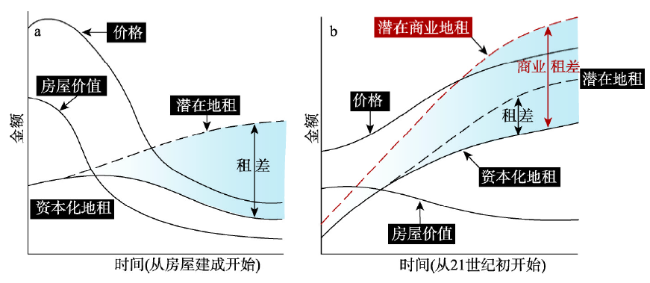
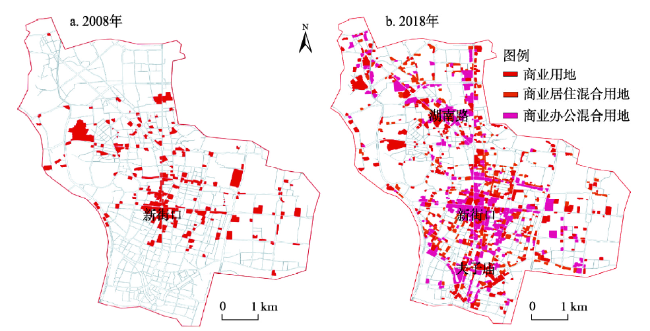
商业绅士化是指城市中传统商业、居住或工业被更高价值商业取代和置换的现象,与居住绅士化互为因果。由于城市发展阶段、模式和管制环境不同,不同国家和地区商业绅士化社会空间特征表现出显著差异。20世纪末以来,在城市社会空间转型语境下,具有异域风情的餐厅、酒吧、咖啡馆、健身房等高档消费场所置换传统住宅或社区商业并在城市特定空间中集聚,是中国最典型的商业绅士化现象。遴选出符合商业绅士化特征的六类高端商娱场所,采用空间核密度等方法,对2008年和2018年南京内城上述商娱场所空间集聚、演进模式和机理效应进行分析。研究发现:① 商业绅士化“热点区”首先出现在城市传统商业中心和文化历史街区,随后向商业中心周边和新兴商业地段跳跃式扩散;② 根据实践路径差异,可将南京内城商业绅士化分为整体植入式、侵入演替式和转型升级式三种模式,分别以1912街区、南京大学—南京师范大学(南大—南师大)片区和新街口地区为代表;③ 经济和文化力量在推动商业绅士化的发生演化中均发挥重要作用,其中地方政府、资本联手对“商业租差”的追逐,以及年轻、高收入绅士化群体日益增长的时尚、高端文化消费需求,从供需两端驱动着商业绅士化过程;④ 商业绅士化在提升城市商业活力和经济效益的同时,也在一定程度上产生对原住居民和低端商业的排挤和置换效应。
宋伟轩 , 孙洁 , 陈艳如 , 尹上岗 , 陈培阳 . 南京内城商业绅士化发育特征研究[J]. 地理学报, 2020 , 75(2) : 426 -442 . DOI: 10.11821/dlxb202002015
Commercial gentrification has been a research frontier of gentrification. It refers to the phenomenon that the traditional business, residence or industry is replaced by business with higher value in the city. Its connotation includes: (1) renovation and renewal of commercial environment and material landscapes; (2) realization of the rent gap of commercial space; (3) the upgrading and succession of business and consumption culture; (4) advanced replacement of business and consumer groups. The social spatial characteristics of commercial gentrification show differences in different countries and regions, for different stages, modes and regulatory environments of urban development. Under the influence of economic globalization and western-style consumer culture, traditional residence or community business was replaced by restaurants with exotic customs, bars, cafes, gyms, and other high-end consumer places, which mainly meet the growing needs of the middle-class consumer groups. They gathered in the specific space of the city since the end of the 20th century. This is the typical commercial gentrification in China, which is a business upgrading and replacement process that meets higher consumer demand. Commercial gentrification in China has a more intense process, as well as a wider range of impact, than that in European and American countries. The paper conducts a kernel density analysis of the six high-end entertainment establishments in the inner city of Nanjing in 2008 and 2018. The result shows that: (1) the "hot spots" of commercial gentrification first appear in the traditional commercial centers and historic conservation areas, and then spread to the periphery of commercial centers and new commercial areas; (2) according to the difference of practice path, commercial gentrification in inner Nanjing can be divided into three modes of holistic implantation, invasive succession, and transformation and upgrading, which are respectively represented by 1912 blocks, NJU-NNU area and Xinjiekou area. Both economic and cultural forces play an important role in promoting the evolution of the three modes of commercial gentrification. The process of commercial gentrification is driven by both the supply side and the demand side, including the facts that local government and capital join hands to pursue commercial rent gap, as well as that young and high-income gentrification groups have a growing demand for fashion and high-end consumption. Commercial gentrification has promoted the business vitality and economic benefits of the city. Also, it has affected the authenticity of the historical blocks, the inclusiveness of the commercial space and the fairness of the space production to a certain extent, for its exclusion and displacement produce effects on the residents, and the low-end business and consumer groups. Commercial gentrification involves cultural identity, quality of life, consumption experience and status symbol, meaning that it has more complicated social spatial connotation than residential gentrification. Consequently, it is urgent to conduct a more systematic study on the phenomenon of commercial gentrification in China.
Key words: gentrification; commercial gentrification; middle class; rent gap; displacement; Nanjing
表1 2008年和2018年南京内城6类商娱场所数量及增长情况Tab. 1 Number and growth of the six types of commercial entertainment places in inner Nanjing in 2008 and 2018 |
| 类型 | 2008年 | 2018年 | 2008—2018年 数量增长(%) | |||
|---|---|---|---|---|---|---|
| 数量(个) | 比例(%) | 数量(个) | 比例(%) | |||
| 异域料理 | 71 | 8.9 | 130 | 12.3 | 83.1 | |
| 咖啡茶馆 | 219 | 27.4 | 282 | 26.8 | 28.8 | |
| 美容美体 | 207 | 25.9 | 254 | 24.1 | 22.7 | |
| 瑜伽健身 | 39 | 4.9 | 75 | 7.1 | 92.3 | |
| 商务会所 | 111 | 13.9 | 139 | 13.2 | 25.2 | |
| 酒吧歌厅 | 152 | 19.0 | 174 | 16.5 | 14.5 | |
| 合计 | 799 | 100 | 1054 | 100 | 31.9 | |
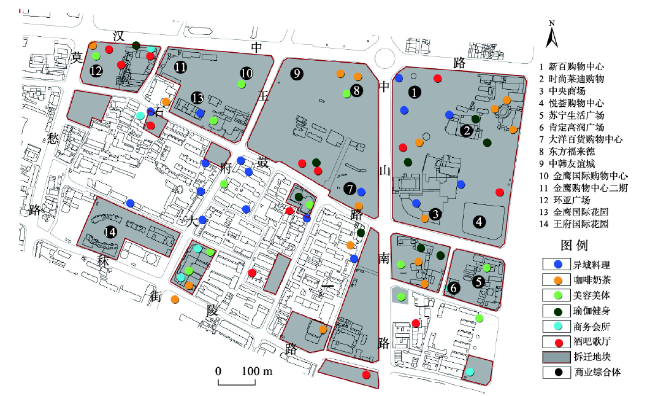
图8 南京新街口地区20世纪末以来拆迁改造地块与2018年6类商娱消费场所布局Fig. 8 Rebuilt plots since the end of the 20th century and the six types of commercial entertainment places in Xinjiekou area in 2018 |
表2 2008年和2018年南京新街口地区零售商店类型(个)Tab. 2 Types of retail stores in Xinjiekou area in 2008 and 2018 |
| 商业类型 | 2008年 | 2018年 | |||||||
|---|---|---|---|---|---|---|---|---|---|
| 总量 | 非连锁店 | 国内连锁 | 国际连锁 | 总量 | 非连锁店 | 国内连锁 | 国际连锁 | ||
| 餐厅食品饮品 | 553 | 297 | 201 | 55 | 918 | 282 | 528 | 108 | |
| 服装鞋帽皮具 | 896 | 306 | 394 | 196 | 1385 | 362 | 605 | 418 | |
| 便利店和超市 | 425 | 247 | 165 | 13 | 496 | 179 | 246 | 71 | |
| 其他日用百货 | 181 | 92 | 70 | 19 | 251 | 84 | 117 | 50 | |
| 合计 | 2055 | 942 | 830 | 183 | 3050 | 827 | 1576 | 647 | |
注:根据高德地图(www.amap.com)提供南京内城商业网点POI数据整理。 |
表3 不同发育模式商业绅士化特征比较Tab. 3 Comparison of commercial gentrification of different modes |
| 整体植入式 | 侵入演替式 | 转型升级式 | |
|---|---|---|---|
| 推动主体 | 政府力量主导 | 市场力量主导 | 政府—市场联合主导 |
| 实践方式 | 颠覆性、突变式拆旧建新 | 单体性、渐进式逐步更新 | 持续性商业环境改造和业态提升 |
| 置换模式 | 原住民和功能全部置换 | 原住民和功能部分置换 | 商业功能的高端化升级 |
| 功能特点 | 单一商业 | 商住混合 | 功能混合 |
| 文化属性 | 以文化再现为噱头 | 根植于区域文化消费需求 | 缺少地方特色的现代商业空间 |
| [1] |
|
| [2] |
|
| [3] |
|
| [4] |
|
| [5] |
|
| [6] |
|
| [7] |
|
| [8] |
[ 宋伟轩, 刘春卉, 汪毅 , 等. 基于“租差”理论的城市居住空间中产阶层化研究: 以南京内城为例. 地理学报, 2017,72(12):2115-2130.]
|
| [9] |
|
| [10] |
|
| [11] |
|
| [12] |
|
| [13] |
|
| [14] |
|
| [15] |
|
| [16] |
|
| [17] |
|
| [18] |
|
| [19] |
|
| [20] |
|
| [21] |
|
| [22] |
|
| [23] |
|
| [24] |
|
| [25] |
|
| [26] |
|
| [27] |
|
| [28] |
|
| [29] |
[ 王兴中, 高丽 . 大城市中产阶层化与商娱场所的空间结构. 人文地理, 2008,23(2):49-55.]
|
| [30] |
|
| [31] |
[ 齐康, 杨志疆 . 民国文化的坐标. 建筑学报, 2006(1):14-18.]
|
| [32] |
[ 丁宏伟 . 南京总统府旧址保护与利用研究: 南京中国近代史博物馆规划设计. 建筑创作, 2003(8):82-107.]
|
| [33] |
[ 孙洁, 朱喜钢, 宋伟轩 , 等. 文化消费驱动的高校周边地区商业绅士化研究: 以南京大学与南京师范大学老校区为例. 城市规划, 2018,42(7):29-35.]
|
| [34] |
[ 肖蓉, 阳建强, 李哲 . 生产—消费均衡视角下城市商业中心演化研究: 以南京新街口为例. 城市规划, 2016,40(1):43-49.]
|
| [35] |
|
| [36] |
|
| [37] |
|
| [38] |
|
| [39] |
|
| [40] |
[ 宋伟轩, 朱喜钢, 吴启焰 . 中国中产阶层化过程、特征与评价: 以南京为例. 城市规划, 2010,34(4):14-20.]
|
| [41] |
|
| [42] |
|
| [43] |
|
| [44] |
|
| [45] |
|
| [46] |
|
| [47] |
|
| [48] |
|
| [49] |
|
| [50] |
|
| [51] |
|
| [52] |
|
| [53] |
|
| [54] |
|
| [55] |
|
| [56] |
|
/
| 〈 |
|
〉 |