



“东突暴恐”事件的批判地缘政治分析
作者简介:安宁(1987-), 男, 陕西汉中人, 博士生, 主要研究方向为政治地理。E-mail: n.an.1@research.gla.ac.uk
收稿日期: 2014-11-27
要求修回日期: 2015-05-28
网络出版日期: 2015-10-20
基金资助
973计划前期研究专项(2014CB460614);国家自然科学基金项目(41171125);国家公派留学基金项目(201306380085)
A critical geopolitical analysis of "East Turkistan violence and terrorism" activities in China
Received date: 2014-11-27
Request revised date: 2015-05-28
Online published: 2015-10-20
Supported by
Special Program of the Preliminary Study of National Basic Research Program (973 Program), No.2014CB460614;National Natural Science Foundation of China, No.41171125;China Scholarship Council, No.201306380085
Copyright
以中国网络媒体对其境内“东突”极端分裂势力制造的暴力恐怖活动的话语实践以及受众群体对此类话语的回应为分析对象,援引批判(流行文化)地缘政治研究理论,利用语义分析和“网络民族志”的方法,探讨了媒体和受众群体作为地理知识生产的场所对新疆及其相关空间的地理意义进行生产和协商的方式,并讨论了由此而生的新疆地理想象与中国政府反恐策略的互动机制。研究发现,媒体以文本表征的手段生产了新疆及其相关空间的消极地理知识、建构了消极的地理想象,这些地理意义的产生在受众的“消费”过程中又不断地被协商与再生产。此外,这些地理意义的生产和协商与国家制定的反恐怖主义政策始终是一致的,它们是国家制定反恐策略的重要参考消息来源之一。从人文地理学角度来讲,将人们日常生活(包括表征和非表征的行为实践)对地理意义的生产过程纳入到人文地理的研究范畴中来。从地缘政治学的角度来讲,研究颠覆了传统的、本体论上的、客观的自然环境对国家政治决策发挥影响作用的地缘政治研究范式,将想象地理作为人文地理学的重要研究对象进行了尝试。此外,从实践意义来讲,本文对网络媒体及受众对地理知识生产的讨论对政府的话语权管理具有一定的参考价值。
安宁 , 朱竑 . “东突暴恐”事件的批判地缘政治分析[J]. 地理学报, 2015 , 70(10) : 1650 -1663 . DOI: 10.11821/dlxb201510009
Widely influenced by "violence and terrorism" activities that are organized by the terrorist organization "the East Turkistan Movement" in China, the imaginative geography of Xinjiang has recently changed a lot. As "the East Turkistan Movement" tries to secede Xinjiang away from China by carrying out "violence and terrorism" activities in and out of Xinjiang, the geographical imagination of Xinjiang is gradually changing from a place of beauty and romance into a space of terror and danger. This article focuses on the variation of the geographical imagination of Xinjiang by exploring how Chinese internet media have impact upon it, and discusses how such variation gets involved into Chinese government's policy of anti-terrorism by employing the theory of critical (popular) geopolitics. To this regard, this article pays attention to how Chinese internet media, such as Baidu News, 360 News, Sougou News, and Sina Weibo, produce, practice, negotiate, and reproduce the geographical meanings of the place and space of Xinjiang, by drawing on the textual analysis and online anthropological exploration of the discursive practice of abovementioned internet media and audiences' responses to them. In doing so, this article summarizes the empirical studies in this body of research. It can be concluded that, the internet media produces the negative geographical knowledge of Xinjiang by representing and spreading the information of "violence and terrorism" activities in and out of Xinjiang, and thereby constructing the negative geographical imagination of Xinjiang. Furthermore, such imagination is incessantly negotiated and reproduced in the process of media consuming by audiences. The negotiation and the reproduction of the geographical meanings of Xinjiang positively get involved into and keep in consistence with Chinese government's policy of anti-terrorism, thus the critical (popular) geopolitics model of Chinese anti-terrorism is constructed in the end of this article. Finally, this article could be widely read as a contribution to: (1) human geography, which gets engaged in the discussion of people's everyday life in producing geographical meanings into geography studies; (2) geopolitics, which subverts the paradigm of traditional geopolitical studies that focuses on the influence of the ontological and objective geography upon statecraft practices, and turns to viewing the imaginative geography as an important research object in geopolitical studies; (3) governance, by which the study of internet media is valuable and meaningful for government's guidance of the discourse of mass media.
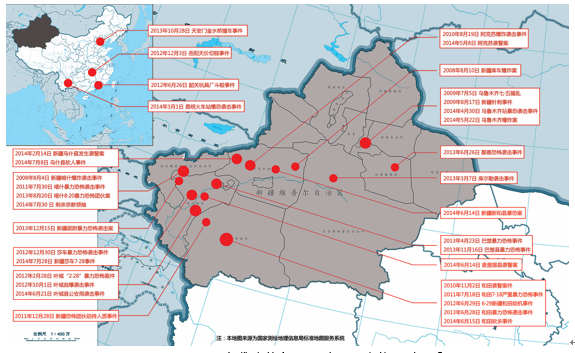
Fig. 1 The distribution of the main "East Turkistan violent and terrorism" activities in China during 2008-2014图1 2008-2014年发生的主要“东突暴恐事件”分布图① |
Tab. 1 High-frequency words concerning "East Turkistan violence and terrorism" activities in Chinese internet media (January 24, 2014 - August 24, 2014)表1 中国网络媒体对“东突暴恐事件”报道词汇频率统计表(2014年1月24日-8月24日) |
| 地理名词 | 频次 | 其他名词 | 频次 | 动词 | 频次 | 形容词/副词 | 频次 |
|---|---|---|---|---|---|---|---|
| 新疆 | 2136 | 恐怖事件 | 611 | 恐怖袭击 | 245 | 暴力 | 1631 |
| 乌鲁木齐 | 295 | 案件 | 422 | 谴责 | 189 | 恐怖 | 657 |
| 昆明 | 213 | 暴徒 | 192 | 分裂 | 167 | 严重 | 466 |
| 喀什 | 158 | 暴力事件 | 133 | 造成 | 131 | 强烈 | 133 |
| 叶城 | 214 | 宗教 | 131 | 袭击 | 130 | 反恐 | 110 |
| 乌什 | 92 | 恐怖分子 | 123 | 组织 | 111 | 稳定 | 82 |
| 和田 | 89 | 恐怖活动 | 98 | 策划 | 90 | 安全 | 38 |
| 莎车县 | 60 | 民族 | 87 | 犯罪 | 87 | 无辜 | 38 |
| 北京 | 58 | 活动 | 83 | 击毙 | 84 | 境外 | 38 |
| 火车站 | 57 | 民警 | 65 | 打击 | 54 | 依法 | 37 |
| 社区 | 49 | 警方 | 59 | 牺牲 | 50 | 国际 | 35 |
| 公安局 | 32 | 暴力犯罪 | 49 | 遇害 | 50 | 非法 | 34 |
| 派出所 | 29 | 恐怖主义 | 45 | 声讨 | 47 | 境内 | 24 |
| … | … | … | … | … | … | … | … |
Tab. 2 Examples of the nonsense words that are deleted in the textual analysis on the reports of "East Turkistan violence and terrorism" activities in Chinese internet media表2 中国网络媒体“东突暴恐事件”报道语义分析中所删除的无意义词汇示例表 |
| 词汇 | 新闻 | html | news | 搜狗 | 记者 | 地区 | people | sina | 消息 |
|---|---|---|---|---|---|---|---|---|---|
| 词频 | 1125 | 707 | 495 | 187 | 155 | 124 | 84 | 78 | 69 |
| 词汇 | 媒体 | 视频 | 思想 | 发生 | 共同 | 社会 | 新华网 | 今年 | … |
| 词频 | 56 | 52 | 51 | 49 | 48 | 43 | 39 | 38 | … |
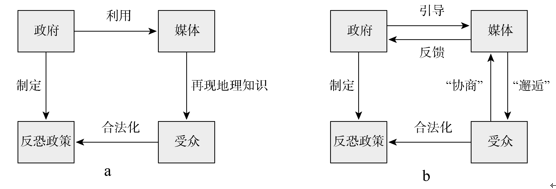
Fig. 2 Models of Chinese popular geopolitics图2 中国流行文化地缘政治模型 |
The authors have declared that no competing interests exist.
| [1] |
|
| [2] |
|
| [3] |
|
| [4] |
[
|
| [5] |
|
| [6] |
|
| [7] |
[
|
| [8] |
[
|
| [9] |
|
| [10] |
|
| [11] |
|
| [12] |
|
| [13] |
|
| [14] |
|
| [15] |
|
| [16] |
|
| [17] |
|
| [18] |
|
| [19] |
|
| [20] |
|
| [21] |
|
| [22] |
|
| [23] |
|
| [24] |
|
| [25] |
|
| [26] |
|
| [27] |
|
| [28] |
|
| [29] |
|
| [30] |
|
| [31] |
|
| [32] |
|
| [33] |
|
| [34] |
[
|
| [35] |
[
|
| [36] |
|
| [37] |
|
| [38] |
|
| [39] |
|
| [40] |
|
| [41] |
|
| [42] |
[
|
| [43] |
[
|
| [44] |
[
|
| [45] |
[
|
| [46] |
|
| [47] |
[
|
| [48] |
[
|
/
| 〈 |
|
〉 |