



Rethinking gentrification in the Chinese context
Received date: 2025-03-24
Revised date: 2025-05-30
Online published: 2025-12-05
Supported by
Research Grant Council, University Grants Committee of Hong Kong, General Research Fund(17616524)
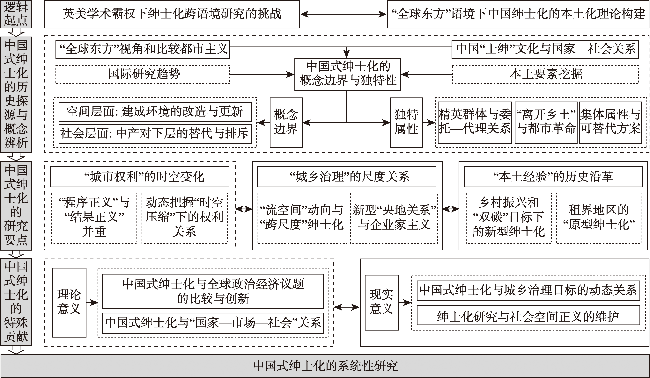
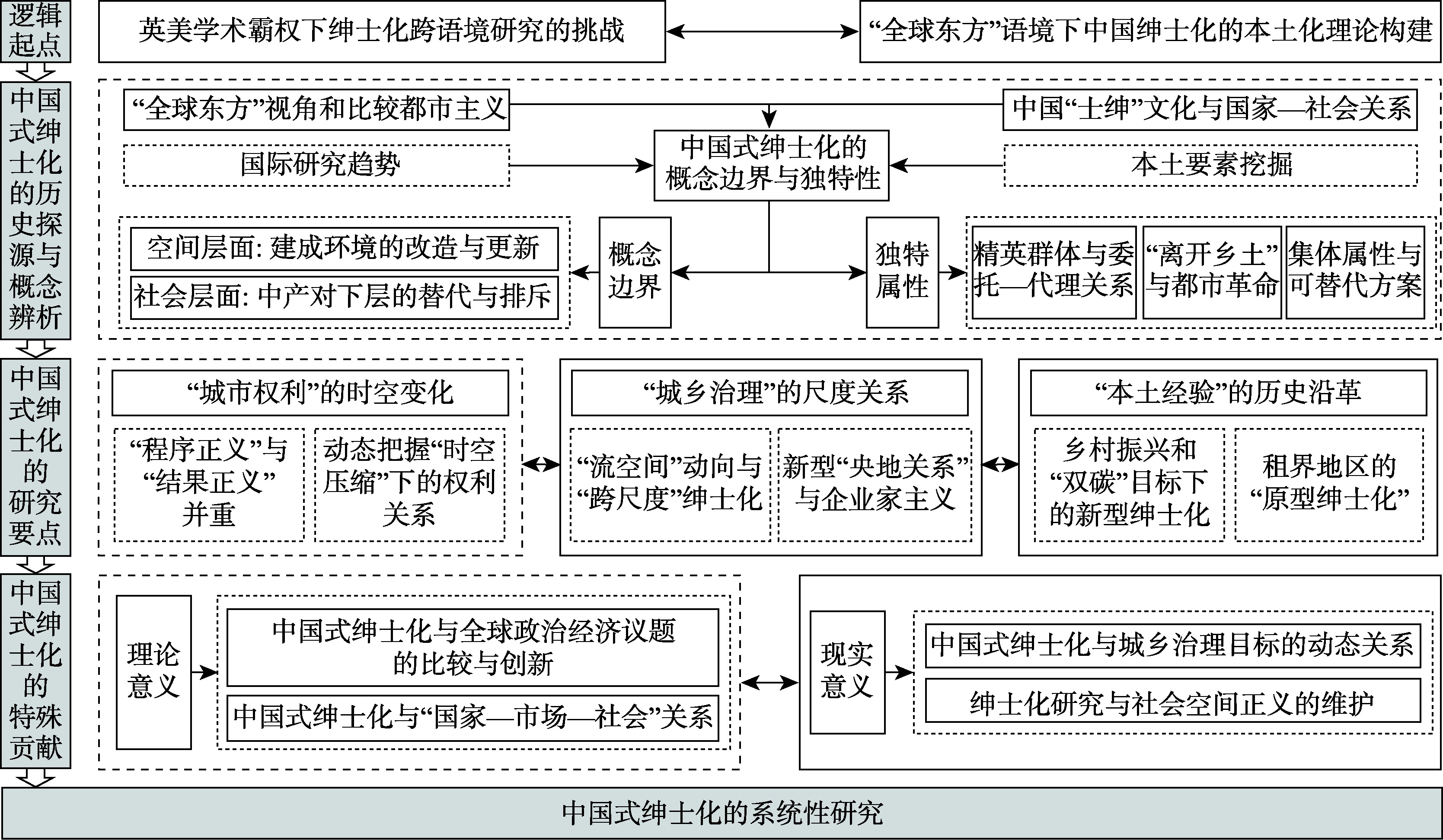
Emerged as a cutting-edge research agenda in urban studies more than half a century ago, gentrification remains an evergreen and debatable topic in the practices and research of urban and rural governance in contemporary China. In response to the lasting and heated debates within the international and domestic academic communities, it is of vital significance to examine and clarify the prevalent discourse of "Chinese-style gentrification" and conduct in-depth exploration and reflections on its historical evolution, conceptual boundaries, research approaches, and theoretical value. This paper situates Chinese-style gentrification into the broader context of the Global East by highlighting its unique features to be distinguished from the Western contexts. We dissect the historical evolution and contemporary identity of the "gentry" class in China under the framework of state-society relationship. The research contends that studies on Chinese gentrification should grasp three fundamental elements: "dynamism", "scale", and "process", namely, to understand the spatiotemporal variations of "the right to the city" conjuncturally, to develop a multi-faceted comprehension of the multi-scalar relationships in urban and rural governance, and to systematically examine the historical evolution of local experiences. Grounded in the specific "state-market-society" interactions in the Global East and China, the inherent complexity and diversity of Chinese-style gentrification will transcend the paradigms of Western gentrification research and make distinctive contributions to international debates. Currently, the processes of gentrification in China have engendered more profound social and spatial ramifications compared to that in the Global North. Balancing efficiency and equity will be a key task for promoting effective governance in urban and rural communities in China. In this new era, exploring innovative approaches to enhancing urban and rural governance and residents' well-being, engaging in comparative studies and constructive dialogues with international researchers should be our utmost tasks. In light of this, researchers should re-examine Chinese-style gentrification in an open-minded yet rigorous, critical yet scientific manner, drawing on but not being constrained by local experiences to make significant contributions to this ever-green and ever-evolving research field.
HE Shenjing , ZHANG Qingyuan . Rethinking gentrification in the Chinese context[J]. Acta Geographica Sinica, 2025 , 80(12) : 3324 -3339 . DOI: 10.11821/dlxb202512012
| [1] |
|
| [2] |
|
| [3] |
|
| [4] |
[张清源, 叶超. 星球绅士化理论前沿及其对中国城乡治理的启示. 地理研究, 2022, 41(6): 1778-1795.]
|
| [5] |
|
| [6] |
|
| [7] |
|
| [8] |
|
| [9] |
|
| [10] |
|
| [11] |
|
| [12] |
|
| [13] |
|
| [14] |
|
| [15] |
|
| [16] |
|
| [17] |
|
| [18] |
|
| [19] |
|
| [20] |
|
| [21] |
|
| [22] |
|
| [23] |
[薛德升. 西方绅士化研究对我国城市社会空间研究的启示. 规划师, 1999, 15(3): 109-112.]
|
| [24] |
[黄幸, 刘玉亭. 中国绅士化研究的本土实践: 特征、议题与展望. 人文地理, 2021, 36(3): 5-14, 36.]
|
| [25] |
|
| [26] |
|
| [27] |
|
| [28] |
|
| [29] |
|
| [30] |
|
| [31] |
|
| [32] |
|
| [33] |
|
| [34] |
|
| [35] |
|
| [36] |
|
| [37] |
|
| [38] |
|
| [39] |
|
| [40] |
[费孝通, 吴晗, 袁方, 等. 皇权与绅权. 北京: 生活·读书·新知三联书店, 2013.]
|
| [41] |
[周雪光. 从“黄宗羲定律”到帝国的逻辑: 中国国家治理逻辑的历史线索. 开放时代, 2014(4): 108-132, 7-8.]
|
| [42] |
|
| [43] |
[萧公权. 中国乡村: 19世纪的帝国控制. 北京: 九州出版社, 2018.]
|
| [44] |
|
| [45] |
[孙立平, 李强, 沈原. 中国社会结构转型的中近期趋势与隐患. 战略与管理, 1998(5): 1-17.]
|
| [46] |
[何海兵. 我国城市基层社会管理体制的变迁: 从单位制、街居制到社区制. 管理世界, 2003, 19(6): 52-62.]
|
| [47] |
[薄一波. 若干重大决策与事件的回顾. 北京: 中共中央党校出版社, 1991.]
|
| [48] |
|
| [49] |
|
| [50] |
|
| [51] |
|
| [52] |
[周黎安. “行政发包制”. 社会, 2014, 35(6): 1-38.]
|
| [53] |
|
| [54] |
|
| [55] |
|
| [56] |
[李培林. 老工业基地的失业治理: 后工业化和市场化: 东北地区9家大型国有企业的调查. 社会学研究, 1998, 13(4): 3-14.]
|
| [57] |
|
| [58] |
[李强. 社会分层与社会空间领域的公平、公正. 中国人民大学学报, 2012, 26(1): 2-9.]
|
| [59] |
[陆学艺. 当代中国社会阶层的分化与流动. 江苏社会科学, 2003(4): 1-9.]
|
| [60] |
|
| [61] |
[叶超, 于洁, 张清源, 等. 从治理到城乡治理: 国际前沿、发展态势与中国路径. 地理科学进展, 2021, 40(1): 15-27.]
|
| [62] |
|
| [63] |
|
| [64] |
|
| [65] |
|
| [66] |
|
| [67] |
|
| [68] |
[陈映芳. 城市中国的逻辑. 北京: 生活·读书·新知三联书店, 2012.]
|
| [69] |
|
| [70] |
|
| [71] |
|
| [72] |
|
| [73] |
|
| [74] |
|
| [75] |
|
| [76] |
|
| [77] |
|
| [78] |
|
| [79] |
|
| [80] |
|
| [81] |
|
| [82] |
|
| [83] |
|
| [84] |
|
| [85] |
|
| [86] |
|
| [87] |
[宋伟轩, 刘春卉, 汪毅, 等. 基于“租差”理论的城市居住空间中产阶层化研究: 以南京内城为例. 地理学报, 2017, 72(12): 2115-2130.]
|
| [88] |
|
| [89] |
|
| [90] |
|
| [91] |
|
| [92] |
|
| [93] |
|
| [94] |
|
| [95] |
|
| [96] |
|
| [97] |
|
| [98] |
[叶超, 罗燊. 中国式现代化的经济地理格局. 地理学报, 2024, 79(12): 3095-3109.]
|
| [99] |
[张清源. 地域类型视角下中国绅士化研究: 特征、经验与展望. 人文地理, 2025, 40(4): 24-35.]
|
| [100] |
|
| [101] |
|
| [102] |
|
/
| 〈 |
|
〉 |