
Biodiversity and Ecosystem Services

The concept, approach, and effectiveness of no net loss of biodiversity

  • XU Dongmei ,
  • PENG Jian
Expand
  • Technology Innovation Center for Integrated Ecosystem Restoration and Sustainable Utilization, Ministry of Natural Resources, College of Urban and Environmental Sciences, Peking University, Beijing 100871, China

Received date: 2024-04-09

  Revised date: 2025-03-10

  Online published: 2025-07-23

Supported by

National Key R&D Program of China(2022YFF1303201)

Abstract

The biodiversity loss due to human activities is occurring at an alarming rate and there is an urgent need to reverse biodiversity decline. No net loss is widely used in environmental impact assessments and serves as an important approach to advancing global biodiversity conservation goals. We systematically reviewed the concept, approach, and effectiveness of no net loss of biodiversity. The early stage of no net loss focused on wetlands, gradually shifting to biodiversity. No net loss of biodiversity is defined as compensating for biodiversity loss caused by human activities, to ensure that the overall biodiversity will not suffer from net loss. Mitigation hierarchy is a recognized systematic approach for achieving no net loss of biodiversity, with avoidance and minimization as preventive measures and restoration and offset as remedial measures. Firstly, negative impacts should be avoided as much as possible. Secondly, if impacts are unavoidable, they should be minimized. Thirdly, the affected area should be restored. Finally, all remaining impacts should be offset. Existing research focuses mostly on biodiversity offset, but it is urgent to move towards effective combinations of mitigation hierarchy to achieve no net loss. Effectiveness evaluation of no net loss of biodiversity has received increasing attention in recent years, and evaluation approaches include statistical matching and regression models. The determination criteria largely influence effectiveness evaluation and are mainly categorized into fixed and dynamic reference baselines, but counterfactual scenarios determination and biodiversity measurement remain challenging. Evidence on the effectiveness of no net loss policies remains scarce, mainly because of unreliable measurement approaches and lack of data to assess whether no net loss is achieved. Future research on no net loss of biodiversity needs to focus on the topics such as the synergistic conservation between diversity and endemism, as well as uncertainty about the achievement of goals, temporal trade-offs of mitigation hierarchy measures, and spatial ranges in achieving no net loss.
Cite this article

XU Dongmei , PENG Jian . The concept, approach, and effectiveness of no net loss of biodiversity[J]. Acta Geographica Sinica, 2025 , 80(7) : 1872 -1887 . DOI: 10.11821/dlxb202507010

1 引言

全球接近3/4的陆地表面已因人类活动而改变,生态系统和自然栖息地退化正以惊人的速度发生,遏制生物多样性丧失成为21世纪可持续发展的重要挑战之一[1]。自工业革命以来,全球平均有10%~16%的遗传多样性已经丧失[2]。目前全球物种灭绝的速度比过去1000万年的平均值高几十到几百倍,并且速度仍在加快,几乎在所有地方、所有层面都是如此[1,3]。全球爬行动物最新评估指出超过1/5的爬行物种被评估为受威胁物种[4],全球鸟类和哺乳动物的灭绝威胁水平每10 a增加1%~2%[5]。因此,生物多样性损失已经越出行星边界[6-7],对地球社会—生态系统可持续性构成重大威胁。
生物多样性丧失的主要驱动因素包括过度开发、栖息地改变、气候变化、外来物种和疾病入侵、环境污染、非法狩猎和野生动物贸易等[8-9]。仅依靠保护栖息地不足以应对生物多样性丧失速度加快的难题,亟需在全球范围内采取保护修复综合管理策略,重点解决主要驱动因素[10-12]。《生物多样性和生态系统服务全球评估报告》和《2011—2020年生物多样性战略计划》等文件[1,13]指出,保护生物多样性的努力在国际、国家和地方计划并进行。但总体而言,这些努力未能取得预期成效[14-15],全球生物多样性正以人类历史上前所未有的速度恶化。例如,20个阻止生物多样性丧失的爱知全球目标均未按时实现[16]。此外,与生物多样性密切相关的可持续发展目标14(水下生物)和15(陆地生物)的全球实现度也不容乐观[17]。由于现有努力并未能使生物多样性保持在安全可控的操作空间内[6-7],亟需发展生物多样性保护的新理论与新方法。无净损失及相关概念(如净积极影响、净收益等,表1)即是在应对生物多样性持续丧失、推动全球目标达成的努力中逐步发展起来的,近年来在环境管理和生物多样性领域的影响力不断增强[18-19]
表1 生物多样性无净损失等概念出处

Tab. 1 Classic sources of no net loss of biodiversity and related concepts

中文 英文 来源
生物多样性无净损失 No net loss of biodiversity [20-21]
缓解等级 Mitigation hierarchy [14, 22]
避免 Avoidance [23-24]
最小化 Minimization [23]
恢复 Restoration [25-26]
生物多样性抵消 Biodiversity offset [27-29]
生物多样性补偿 Biodiversity compensation [30]
参照基准 Reference baseline [18, 31]
自然向好 Nature positive [32-33]
净收益 Net gain https://www.gov.uk/government/collections/biodiversity-net-gain
净积极影响 Net positive impact [34-35]
无净损失是指采取适当措施以确保开发等活动不会导致整体环境保护目标(如湿地、生物多样性保护等)的净损失,最好是净增加[11,19]。生物多样性无净损失目标预计将有助于扭转生物多样性下降趋势,助力《生物多样性公约》目标和联合国可持续发展目标的实现[20,22]。缓解等级是公认的实现无净损失的系统途径,旨在通过一系列措施来避免或减轻人类活动对生态系统和生物多样性产生的负面影响[14]。不过,现有大多数无净损失研究均为理论探讨,尽管在理论上得到广泛支持,但是计量性的实证研究较少,且缺少系统梳理,在实践应用中仍然存在一定挑战。
基于此,本文系统梳理生物多样性无净损失的定义、发展历程,明晰缓解等级的四大途径(避免、最小化、恢复和抵消),归纳判定标准和成效评估进展,最后展望生物多样性无净损失重点研究方向,以期推动生物多样性无净损失政策在中国的制定、实施和实现。

2 生物多样性无净损失的定义与实现途径

无净损失概念早期应用于湿地,2010年以来逐步转向生物多样性。生物多样性无净损失目标指整体生物多样性(包括遗传多样性、物种多样性和生态系统多样性)没有净损失。缓解等级是无净损失广泛使用的组合实现途径,分为避免、最小化、恢复和抵消四大途径,其核心目标均为在最大程度上减少人类活动对环境的负面影响[21-23]

2.1 定义与发展历程

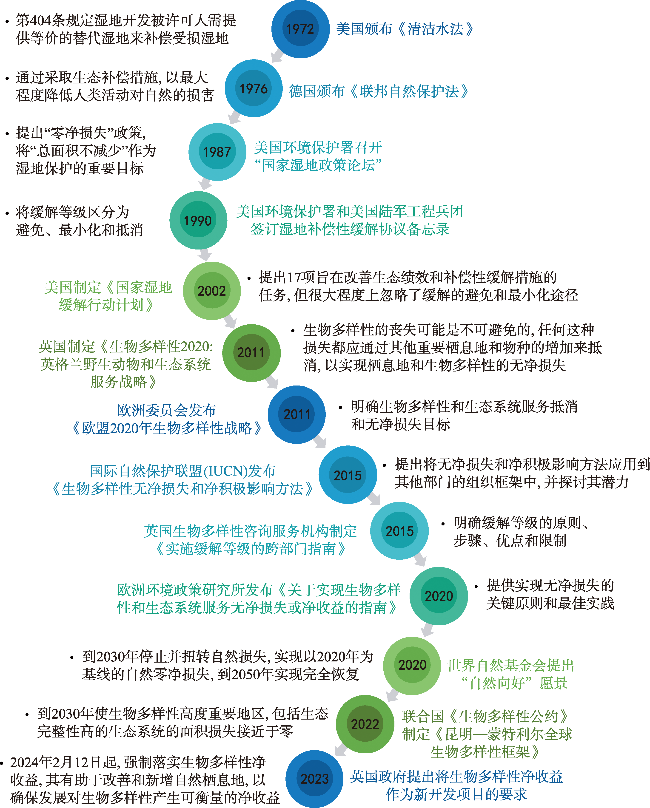
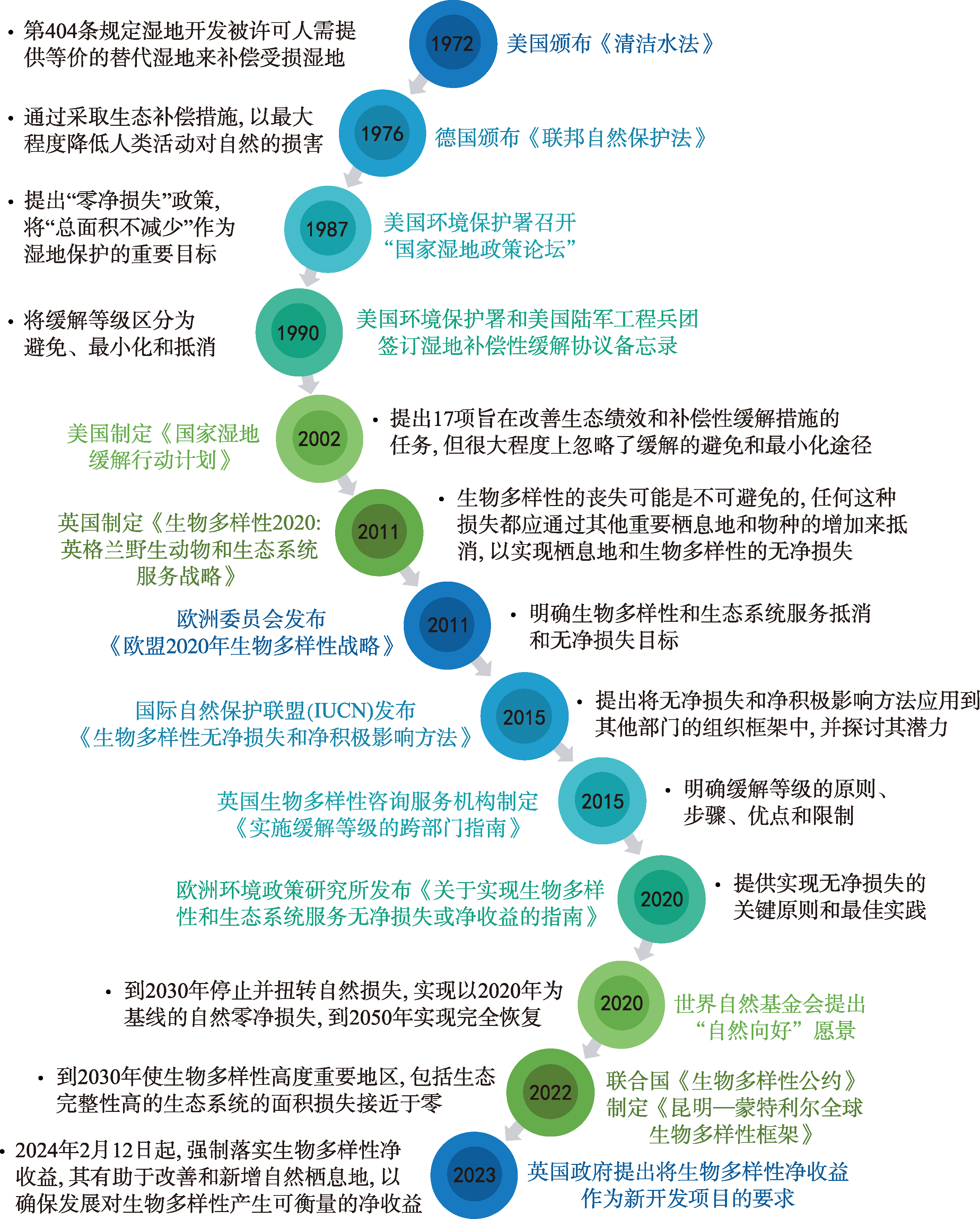
生物多样性无净损失是指在进行人类活动、开发和利用自然资源的过程中,采取措施有效管理和控制对生物多样性产生的负面影响,以确保不会导致整体生物多样性的净损失[18-19,21]。无净损失发展历程如图1所示。随着过去3个世纪全球湿地的大量流失[36],无净损失概念早期重点应用于湿地。1972年美国颁布《清洁水法》,其中第404条规定湿地开发被许可人需提供等价的替代湿地来补偿受损湿地。1976年德国颁布《联邦自然保护法》,旨在通过采取一定的补偿措施最大程度降低人类活动对自然的损害。随着欧盟委员会1985年制定《环境影响评估指令》和2001年通过《战略环境评估指令》,要求对有显著环境影响的计划和规划进行环境影响评价,生态补偿原则逐渐得到重视。1987年美国环境保护署召开“国家湿地政策论坛”,提出“零净损失”政策,将“总面积不减少”作为湿地保护的重要目标。无净损失政策于1989年首次被时任美国总统采纳,成为美国湿地保护政策的核心条例。1990年美国环境保护署和美国陆军工程兵团签订湿地补偿性缓解协议备忘录,将缓解等级分为避免、最小化和抵消。在整个20世纪80—90年代抵消几乎是缓解政策的唯一重点,并且此后一直是诸多指导文件的主题[37]。2000年以来,随着可持续发展理念的普及,全球越来越多的国家将无净损失作为环境保护政策目标。2002年美国制定《国家湿地缓解行动计划》,提出17项旨在改善生态绩效和补偿性缓解措施的任务,但很大程度上仍忽略了缓解等级中的避免和最小化途径[38]
图1 无净损失政策发展历程

Fig. 1 Development history of no net loss policy

全球湿地面积减少和质量下降与生物多样性丧失这两项挑战的解决存在共性:① 经济发展和生态保护平衡。需要平衡开发活动对于湿地和生物多样性损失影响的关系,探索可持续发展路径;② 基线确定和长期监测。量化湿地和生物多样性的损失和缓解措施的成效;③ 复杂性。湿地生态系统和生物多样性的复杂性和不可预测性使得缓解措施的设计和实施变得困难,需要采取多层次的综合保护修复策略。2010年以来全球生物多样性保护意识逐渐提升,但尽管实施了诸多努力,生物多样性丧失持续加速,生物多样性保护理论和方法亟需深化,因此无净损失逐渐应用到生物多样性保护领域[34,39 -41]。2011年英国政府制定《生物多样性2020:英格兰野生动物和生态系统服务战略》,提出生物多样性丧失可能是不可避免的,任何这种损失都应该通过其他重要物种和栖息地的增加来抵消(但不能采用常见的物种取代稀有和受威胁的物种),以实现物种栖息地和生物多样性的无净损失[39]。同年,欧洲委员会发布《欧盟2020年生物多样性战略》,明确生物多样性和生态系统服务抵消和无净损失目标[40]。2015年国际自然保护联盟(IUCN)发布《生物多样性无净损失和净积极影响方法》,提出将无净损失和净积极影响理念应用到其他部门的组织框架中,并探讨其应用潜力[34]。同年,英国生物多样性咨询服务机构制定《实施缓解等级的跨部门指南》,明确缓解等级的原则、步骤、优点和限制。2020年欧洲环境政策研究所发布《关于实现生物多样性和生态系统服务无净损失或净收益的指南》,该指南建立在《欧盟2020年生物多样性战略》基础上,提供实现无净损失的关键原则和最佳实践,目标是支持《欧盟2030年生物多样性战略》,即到2030年使欧盟生物多样性走上恢复轨道,以造福人类、气候和地球[41]。2020年世界自然基金会提出“自然向好”愿景,即到2030年通过改善物种、种群和生态系统的健康、丰度、多样性和韧性助力自然恢复,使其超过2020年的基线水平,实现2020年以来自然无净损失,到2050年完全恢复[32]。2022年《昆明—蒙特利尔全球生物多样性框架》目标1指出,到2030年使生物多样性高度重要地区,包括生态完整性高的生态系统面积损失接近于零[42]。2023年英国政府提出将生物多样性净收益作为开发项目的新要求(https://www.gov.uk/government/collections/biodiversity-net-gain)。

2.2 实现途径

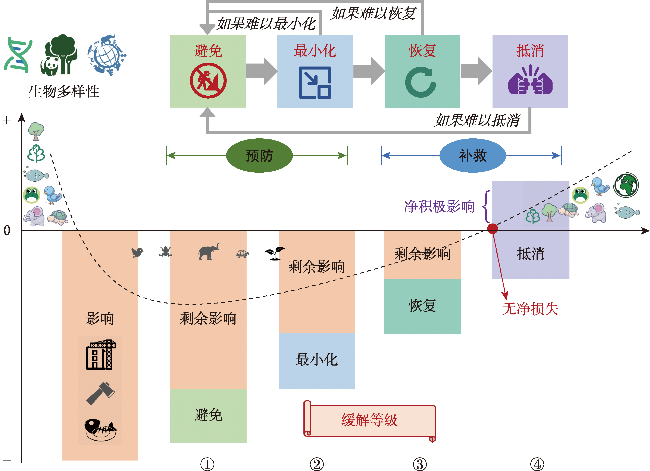
缓解等级是由避免、最小化、恢复和抵消组成的一系列途径,是公认的无净损失实现的重要框架和系统途径,其目标是在遗传、物种和生态系统层面实现生物多样性的无净损失,最好是净增加[43-44]。缓解等级不是单向的线性过程,往往需要进行步骤迭代,其实施有助于优化成本效益同时评估和管理风险[23]。实现生物多样性无净损失的缓解等级及其关联如图2所示。缓解等级逐渐转向包括所有保护和修复行动[22],最初建立在Arlidge等的提议上[14],而后被Bull等进一步发展[45]。缓解等级要求首先尽可能避免负面影响;在无法避免影响的情况下,应最大程度地减少影响;然后恢复受影响的地区;最后抵消所有剩余的影响[27,46]。相较而言,避免和最小化是预防途径,恢复和抵消为补救途径,预防途径优先于补救途径[20]。对于难以或不可能恢复或抵消的影响(如濒危物种),则必须加以避免和最小化。尽管缓解等级被广泛建议,但在应用实践中仍存在问题,例如依赖抵消但忽视避免和最小化,未来需要从生物多样性抵消走向无净损失缓解等级的有效组合[18,47 -48]。缓解等级的有效实施将有助于昆明—蒙特利尔全球生物多样性框架等的实现,其代表性具体行动和相关案例如表2所示。
图2 实现生物多样性无净损失的缓解等级及其关联

Fig. 2 Mitigation hierarchy and interrelationships in achieving no net loss of biodiversity

表2 基于缓解等级实现无净损失的生物多样性保护行动

Tab. 2 Biodiversity conservation actions based on mitigation hierarchy for no net loss

缓解等级 措施 具体行动 相关案例
避免 空间选址
时间安排
保护区设立;零毁林承诺;禁止濒危物种贸易;防止引进外来入侵物种;避开脆弱性较高的时间段 坦桑尼亚液化天然气安装设施选址:严格避免高生物多样性价值的区域;加拿大Kiggavik铀矿项目的道路选址与管理:避免道路分布对迁徙驯鹿造成影响,且在驯鹿移动或迁徙期间,道路活动将被停止或管理
最小化 物理控制
操作控制
减排控制
建设道路野生动物通道;控制或管理外来入侵物种的影响;有机和低化学投入农业;减少开发产生的噪声量、粉尘等 瑞典北部Västerbotten的金矿污染最小化:该金矿位于Natura 2000区域的集水区,为减少其环境影响,所有来自矿区的水都被收集、处理并通过分水岭输送到另一个集水区
恢复 受影响区域的生境和生物多样性重建 退化生态系统恢复;化学去污;根除外来入侵物种;物种资源补充和重新引入 意大利Agri River Valley森林和草地恢复:保留受干扰地区的表土或从附近参照系统获取表土,选用本地种子重新播种,管理外来入侵物种
抵消 受影响区域以外的保护和恢复 保护区扩张;生物多样性损失区域以外开展保护和修复行动 澳大利亚塔斯马尼亚州和维多利亚州间的电缆工程生态影响抵消:受影响的地点位于国家森林特别保护区内,在与项目主要影响地点相邻的具有类似但退化植被的区域,进行恢复、维护和改善栖息地

2.2.1 避免

避免是在采取可能导致负面影响的决定或行动之前,在调整项目选址和基础设施位置仍然可行的项目规划阶段采取的措施,以完全避免对生物多样性产生负面影响[43]。避免途径被广泛认为是缓解等级中最重要但尚未得到充分研究的途径[24]。避免一方面是空间避免,明确生物多样性丰富区域和确定替代地点;另一方面是时间避免,识别和避开脆弱性较高的时间段[24]。避免途径存在以下优点:① 避免途径在缓解等级中往往最具成本效益,且成功概率高;② 避免途径是一次性的,无须持续进行;③ 对于一些不可替代的生物多样性(如古老森林、当地特有物种),避免途径是唯一选择。但是也存在一些限制和挑战[23]:① 避免决策有时在商业和政治上是保密的,因此不能有效地传达给大多数利益相关者;② 避免行动有时可能成本较大,如放弃采矿以避免影响、选择替代项目带来的额外基础设施成本等,此时需要成本效益分析来判定避免途径是否可行。

2.2.2 最小化

最小化途径是采取措施减少无法完全避免的影响的持续时间、强度和范围[43]。最小化和避免是密切相关的,如果难以避免,则应采用最小化途径将影响降至最低[22]。如重新规划道路以完全避开动物迁徙路线,为避免途径;而在迁徙季节控制车辆的移动,以减少动物死亡率和提升景观连通,则为最小化途径。最小化途径可大致分为3大类(尽管可能重叠)[23]:① 物理控制,调整项目基础设施的物理设计,以减少潜在影响,例如给道路建设野生动物通道;② 操作控制,管理和规范操作人员的行为,例如减少钻井建设造成的土壤洒落、减少捕杀野生动物;③ 减排控制,降低环境干扰(如减少开发产生的噪声量、粉尘)或设置屏障阻隔干扰。最小化途径存在以下优点:① 对于部分利益相关者来说,最小化努力可能比避免途径更具体和可行;② 在整个项目周期中,可以适应性地规划和实施最小化途径。但也存在一些限制,与避免途径相比,最小化途径通常只能部分减轻影响,且有效性往往并不能充分保障。

2.2.3 恢复

恢复是在遭受无法完全避免和尽量减少影响后,为恢复退化生态系统而在受影响区域开展的补救途径[43]。与避免和最小化途径相比,恢复途径更易衡量收益,但是通常更具挑战性和不确定性,成本效益可能不佳,且可能需要长期管理干预。确定恢复目标时需要考虑时间维度和空间维度,综合纳入历史生态状况、成本、利益相关者的期望、生物群落和气候本底及其变化等因素[49-50]。生物多样性恢复行动是阻止生态系统退化和扭转生物多样性下降趋势的有效措施。近些年国际机构和政府发起了多项大规模的生物多样性和生态系统恢复优先事项,例如欧盟2030年生物多样性战略和联合国生态系统恢复十年(2021—2030)等[51]。较多研究基于生境退化识别恢复区域[25],有研究基于自然保护区、关键生物多样性区域、生态完整区域识别全球生物多样性保护规模阈值[52];也有研究基于哺乳动物、两栖动物和鸟类灭绝风险等标准,识别生物多样性恢复优先区域,并量化生态系统恢复对于灭绝债务减少的贡献[26]

2.2.4 抵消

抵消是在采取适当的预防和补救途径后,为抵消项目开发产生的剩余生物多样性不利影响而在受影响区域以外采取的补救行动[48,53 -54]。生物多样性抵消的核心是,首先衡量因发展而损失的生物多样性和通过抵消而获得的生物多样性,其次平衡此生物多样性增减,以确定是否达到无净损失[55-56]。抵消具有多样性,包括保护抵消和恢复抵消[23],其适宜性和成功率受到避免、最小化和恢复等途径实施程度的影响。抵消具有以下核心原则:① 限制性。并非所有影响均可抵消,相对可抵消性取决于对受影响生物多样性的保护关注、剩余影响程度、适宜抵消机会,以及实施抵消的可行性[57];② 附加性。抵消带来的生物多样性收益是一切照旧情景的附加;③ 等效性。取得的生物多样性收益与项目造成剩余损失相当;④ 持久性。所取得的生物多样性收益是持久的,能够避免失败风险[27,34,58]。需要注意的是,补偿和抵消经常混用,但抵消是补偿的子集,即并不是所有的补偿行动都是抵消行动[30]

3 生物多样性无净损失的判定标准与成效评估

无净损失的判定标准很大程度上影响成效评估,大致可以分为固定参照基准和动态参照基准。此外,生物多样性损失和增加在空间、时间和类型等方面均具有较强的灵活性,生物多样性衡量指标也是无净损失是否实现的决定性因素。生物多样性无净损失政策的成效评估方法包括统计匹配和回归模型等。现有无净损失政策的成效评估常采用基于面积的测量方法,但因缺少基于物种的生物多样性表征而广受批评。

3.1 判定标准

与什么场景相比是无净损失的?参照基线的选择对于成效评估毫无疑问具有至关重要的作用[59]。未指定参照基线的政策目标并不明确,然而在实践中参照基线很少被阐明[60-61]。如果没有明确的参照基线,那么“无净损失”一词便毫无意义[18,60,62];必须从科学层面明确无净损失参照基线的定义和内涵。由于无净损失是为弥补人类活动造成的生物多样性丧失,因此参照基准的确定首先需要厘清人类活动和气候变化对生物多样性丧失的贡献程度,可以基于统计方法、对照试验或情景模拟来定量区分人为、自然贡献[63-64]。事实上,很少有政策或研究将无净损失解释为相对于影响之前没有生物多样性损失,而通常解释为维持某种假定的“背景”衰退轨迹[60]
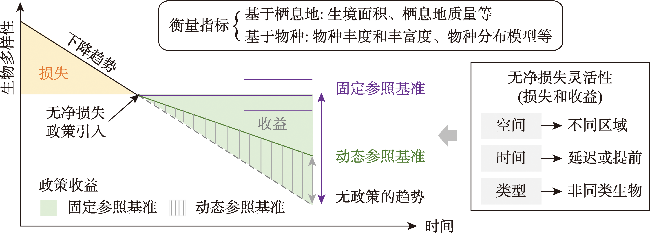
总的来说,生物多样性无净损失参照基线可以是固定的,也可以是动态的(图3[18]:① 固定参照基线,是指相对于一个固定值是无净损失的,该固定值可以高于、等于或低于当前状态。一方面,在时间上依据历史重要节点或历史最优原则选取历史参照系统。如联合国政府间气候变化专门委员会(IPCC)将工业革命(人类影响生态系统的重要时间节点)前参照系统作为历史参照系统,评估工业革命以来的全球气候变化和生物多样性丧失[65]。历史知识发挥提供信息和参考、丰富文化联系和揭示未来的作用,应将历史状态作为指南而不是模板[66];另一方面,在空间上依据相邻和相似原则,识别相同水热条件的未受人类干扰的生物多样性较高的当代参照系统[31,63]。但固定参照基准也存在挑战,主要是由于使用固定状态作为目标,虽然可以提高环境衰退终点的确定性,但忽视了即使没有人类干扰生物多样性本身也会随时间发生变化这一事实。② 动态参照基线,在固定参照基准的基础上纳入自然状态下生物多样性动态变化趋势。动态参照基准是指随时间变化的相对于没有生物多样性干预措施的情况下系统可能出现的轨迹,又被称为反事实情景。反事实情景是衡量收益和损失的决定性因素,对比该情景和现实情况,可以估计人类活动影响地点的可能损失和生态保护修复工程地点的预期收益[67]。近年来,反事实情景逐渐受到更多关注[18,60,67]。动态参照基准存在以下挑战:如果以生物多样性下降的背景速度为前提,放缓其下降速度以产生所需的生物多样性收益,但生物多样性的损失仍在发生[21];选择参照基准需要对未来的变化做出合理且细致的预测;同时,动态参照基准可能在空间上、不同生物群落之间以及随着时间的推移等方面存在较大差异[18]。需要明确的是,固定和动态参照基准均具有时间、空间和类型灵活性以及指标多维性的共同特征。
图3 生物多样性无净损失判定标准

Fig. 3 Judgment criteria for no net loss of biodiversity

具体而言,无净损失参照基准的灵活性体现在生物多样性的损失和收益在空间上和时间上是分开的,而且生物多样性类型也可能不同:① 空间上的灵活性表现在不同区域的损失和收益缓解,生物多样性的压力不可能在所有地方完全消除,某些地方的生物多样性可能依然在下降,但可以通过在其他地方获得生物多样性收益,达到整体收支平衡(无净损失)或增加(净增益)[68];② 时间上的灵活性表现在相对于开发延迟或提前缓解。允许通过未来承诺的生物多样性收益来抵消现在的影响,比如在英国拟议的生物多样性净收益政策中,收益可以在未来长达32 a内提供[69]。但人们普遍认为,与未来通过长期规划的恢复行动所承诺的结果相比,在开发造成生物多样性丧失之前就实现生物多样性增益更有可能实现无净损失[70];此外,损失和缓解均在时间上是累积的,因此可以基于生物多样性变化曲线下面积计算缓解的累积成效,从而进行动态缓解以实现无净损失[71]。但目前缓解生物多样性丧失的行动仍然忽视累积影响;③ 类型上的灵活性表现在非同类缓解[68]。但对于不可替代的和濒危的物种和生态系统,在面临不可逆转的生物多样性丧失或损失程度超出可接受范围的情况下,要求无损失,而不是无净损失,需要严格保护,避免意外替代[72]
在指标多维性方面,全球生物多样性衡量指标存在差异,这也带来另一个推进无净损失面临的难题,即大多数制定无净损失政策的国家并没有很好地掌握生物多样性的量化方法[73]。生物多样性指标的不一致和不明确,以及无净损失政策实施地点的监测和合规性不足,是生物多样性无净损失目标失效的重要原因[74]。生物多样性评估通常采用基于栖息地或基于物种的方法;具体而言,基于栖息地的方法通常依赖于栖息地面积和质量、景观连通性[75-76]、植被组成、生态系统服务或遥感指标[77]等来计算损失和收益;基于物种的方法倾向于关注物种丰度和丰富度(多为动物或植物)[78-79]。过去,政策主要侧重于评估栖息地特征和条件以量化生物多样性,通过受影响的栖息地特征变化来代表关键物种或群落的变化[28,80];由于生态系统服务、植被生产力等栖息地指标比物种数据更易获取和量化评估,常常被选取作为它们所支持的物种和群落的替代指标[77,81]。但越来越多的研究表明,使用基于栖息地的生物多样性指标通常无法有效捕捉发展影响,特别是对物种和群落的影响,因此必须更明确地采用物种数据[74,80,82]。例如,Xu等研究发现2000—2015年中国新增湿地2.76万km2、丧失湿地2.61万km2,总面积净增加了0.15万km2,但生物多样性却在下降,说明不能仅仅满足于“总面积不减少”的成效,要将类型、质量和功能均作为重要衡量指标[83]

3.2 成效评估

面对持续的生物多样性危机,生物多样性无净损失政策对生物多样性保护的贡献成效受到关注。2018年的一项调查发现,全球大约开展了1.3万个生物多样性抵消项目,总面积约15万km2,主要集中在北美、西欧和澳大利亚[29]。然而到目前为止,生物多样性无净损失政策有效性的证据仍较少,监测和评估无净损失成效始终存在困难,重要挑战是大多数度量方法不可靠且缺乏数据来确认无净损失是否实现[48,84 -85]。目前无净损失目标在林地几乎没有实现,在湿地的成功率较高,原因主要为湿地具有较强的自净和自我恢复能力,且湿地政策实施时间较久[86]。尽管截至2019年,100多个国家制定或实施了生物多样性抵消政策,但只有9个国家整理了公共抵消登记册,还都不包含完整的全国覆盖范围,这表明在透明公开的文件记录和信息报告方面存在较大不足,而这对于评估生物多样性抵消和无净损失有效性至关重要[87]
大约1/3的无净损失政策和研究实现了无净损失,尽管大多数研究使用了广受批评的基于区域面积的度量方法;最常见的度量方法是使用高补偿率,即采用比受影响区域更大的面积来抵消影响[86]。目前较多研究逐渐采用“栖息地条件×面积”评估生物多样性保护成效[68,88],未来需要将基于物种的生物多样性表征指标纳入成效评估体系。在评估无净损失政策成效时,明确定义反事实情景至关重要,并将政策实施区和对照区的生物多样性指标进行统计匹配和回归模型建立[89-91]。例如,zu Ermgassen等使用反事实方法评估了澳大利亚维多利亚州生物多样性抵消政策对原生植被的影响,结果表明抵消区域比非抵消区域每年增加1.9%~3.6%的木本植被范围[89];Devenish等使用统计匹配和固定效应回归评估了马达加斯加最大矿山的生物多样性抵消政策有效性,并检验其稳健性,结果表明相关的抵消有望成功实现森林的无净损失[91];Gibbons等使用反事实方法评估了澳大利亚新南威尔士州引入生物多样性抵消政策前后开发地点和抵消地点原生植被面积和质量的损失、收益,结果表明预计抵消政策(每批准清除1 hm2的原生植被,承诺建立3.8 hm2的生物多样性抵消)将在146 a后实现原生植被面积无净损失目标,其中82%的总面积抵消计划通过避免对现有原生植被的损失来获得,该研究证明了通过避免损失来抵消所获得的生物多样性收益很容易被夸大[92]。在量化缓解等级各途径对实现无净损失目标的贡献方面,Kosma等对比了避免、最小化和抵消3种途径对栖息地连通性的贡献,结果发现减轻城市发展负面影响的最有效方案是避免途径,其次是抵消途径[76]

4 生物多样性无净损失研究展望

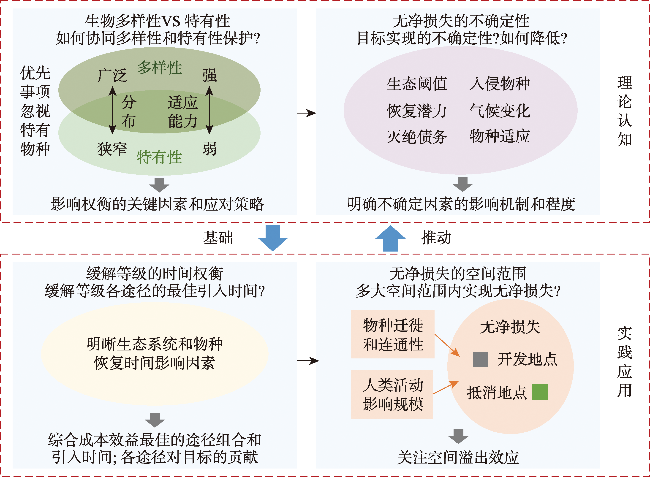
生物多样性无净损失是无损失退而求其次的目标。本文在系统梳理生物多样性无净损失发展历程的基础上,明确无净损失实现的缓解等级,并归纳无净损失是否实现的判定标准及其成效评估进展。未来需要进一步从理论认知方面考量生物多样性和特有性的协同保护以及目标实现存在的不确定性,同时从实践应用方面探讨缓解等级的时间权衡以及无净损失实现的空间范围(图4)。理论与实践两个方面相互联系,即理论认知作为实践应用的基础,反过来实践应用推动理论认知,从而深入推进生物多样性无净损失目标制定和实现的科学性、可行性。
图4 生物多样性无净损失研究展望

Fig. 4 Research prospects of no net loss of biodiversity

4.1 生物多样性和特有性的协同保护

不同物种和生态系统发挥不同的生态角色和功能,更高的生物多样性通常与更强的生态系统稳定性相关联[93-94]。特有物种通常生存在相对独特的生态位,对环境变化较为敏感,适应性较弱,可能更容易受到外部胁迫威胁[95]。生物多样性为特有性的形成和维持提供了基础,反过来保护特定区域的特有物种和独特生态系统有助于维护全球生物多样性和生态系统稳定性,但有时却不得不需要以牺牲部分多样性为代价来保护特有物种和独特生态系统。研究发现全球物种丰富度与特有度之间的相关性较低,仅基于丰富度的全球保护优先事项往往忽略特有物种[96]。此外,有必要结合食物网分析、资源利用分析、生态系统韧性分析等方法明晰生态系统中关键种、优势种和一般物种等的重要程度及其关联,促进物种共存[97]。维护生态系统整体健康和稳定需要同时保护生物多样性和特有性,综合考虑生态系统多物种之间的关系和物种保护重要程度,识别和确定保护修复优先区域,追求综合效益最大化[63]。未来需要进一步关注影响生物多样性和特有性协同关系的关键因素以及相应保护、修复和适应策略,以实现无净损失目标。

4.2 无净损失目标实现的不确定性

明确并管控加剧生物多样性无净损失目标失败风险的不确定性因素有助于增强保护效果并降低后期维护成本,是减缓生物多样性下降趋势的有效且可持续途径。无净损失目标实现的可能性受到生态系统和人类活动的相互作用和反馈机制的影响,如生态阈值、恢复潜力和灭绝债务[68]。此外,无净损失目标的实现可能受到物种间竞争和入侵物种的影响,这些因素会改变生态系统结构和功能,从而增加对目标实现的不确定性;最后,气候变化对物种分布范围和相互作用的影响以及物种对气候变化的适应能力也是目标失败风险的重要影响因素[98-99]。需要说明的是,以生物多样性为目标和以生态系统服务为目标的无净损失政策之间在部分地区可能存在权衡[100]。当地自然条件(如土地适宜性)和政策设计(如实施和遵守)及其相互作用是无净损失目标能否实现的决定性因素[101]。未来需要进一步明确不确定因素对于生物多样性无净损失目标实现的影响机制和程度,以及探索降低失败风险的途径。

4.3 生物多样性无净损失的时间权衡

时间权衡是指在有限的时间内,有效地安排和管理优先事项,以实现无净损失目标。实现无净损失需要遵循缓解等级,以降低成本,但引入各途径的最佳时间点尚未达成共识[102]。进行时间权衡首先需要明确复杂而长期的生物多样性无净损失目标,其次需要商定在规定时间内实现目标的一系列行动,制定明确的目标实现时间表将有助于利益相关者管理和降低生物多样性丧失风险[58,103]。有研究基于灭绝、定殖、物种形成的自然进化速率,估算出蝙蝠从现在的数量恢复到人类存在之前的数量需要160万a,而非飞行哺乳动物需要290万a[104]。生态系统和物种恢复所需的时间范围存在很大差异,受到物种生长速度和适应能力、起始状态、参照条件、社会—生态环境和全球变化等多因素影响,大致划分为短期(< 20 a)、中期(20~100 a)、长期(100~300 a)和永久(≥ 300 a)4大类[19],且物种变化往往滞后于栖息地变化[105]。未来需要进一步探索综合成本效益最佳的生物多样性无净损失实现途径的组合和引入时间,并明确各途径对生物多样性无净损失目标实现的贡献和潜力。

4.4 生物多样性无净损失的空间范围

决定生物多样性无净损失的空间范围涉及多种因素,包括生态系统特征、物种迁徙和连通性,以及人类活动的影响规模等。不同类型的生态系统具有不同的栖息地环境和物种组成,景观结构和功能影响生物多样性分布和维持;对于依赖于连通景观的迁徙物种,需要考虑跨越多个地理区域的无净损失;不同类型和强度的人类活动在不同范围内对生物多样性产生重大影响,因此区域无净损失目标的制定需要与涉及的人类活动影响规模相匹配。当前需要重点解决的关键问题是潜在抵消地点的确定,可以将其选择在受影响地点附近的区域(确保同一地区获得收益),或可能提供最佳保护收益的区域(较少考虑空间距离)。如Marxan算法基于成本函数确定潜在抵消地点的选址和规模[46]。此外,全球无净损失目标需考虑人类发展指数以公平地转化为国家级目标[106]。未来需要进一步关注生物多样性无净损失的空间溢出效应,无净损失政策的实施可能会对实施区域以外的生物多样性产生意外的正面或负面影响[107-108]
[1]
Brondizio E S, Settele J, Díaz S, et al. Global assessment report on biodiversity and ecosystem services of the Intergovernmental Science-Policy Platform on Biodiversity and Ecosystem Services. Bonn: IPBES Secretariat, 2019.

[2]
Exposito-Alonso M, Booker T R, Czech L, et al. Genetic diversity loss in the Anthropocene. Science, 2022, 377(6613): 1431-1435.

DOI PMID

[3]
Pimm S L, Jenkins C N, Abell R, et al. The biodiversity of species and their rates of extinction, distribution, and protection. Science, 2014, 344(6187): 1246752. DOI: 10.1126/science.1246752.

[4]
Cox N, Young B E, Bowles P, et al. A global reptile assessment highlights shared conservation needs of tetrapods. Nature, 2022, 605: 285-290.

[5]
Johnson C N, Balmford A, Brook B W, et al. Biodiversity losses and conservation responses in the Anthropocene. Science, 2017, 356(6335): 270-275.

DOI PMID

[6]
Steffen W, Richardson K, Rockström J, et al. Planetary boundaries: Guiding human development on a changing planet. Science, 2015, 347(6223): 1259855. DOI: 10.1126/science.1259855.

[7]
Rockström J, Steffen W, Noone K, et al. A safe operating space for humanity. Nature, 2009, 461: 472-475.

[8]
Maxwell S L, Fuller R A, Brooks T M, et al. Biodiversity: The ravages of guns, nets and bulldozers. Nature, 2016, 536: 143-145.

[9]
Liang D, Giam X, Hu S F, et al. Assessing the illegal hunting of native wildlife in China. Nature, 2023, 623: 100-105.

[10]
Leclère D, Obersteiner M, Barrett M, et al. Bending the curve of terrestrial biodiversity needs an integrated strategy. Nature, 2020, 585: 551-556.

[11]
Obura D O, Katerere Y, Mayet M, et al. Integrate biodiversity targets from local to global levels. Science, 2021, 373(6556): 746-748.

DOI PMID

[12]
Hahn T, Koh N S, Elmqvist T. No net loss of biodiversity, green growth, and the need to address drivers. One Earth, 2022, 5(6): 612-614.

[13]
Convention on Biological Diversity. The strategic plan for biodiversity 2011-2020 and the Aichi biodiversity targets. 2010.

[14]
Arlidge W N S, Bull J W, Addison P F E, et al. A global mitigation hierarchy for nature conservation. BioScience, 2018, 68(5): 336-347.

DOI PMID

[15]
Butchart S H M, Walpole M, Collen B, et al. Global biodiversity: Indicators of recent declines. Science, 2010, 328(5982): 1164-1168.

DOI PMID

[16]
Secretariat of the Convention on Biological Diversity. Global Biodiversity Outlook 5: Summary for Policymakers. 2020.

[17]
United Nations. The Sustainable Development Goals Report 2023:Special edition. 2023.

[18]
Maron M, Brownlie S, Bull J W, et al. The many meanings of no net loss in environmental policy. Nature Sustainability, 2018, 1: 19-27.

[19]
Damiens F L P, Backstrom A, Gordon A. Governing for "no net loss" of biodiversity over the long term: Challenges and pathways forward. One Earth, 2021, 4(1): 60-74.

[20]
zu Ermgassen S O S E, Utamiputri P, Bennun L, et al. The role of "no net loss" policies in conserving biodiversity threatened by the global infrastructure boom. One Earth, 2019, 1(3): 305-315.

[21]
Bull J W, Gordon A, Watson J E M, et al. Seeking convergence on the key concepts in 'no net loss' policy. Journal of Applied Ecology, 2016, 53(6): 1686-1693.

[22]
Milner-Gulland E J, Addison P, Arlidge W N S, et al. Four steps for the earth: Mainstreaming the post-2020 global biodiversity framework. One Earth, 2021, 4(1): 75-87.

[23]
The Biodiversity Consultancy. A Cross-sector Guide for Implementing the Mitigation Hierarchy. 2015.

[24]
Phalan B, Hayes G, Brooks S, et al. Avoiding impacts on biodiversity through strengthening the first stage of the mitigation hierarchy. Oryx, 2018, 52(2): 316-324.

[25]
Tedesco A M, López-Cubillos S, Chazdon R, et al. Beyond ecology: Ecosystem restoration as a process for social-ecological transformation. Trends in Ecology & Evolution, 2023, 38(7): 643-653.

[26]
Strassburg B B N, Iribarrem A, Beyer H L, et al. Global priority areas for ecosystem restoration. Nature, 2020, 586: 724-729.

[27]
Gardner T A, Von Hase A, Brownlie S, et al. Biodiversity offsets and the challenge of achieving no net loss. Conservation Biology, 2013, 27(6): 1254-1264.

DOI PMID

[28]
Maron M, Hobbs R J, Moilanen A, et al. Faustian bargains? Restoration realities in the context of biodiversity offset policies. Biological Conservation, 2012, 155: 141-148.

[29]
Bull J W, Strange N. The global extent of biodiversity offset implementation under no net loss policies. Nature Sustainability, 2018, 1: 790-798.

[30]
Pope J, Morrison-Saunders A, Bond A, et al. When is an offset not an offset? A framework of necessary conditions for biodiversity offsets. Environmental Management, 2021, 67: 424-435.

DOI PMID

[31]
McNellie M J, Oliver I, Dorrough J, et al. Reference state and benchmark concepts for better biodiversity conservation in contemporary ecosystems. Global Change Biology, 2020, 26(12): 6702-6714.

DOI PMID

[32]
Nature Positive Initiative. The Definition of Nature Positive. 2023.

[33]
Maron M, Quétier F, Sarmiento M, et al. 'Nature positive' must incorporate, not undermine, the mitigation hierarchy. Nature Ecology & Evolution, 2024, 8: 14-17.

[34]
Aima D, Edwards S, Bos G, et al. No net loss and net positive impact approaches for biodiversity: Exploring the potential application of these approaches in the commercial agriculture and forestry sectors. Gland: IUCN, 2015.

[35]
NPI Alliance. Net Positive Impact on Biodiversity: The Conservation Case. Gland, Switzerland: IUCN. 2015.

[36]
Fluet-Chouinard E, Stocker B D, Zhang Z, et al. Extensive global wetland loss over the past three centuries. Nature, 2023, 614: 281-286.

[37]
Hough P, Robertson M. Mitigation under Section 404 of the Clean Water Act: Where it comes from, what it means. Wetlands Ecology and Management, 2009, 17: 15-33.

[38]
The US Army Corps of Engineers (Corps), the Environmental Protection Agency (EPA). National Wetlands Mitigation Action Plan. 2002.

[39]
Department for Environment Food and Rural Affairs. Biodiversity 2020: A Strategy for England's Wildlife and Ecosystem Services. 2010.

[40]
European Commission. Our Life Insurance, Our Natural Capital: An EU Biodiversity Strategy to 2020. 2011.

[41]
Tucker G, Quétier F, Wende W. Guidance on Achieving No Net Loss or Net Gain of Biodiversity and Ecosystem Services. Report to the European Commission, DG Environment on Contract ENV.B.2/SER/2016/0018, Institute for European Environmental Policy, Brussels, 2020.

[42]
Convention on Biological Diversity. Kunming-montreal global biodiversity framework draft decision submitted by the president. 2022.

[43]
Business and Biodiversity Offsets Programme. Standard on Biodiversity Offsets. Washington D.C., 2012.

[44]
Weissgerber M, Roturier S, Julliard R, et al. Biodiversity offsetting: Certainty of the net loss but uncertainty of the net gain. Biological Conservation, 2019, 237: 200-208.

DOI

[45]
Bull J W, Milner-Gulland E J, Addison P F E, et al. Net positive outcomes for nature. Nature Ecology & Evolution, 2019, 4: 4-7.

[46]
Kiesecker J M, Copeland H, Pocewicz A, et al. A framework for implementing biodiversity offsets: Selecting sites and determining scale. BioScience, 2009, 59(1): 77-84.

[47]
Bull J W, Suttle K B, Gordon A, et al. Biodiversity offsets in theory and practice. Oryx, 2013, 47(3): 369-380.

[48]
Maron M, von Hase A, Quétier F, et al. Biodiversity offsets, their effectiveness and their role in a nature positive future. Nature Reviews Biodiversity, 2025, 1: 183-196.

[49]
Peng J, Tang H, Su C, et al. Regarding reference state to identify priority areas for ecological restoration in a Karst region. Journal of Environmental Management, 2023, 348: 119214. DOI: 10.1016/j.jenvman.2023.119214.

[50]
Shackelford N, Dudney J, Stueber M M, et al. Measuring at all scales: Sourcing data for more flexible restoration references. Restoration Ecology, 2024, 32(8): e13541. DOI: 10.1111/rec.13541.

[51]
Gann G D, McDonald T, Walder B, et al. International principles and standards for the practice of ecological restoration. Second edition. Restoration Ecology, 2019, 27(S1): S1-S46.

[52]
Allan J R, Possingham H P, Atkinson S C, et al. The minimum land area requiring conservation attention to safeguard biodiversity. Science, 2022, 376(6597): 1094-1101.

DOI PMID

[53]
Moilanen A, Kotiaho J S. Three ways to deliver a net positive impact with biodiversity offsets. Conservation Biology, 2021, 35(1): 197-205.

[54]
Moilanen A, Kotiaho J S. Fifteen operationally important decisions in the planning of biodiversity offsets. Biological Conservation, 2018, 227: 112-120.

[55]
Sonter L J, Gordon A, Archibald C, et al. Offsetting impacts of development on biodiversity and ecosystem services. Ambio, 2020, 49: 892-902.

DOI PMID

[56]
Maseyk F J F, Barea L P, Stephens R T T, et al. A disaggregated biodiversity offset accounting model to improve estimation of ecological equivalency and no net loss. Biological Conservation, 2016, 204: 322-332.

[57]
Pilgrim J D, Brownlie S, Ekstrom J M M, et al. A process for assessing the offsetability of biodiversity impacts. Conservation Letters, 2013, 6(5): 376-384.

[58]
McKenney B A, Kiesecker J M. Policy development for biodiversity offsets: A review of offset frameworks. Environmental Management, 2010, 45: 165-176.

DOI PMID

[59]
Liersch S, Drews M, Pilz T, et al. One simulation, different conclusions. The baseline period makes the difference. Environmental Research Letters, 2020, 15: 104014. DOI: 10.1088/1748-9326/aba3d7.

[60]
Maron M, Bull J W, Evans M C, et al. Locking in loss: Baselines of decline in Australian biodiversity offset policies. Biological Conservation, 2015, 192: 504-512.

[61]
Bull J W, Gordon A, Law E A, et al. Importance of baseline specification in evaluating conservation interventions and achieving no net loss of biodiversity. Conservation Biology, 2014, 28(3): 799-809.

PMID

[62]
Maron M, Ives C D, Kujala H, et al. Taming a wicked problem: Resolving controversies in biodiversity offsetting. BioScience, 2016, 66(6): 489-498.

[63]
Peng J, Xu D M, Xu Z H, et al. Ten key issues for ecological restoration of territorial space. National Science Review, 2024, 11(7): nwae176. DOI: 10.1093/nsr/nwae176.

[64]
Burrell A L, Evans J P, De Kauwe M G. Anthropogenic climate change has driven over 5 million km2 of drylands towards desertification. Nature Communications, 2020, 11: 3853. DOI: 10.1038/s41467-020-17710-7.

PMID

[65]
IPCC. Climate Change 2022:Impacts, Adaptation and Vulnerability. Contribution of Working Group II to the Sixth Assessment Report of the Intergovernmental Panel on Climate Change. Cambridge and New York: Cambridge University Press, 2022. DOI:10.1017/9781009325844.

[66]
Higgs E, Falk DA, Guerrini A, et al. The changing role of history in restoration ecology. Frontiers in Ecology and the Environment, 2014, 12(9): 499-506.

[67]
Bull J W, Strange N, Smith R J, et al. Reconciling multiple counterfactuals when evaluating biodiversity conservation impact in social-ecological systems. Conservation Biology, 2021, 35(2): 510-521.

[68]
Bull J W, Hardy M J, Moilanen A, et al. Categories of flexibility in biodiversity offsetting, and their implications for conservation. Biological Conservation, 2015, 192: 522-532.

[69]
Crosher I, Gold S, Heaver M, et al. The biodiversity metric 2.0: Auditing and accounting for biodiversity value. 2019.

[70]
zu Ermgassen S O S E, Maron M, Walker C M C, et al. The hidden biodiversity risks of increasing flexibility in biodiversity offset trades. Biological Conservation, 2020, 252: 108861. DOI: 10.1016/j.biocon.2020.108861.

[71]
Bendor T. A dynamic analysis of the wetland mitigation process and its effects on no net loss policy. Landscape and Urban Planning, 2009, 89(1/2): 17-27.

[72]
Maron M, Juffe-Bignoli D, Krueger L, et al. Setting robust biodiversity goals. Conservation Letters, 2021, 14(5): e12816. DOI: 10.1111/conl.12816.

[73]
Marshall E, Southwell D, Wintle B A, et al. A global analysis reveals a collective gap in the transparency of offset policies and how biodiversity is measured. Conservation Letters, 2024, 17(1): e12987. DOI: 10.1111/conl.12987.

[74]
Marshall E, Valavi R, O'Connor L, et al. Quantifying the impact of vegetation-based metrics on species persistence when choosing offsets for habitat destruction. Conservation Biology, 2021, 35(2): 567-577.

[75]
Tarabon S, Calvet C, Delbar V, et al. Integrating a landscape connectivity approach into mitigation hierarchy planning by anticipating urban dynamics. Landscape and Urban Planning, 2020, 202: 103871. DOI: 10.1016/j.landurbplan.2020.103871.

[76]
Kosma M, Laita A, Duflot R. No net loss of connectivity: Conserving habitat networks in the context of urban expansion. Landscape and Urban Planning, 2023, 239: 104847. DOI: 10.1016/j.landurbplan.2023.104847.

[77]
Skidmore A K, Coops N C, Neinavaz E, et al. Priority list of biodiversity metrics to observe from space. Nature Ecology & Evolution, 2021, 5: 896-906.

[78]
Business and Biodiversity Offsets Programme. Resource Paper:No Net Loss and Loss-gain Calculations in Biodiversity Offsets. Washington DC, 2009.

[79]
Gamarra M J C, Lassoie J P, Milder J. Accounting for no net loss: A critical assessment of biodiversity offsetting metrics and methods. Journal of Environmental Management, 2018, 220: 36-43.

DOI PMID

[80]
Cristescu R H, Rhodes J, Frére C, et al. Is restoring flora the same as restoring fauna? Lessons learned from koalas and mining rehabilitation. Journal of Applied Ecology, 2013, 50(2): 423-431.

[81]
Schmeller D S, Weatherdon L V, Loyau A, et al. A suite of essential biodiversity variables for detecting critical biodiversity change. Biological Reviews, 2018, 93(1): 55-71.

[82]
Marshall E, Visintin C, Valavi R, et al. Integrating species metrics into biodiversity offsetting calculations to improve long-term persistence. Journal of Applied Ecology, 2022, 59(4): 1060-1071.

[83]
Xu W H, Fan X Y, Ma J G, et al. Hidden loss of wetlands in China. Current Biology, 2019, 29(18): 3065-3071.

DOI PMID

[84]
Droste N, Olsson J A, Hanson H, et al. A global overview of biodiversity offsetting governance. Journal of Environmental Management, 2022, 316: 115231. DOI: 10.1016/j.jenvman.2022.115231.

[85]
May J, Hobbs R J, Valentine L E. Are offsets effective? An evaluation of recent environmental offsets in Western Australia. Biological Conservation, 2017, 206: 249-257.

[86]
zu Ermgassen S O S E, Baker J, Griffiths R A, et al. The ecological outcomes of biodiversity offsets under "no net loss" policies: A global review. Conservation Letters, 2019, 12: e12664. DOI: 10.1111/conl.12664.

[87]
Kujala H, Maron M, Kennedy C M, et al. Credible biodiversity offsetting needs public national registers to confirm no net loss. One Earth, 2022, 5(6): 650-662.

[88]
Bull J W, Milner-Gulland E J, Suttle K B, et al. Comparing biodiversity offset calculation methods with a case study in Uzbekistan. Biological Conservation, 2014, 178: 2-10.

[89]
zu Ermgassen S O S E, Devenish K, Simmons B A, et al. Evaluating the impact of biodiversity offsetting on native vegetation. Global Change Biology, 2023, 29(15): 4397-4411.

DOI PMID

[90]
Sonter L J, Barnes M, Matthews J W, et al. Quantifying habitat losses and gains made by U.S. Species Conservation Banks to improve compensation policies and avoid perverse outcomes. Conservation Letters, 2019, 12(3): e12629. DOI: 10.1111/conl.12629.

[91]
Devenish K, Desbureaux S, Willcock S, et al. On track to achieve no net loss of forest at Madagascar's biggest mine. Nature Sustainability, 2022, 5: 498-508.

[92]
Gibbons P, MacIntosh A, Constable A L, et al. Outcomes from 10 years of biodiversity offsetting. Global Change Biology, 2018, 24(2): e643-e654.

[93]
Zhang R Y, Tian D S, Wang J S, et al. Critical role of multidimensional biodiversity in contributing to ecosystem sustainability under global change. Geography and Sustainability, 2023, 4(3): 232-243.

[94]
Wang Y F, Cadotte M W, Chen Y X, et al. Global evidence of positive biodiversity effects on spatial ecosystem stability in natural grasslands. Nature Communications, 2019, 10: 3207. DOI: 10.1038/s41467-019-11191-z.

PMID

[95]
Manes S, Costello M J, Beckett H, et al. Endemism increases species' climate change risk in areas of global biodiversity importance. Biological Conservation, 2021, 257: 109070. DOI: 10.1016/j.biocon.2021.109070.

[96]
Lamoreux J F, Morrison J C, Ricketts T H, et al. Global tests of biodiversity concordance and the importance of endemism. Nature, 2005, 440: 212-214.

[97]
Wang S P, Hong P B, Adler P B, et al. Towards mechanistic integration of the causes and consequences of biodiversity. Trends in Ecology & Evolution, 2024, 39(7): 689-700.

[98]
Pigot A L, Merow C, Wilson A, et al. Abrupt expansion of climate change risks for species globally. Nature Ecology & Evolution, 2023, 7: 1060-1071.

[99]
Walther G R. Community and ecosystem responses to recent climate change. Philosophical Transactions of the Royal Society of London Series B: Biological Sciences, 2010, 365(1549): 2019-2024.

[100]
Sonter L J, Gourevitch J, Koh I, et al. Biodiversity offsets may miss opportunities to mitigate impacts on ecosystem services. Frontiers in Ecology and the Environment, 2018, 16(3): 143-148.

[101]
Sonter L J, Simmonds J S, Watson J E M, et al. Local conditions and policy design determine whether ecological compensation can achieve No Net Loss goals. Nature Communications, 2020, 11: 2072. DOI : 10.1038/s41467-020-15861-1.

PMID

[102]
de Witt M, Pope J, Retief F, et al. Biodiversity offsets in EIA: Getting the timing right. Environmental Impact Assessment Review, 2019, 75: 1-12.

DOI

[103]
Mace G M, Barrett M, Burgess N D, et al. Aiming higher to bend the curve of biodiversity loss. Nature Sustainability, 2018, 1: 448-451.

[104]
Michielsen N M, Goodman S M, Soarimalala V, et al. The macroevolutionary impact of recent and imminent mammal extinctions on Madagascar. Nature Communications, 2023, 14: 14. DOI: 10.1038/s41467-022-35215-3.

PMID

[105]
Marco M D, Venter O, Possingham H P, et al. Changes in human footprint drive changes in species extinction risk. Nature Communications, 2018, 9: 4621. DOI: 10.1038/s41467-018-07049-5.

PMID

[106]
Maron M, Simmonds J S, Watson J E M, et al. Global no net loss of natural ecosystems. Nature Ecology & Evolution, 2019, 4(1): 46-49.

[107]
Brodie J F, Mohd-Azlan J, Chen C, et al. Landscape-scale benefits of protected areas for tropical biodiversity. Nature, 2023, 620: 807-812.

[108]
Shen Y, Liu G H, Zhou W, et al. Protected areas have remarkable spillover effects on forest conservation on the Qinghai-Tibet Plateau. Diversity and Distributions, 2022, 28(12): 2944-2955.

Outlines

/