



Evaluation of geopolitical environment along the Belt and Road
Received date: 2023-09-11
Revised date: 2024-11-01
Online published: 2025-02-13
Supported by
National Natural Science Foundation of China(42071153)
National Natural Science Foundation of China(41101119)
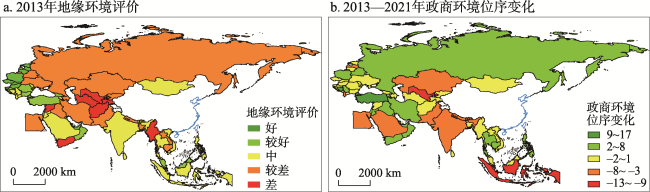
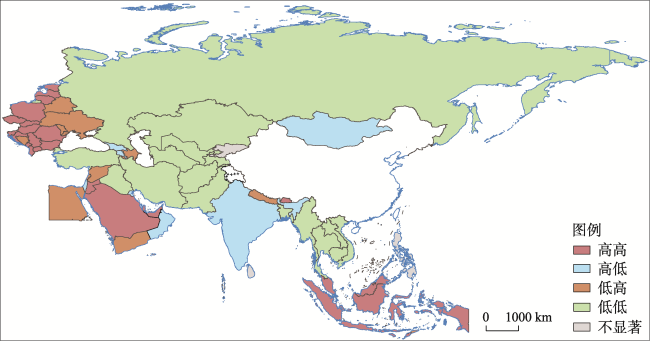
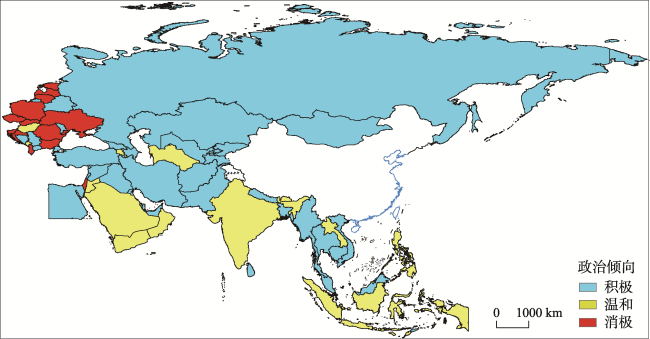
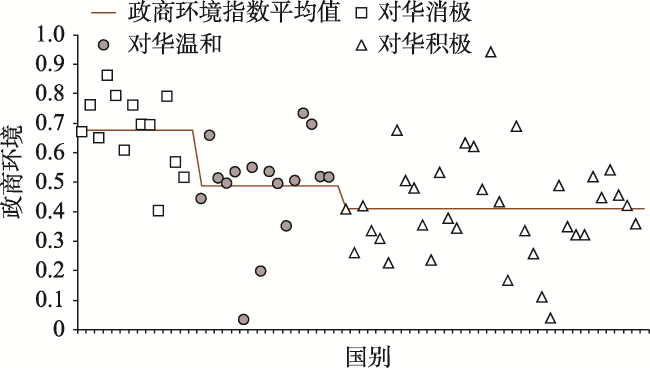
Focusing on the investment security of the Belt and Road Initiative (BRI), this study analyzes the geopolitical environment of countries (regions) along the Belt and Road from two dimensions: the political-business environment and political inclination. Since the proposal of the BRI in 2013, the political-business environments of the participating countries (regions) have shown slight improvements, though there are significant regional disparities. Generally, these environments are better at the eastern and western ends of the BRI countries (regions), while the central regions lag behind. There is no significant spatial dependence in the political-business environments of these countries (regions), but a weak trend toward homogenization exists, with lower-scoring countries (regions) mainly located in the former Commonwealth of the Independent States, the Middle East, and the Indochina Peninsula. These regions show weak interconnections and exhibit characteristics of "being alike but not cohesive", suggesting that BRI efforts should focus on contiguous breakthroughs rather than scattering in isolated points. The evaluation of political inclination shows that the political division among the BRI countries (regions) is significant, with varying attitudes towards China. As the attitudes towards China warm up, the political-business environment tends to deteriorate. This negative correlation between the two factors indicates that countries (regions) actively participating in the BRI are relatively politically unstable and economically underdeveloped, seeking to leverage the initiative for their development. Therefore, in the construction of the Belt and Road, while ensuring investment security, we should actively promote Chinese values, striving for the support and participation of more countries (regions) with favorable political-business environments. Given the realities of underdeveloped political-business environments and political divisions along the Belt and Road, China urgently needs to explore a geopolitical theory that fits the geopolitical pattern of the BRI to ensure the progress and reclaim the political narrative power through reshaping the geopolitical strategic narrative. This paper's quantitative evaluation of political inclination provides a preliminary exploration into the political fragmentation among these countries (regions) and serves as a reference for advancing research on the geopolitical environment.
NIU Fangqu , XUAN Bingcheng . Evaluation of geopolitical environment along the Belt and Road[J]. Acta Geographica Sinica, 2025 , 80(2) : 475 -489 . DOI: 10.11821/dlxb202502013
表1 政商环境评价指标体系及统计特征Tab. 1 The political-business environment evaluation index system and its statistical characteristics |
| 指标 | 指标含义 | 说明 | 最小值 | 最大值 | 平均值 | 方差 |
|---|---|---|---|---|---|---|
| X1 | 公民言论与问责机制 | 值越高,表明机制越完善。 | -1.960 | 1.191 | -0.486 | 0.808 |
| X2 | 政局稳定度与无暴力情况 | 值越高,表明政局越稳定,暴力事件越少 | -2.660 | 1.490 | -0.295 | 0.951 |
| X3 | 政府对市场管理和促进能力 | 值越高,表明管理和促进能力越强 | -2.300 | 2.290 | -0.010 | 0.749 |
| X4 | 公共政策和制度的执行力 | 值越高,表明执行力越强 | -2.020 | 2.230 | 0.013 | 0.779 |
| X5 | 社会规则的信任与遵守度 | 值越高,表明信任度和遵守度越强 | -2.070 | 1.860 | -0.180 | 0.724 |
| X6 | 腐败控制 | 值越高,表明政府越清廉。 | -1.780 | 2.170 | -0.226 | 0.674 |
| X7 | 人均GDP(US$) | 值越高,表明经济发展水平越高 | 355.78 | 77710.09 | 12786.13 | 239656287.5 |
表2 聚类跃迁类型Tab. 2 Spatiotemporal transition of clusters |
| 类型 | 描述 | 跃迁方向 |
|---|---|---|
| I | 自身跃迁,邻域稳定 | HHt→LHt+1,LHt+1→HHt+1,HLt→LLt+1,LLt→HLt+1 |
| II | 自身稳定,邻域跃迁 | HHt→HLt+1,LHt→LLt+1,HLt→HHt+1,LLt→LHt+1 |
| III | 自身与邻域均跃迁 | HHt→LLt+1,LHt→HLt+1,HLt→LHt+1,LLt→HHt+1 |
| IV | 自身与邻域均稳定 | HHt→HHt+1,LHt→LHt+1,HLt→HLt+1,LLt→LLt+1 |
表3 政商环境评价指标的主成分及变量载荷Tab. 3 Principal component and variable loadings of political-business environment evaluation indicators |
| 变量 | 主成分1变量载荷 | |
|---|---|---|
| 2013 | 2021 | |
| X1 | 0.670 | 0.661 |
| X2 | 0.748 | 0.812 |
| X3 | 0.966 | 0.941 |
| X4 | 0.879 | 0.882 |
| X5 | 0.972 | 0.974 |
| X6 | 0.938 | 0.943 |
| X7 | 0.689 | 0.776 |
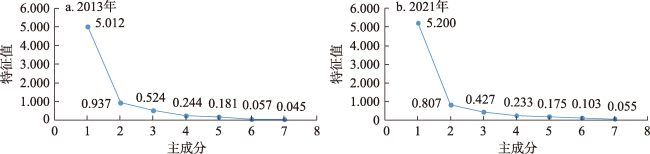
| 特征值 | 5.012 | 5.200 |
| 变化(%) | 71.603 | 74.274 |
注:粗体表征变量对主成分贡献较大。 |
表4 变量权重Tab. 4 Weights of variables |
| 变量 | 权重 | ||
|---|---|---|---|
| 2013 | 2021 | 平均值 | |
| X1 | 0.114 | 0.110 | 0.112 |
| X2 | 0.128 | 0.136 | 0.132 |
| X3 | 0.165 | 0.157 | 0.161 |
| X4 | 0.150 | 0.147 | 0.149 |
| X5 | 0.166 | 0.163 | 0.164 |
| X6 | 0.160 | 0.157 | 0.159 |
| X7 | 0.118 | 0.130 | 0.124 |
表5 “一带一路”沿线国家(地区)政商环境空间依赖关系的跃迁Tab. 5 Transition in spatial dependence of political-business environment of the BRI countries (regions) |
| t/t+1 | HHt+1 | HLt+1 | LHt+1 | LLt+1 | 统计 |
|---|---|---|---|---|---|
| HHt | 0.370(Ⅳ型) | 0.030(Ⅱ型) | 0(Ⅰ型) | 0(Ⅲ型) | I 型:0.077 II 型:0.098 III型:0 IV型:0.825 SHTI:0 |
| HLt | 0.017(Ⅱ型) | 0.068(Ⅳ型) | 0(Ⅲ型) | 0.017(Ⅰ型) | |
| LHt | 0.030(Ⅰ型) | 0(Ⅲ型) | 0.150(Ⅳ型) | 0.017(Ⅱ型) | |
| LLt | 0(Ⅲ型) | 0.030(Ⅰ型) | 0.034(Ⅱ型) | 0.237(Ⅳ型) |
注:I型为自身跃迁、邻域稳定,II型为自身稳定、邻域跃迁,III型为自身与邻域均跃迁,IV型为自身与邻域均稳定。 |
感谢南京师范大学张庆慧同学在前期的数据准备与分析中给予的帮助,并对编辑部及3位匿名审稿专家表示诚挚的谢意,专家所提意见对于文章的提升有很大帮助。
| [1] |
[国家发改委, 外交部, 商务部. 推动共建丝绸之路经济带和21世纪海上丝绸之路的愿景与行动. 北京, 2015.]
|
| [2] |
[葛全胜, 江东, 陆锋, 等. 地缘环境系统模拟研究探讨. 地理学报, 2017, 72(3): 371-381.]
|
| [3] |
[王雪冬. “一带一路”倡议的国际认同度研究. 世界社会主义研究, 2020, 5(11): 67-74, 95.]
|
| [4] |
Belt and Road Portal. http://www.yidaiyilu.gov.cn/. [2024-01-10].
“一带一路”网. https://www.yidaiyilu.gov.cn/. [2024-01-10.]]
|
| [5] |
[刘海猛, 胡森林, 方恺, 等. “一带一路”沿线国家政治—经济—社会风险综合评估及防控. 地理研究, 2019, 38(12): 2966-2984.]
|
| [6] |
[刘卫东. “一带一路”倡议的科学内涵与科学问题. 地理科学进展, 2015, 34(5): 538-544.]
|
| [7] |
[陈伟, 王芯芮, 龙燕, 等. “一带一路”沿线地区贸易网络韧性研究. 经济地理, 2024, 44(1): 22-31.]
|
| [8] |
[张新焕, 张小雷, 张璐, 等. 中国与“一带一路”沿线国家地缘关系时空演变特征. 世界地理研究, 2023, 32(9): 17-27.]
|
| [9] |
[胡伟, 胡志丁, 葛岳静. 中国地缘环境研究进展与思考. 地理科学进展, 2019, 38(4): 477-488.]
|
| [10] |
[胡志丁, 杜德斌. 日本德川幕府时期的地缘环境分析: 兼论国别地缘环境分析框架. 地理学报, 2020, 75(10): 2047-2060.]
|
| [11] |
[杨吾扬. 论中国发展的地缘环境. 大自然探索, 1995(1): 7-10.]
|
| [12] |
[胡志丁, 葛岳静, 鲍捷, 等. 南亚地缘环境的空间格局与分异规律研究. 地理科学, 2013, 33(6): 685-692.]
|
| [13] |
[宋长青, 葛岳静, 刘云刚, 等. 从地缘关系视角解析“一带一路” 的行动路径. 地理研究, 2018, 37(1): 3-19.]
|
| [14] |
[胡志丁, 曹原, 刘玉立, 等. 我国政治地理学研究的新发展: 地缘环境探索. 人文地理, 2013, 28(5): 123-128.]
|
| [15] |
[安宁, 蔡晓梅. 跨学科视角下“地缘政治”概念及其研究范式. 地理科学, 2020, 40(9): 1412-1420.]
|
| [16] |
[潘峰华, 赖志勇, 葛岳静. 经贸视角下中国周边地缘环境分析: 基于社会网络分析方法. 地理研究, 2015, 34(4): 775-786.]
|
| [17] |
[宋涛, 程艺, 刘卫东, 等. 中国边境地缘经济的空间差异及影响机制. 地理学报, 2017, 72(10): 1731-1745.]
|
| [18] |
[谢瑾, 肖晔, 张丽雪, 等. “一带一路”沿线国家能源供给潜力与能源地缘政治格局分析. 世界地理研究, 2017, 26(6): 11-21.]
|
| [19] |
[张琼, 苑可鑫. 油气投资风险评估与影响因素分析: 基于“一带一路”沿线地区的实证. 大连海事大学学报(社会科学版), 2022, 21(2): 88-96.]
|
| [20] |
[常耀伟, 张晶, 韩志军, 等. 合作视角下的印太地区国家地缘军事关系网络演化研究. 世界地理研究, 2023, 32(8): 1-15.]
|
| [21] |
[王淑芳, 阳婷慧, 葛岳静, 等. 基于事件数据分析法的中缅地缘关系演变. 经济地理, 2015, 35(10): 13-20.]
|
| [22] |
[陈俊华, 苏敏, 李澳, 等. 中东地缘环境时空演变及驱动机制分析. 世界地理研究, 2023, 32(11): 30-42.]
|
| [23] |
[邹汶君, 兰月新, 夏一雪, 等. “一带一路” 沿线国家涉华舆情风险感知与对策研究. 情报科学, 2021, 39(11): 60-68, 75.]
|
| [24] |
[吴绍洪, 刘路路, 刘燕华, 等. “一带一路”陆域地理格局与环境变化风险. 地理学报, 2018, 73(7): 1214-1225.]
|
| [25] |
|
| [26] |
|
| [27] |
|
| [28] |
|
| [29] |
|
| [30] |
|
| [31] |
|
| [32] |
[巩茗霏. 中国崛起的周边地缘环境分析. 世界经济与政治, 2000(7): 29-33.]
|
| [33] |
|
| [34] |
[陈伟, 赵晞泉, 刘卫东, 等. “一带一路”贸易网络演化与贸易门户国家识别. 地理学报, 2023, 78(10): 2465-2483.]
|
| [35] |
[刘卫东. 共建绿色丝绸之路:资源环境基础与社会经济背景. 北京: 商务印书馆, 2019.]
|
| [36] |
|
| [37] |
|
| [38] |
[李晓, 李俊久. “一带一路”与中国地缘政治经济战略的重构. 世界经济与政治, 2015(10): 30- 59, 156-157.]
|
| [39] |
[李建平, 孙晓蕾, 何琬. 资源国国家风险:理论、评估方法与实证. 北京: 科学出版社, 2014.]
|
| [40] |
|
| [41] |
|
| [42] |
|
| [43] |
|
| [44] |
[刘震, 吴广, 丁维岱, 等. SPSS统计分析与应用. 北京: 电子工业出版社, 2011.]
|
| [45] |
|
| [46] |
|
/
| 〈 |
|
〉 |