



Positive contribution and negative impact of karst rocky desertification control on biodiversity in southwest China
Received date: 2023-07-13
Revised date: 2024-01-11
Online published: 2024-01-29
Supported by
Strategic Priority Research Program of the Chinese Academy of Sciences(XDA23060100)
Strategic Priority Research Program of the Chinese Academy of Sciences(XDB40000000)
National Natural Science Foundation of China(U22A20619)
National Natural Science Foundation of China(42077455)
Western Light Cross-team Program of Chinese Academy of Sciences(xbzg-zdsys-202101)
Guizhou Provincial Science and Technology Projects(Qiankehe Support [2023] General 219)
High-level Innovative Talents in Guizhou Province(GCC[2022]015-1)
High-level Innovative Talents in Guizhou Province(2016-5648)
Guizhou Provincial Science and Technology Subsidies(GZ2019SIG)
Guizhou Provincial Science and Technology Subsidies(GZ2020SIG)
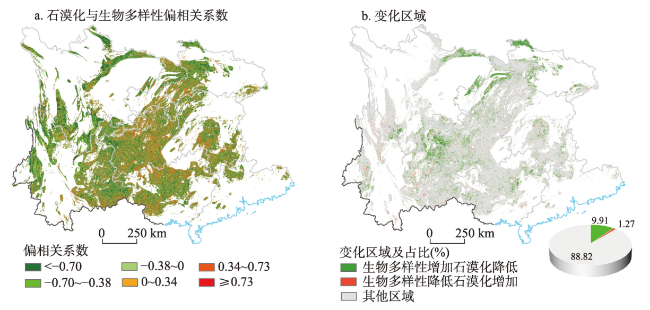
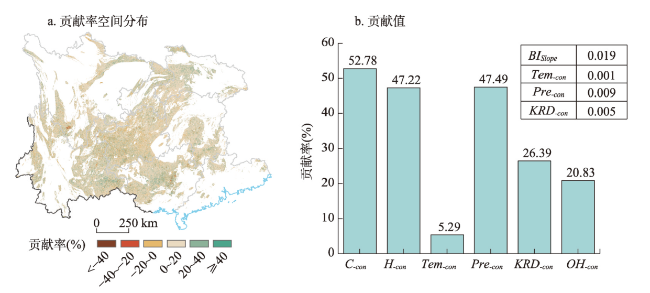
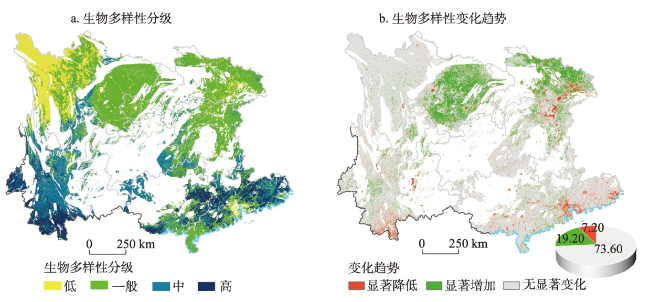
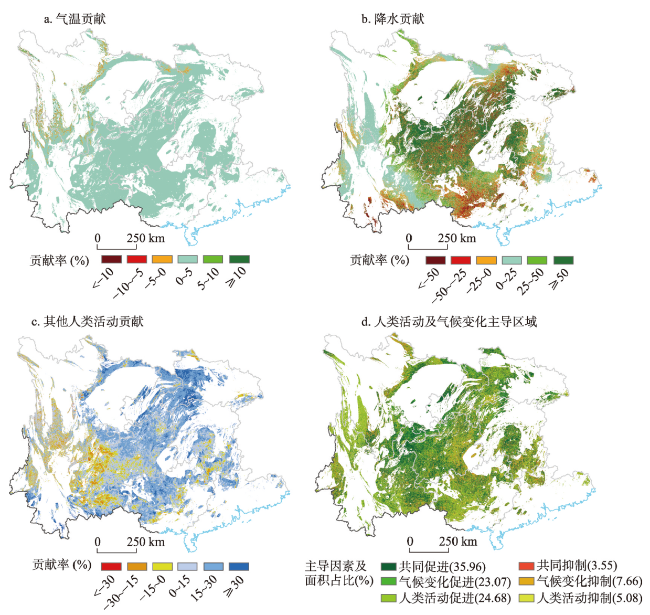
Ecological restoration measures have a significant impact on biodiversity hotspots. Therefore, quantifying the contribution of desertification control to biodiversity is crucial in the karst region of southwest China. This study employed regression analysis and residual trend analysis to reveal the evolutionary patterns of desertification and biodiversity from 2000 to 2020 in this region. It quantified the contributions of desertification control and other factors to biodiversity. The results indicated that during the study period, desertification in the karst region was mainly classified as mild and moderate levels, with a total area reduction of 102500 km2 at an annual rate of 4900 km2/a. Overall, biodiversity showed an increasing trend, with a mean value of the biodiversity composite index at 0.40, maintaining a moderate level. There was a positive correlation between desertification control and biodiversity, with desertification control contributing 26.39% of the overall impact. Climate change and human activities contributed 52.78% and 47.22% to biodiversity, respectively. This suggests that desertification control has made a positive contribution to biodiversity and provides valuable guidance for future ecological restoration projects and biodiversity conservation.
LONG Mingkang , BAI Xiaoyong , LI Zilin , XUE Yingying , CHEN Fei , LI Chaojun , RAN Chen , ZHANG Sirui , DU Chaochao , SONG Fengjiao , XIAO Biqin , XIONG Lian . Positive contribution and negative impact of karst rocky desertification control on biodiversity in southwest China[J]. Acta Geographica Sinica, 2024 , 79(1) : 97 -113 . DOI: 10.11821/dlxb202401007
表1 石漠化指数构建的指标及权重Tab. 1 Index and weight of rocky desertification index construction |
| 石漠化指标 | 权重 |
|---|---|
| 岩石裸露率 | 0.5534 |
| 植被覆盖度 | 0.2841 |
| 坡度 | 0.1625 |
表2 生物多样性指数体系及权重Tab. 2 Biodiversity index system and its weight |
| 生物多样性层次 | 选取指标 | 权重 |
|---|---|---|
| 物种多样性 | 生境质量指数(HQI) | 0.35 |
| 净初级生产力(NPP) | 0.25 | |
| 增强型植被指数(EVI) | 0.15 | |
| 生态系统多样性 | 生境面积百分比(Sp) | 0.10 |
| 景观多样性 | 香农多样性指数(SHDI) | 0.15 |
表3 量化气候变化和人类活动对生物多样性的贡献的6种情景Tab. 3 Six scenarios used to quantify the contribution of climate change and rocky desertification control to biodiversity |
| 情景 | BISlope | C-con | H-con | 气候变化贡献率 | 人类活动贡献率 | 说明 |
|---|---|---|---|---|---|---|
| 1 | > 0 | > 0 | > 0 | 共同促进 | ||
| 2 | > 0 | < 0 | 100% | 0 | 气候变化促进 | |
| 3 | < 0 | > 0 | 0 | 100% | 人类促进 | |
| 4 | < 0 | < 0 | < 0 | 共同抑制 | ||
| 5 | < 0 | > 0 | 100% | 0 | 气候变化抑制 | |
| 6 | > 0 | < 0 | 0 | 100% | 人类抑制 |
表4 石漠化分级标准Tab. 4 Grading standard of rocky desertification |
| 等级 | 石漠化指数区间 |
|---|---|
| 无石漠化 | [0, 0.2291] |
| 潜在石漠化 | (0.2291, 0.3049] |
| 轻度石漠化 | (0.3049, 0.3356] |
| 中度石漠化 | (0.3356, 0.4230] |
| 重度石漠化 | (0.4230, 0.5692] |
| 极重度石漠化 | (0.5692, 1] |
表5 本文结果与石漠化公报对比Tab. 5 Comparison between this study and rocky desertification bulletin |
| 石漠化面积(万km2) | 2000年 | 2005年 | 2010—2011年 | 2015—2016年 | 2020—2021年 | |||||||||
|---|---|---|---|---|---|---|---|---|---|---|---|---|---|---|
| 本文 | 公报 | 本文 | 公报 | 本文 | 公报 | 本文 | 公报 | 本文 | 公报 | |||||
| 总面积 | 17.71 | - | 13.79 | 12.96 | 13.48 | 12.01 | 10.29 | 10.07 | 7.46 | 7.22 | ||||
| 轻度石漠化面积 | 5.66 | - | 3.55 | 3.56 | 4.86 | 4.32 | 4.02 | 3.91 | 3.32 | - | ||||
| 中度石漠化面积 | 6.79 | - | 6.22 | 5.92 | 5.64 | 5.19 | 4.34 | 4.33 | 2.94 | - | ||||
| 重度石漠化面积 | 4.09 | - | 3.28 | 2.94 | 2.57 | 2.18 | 1.82 | 1.66 | 1.12 | - | ||||
| 极重度石漠化面积 | 1.17 | - | 0.74 | 0.54 | 0.41 | 0.32 | 0.11 | 0.17 | 0.08 | - | ||||
| 消减速率(万km2/a) | - | - | 0.78 | - | 0.06 | 0.16 | 0.64 | 0.39 | 0.57 | 0.67 | ||||
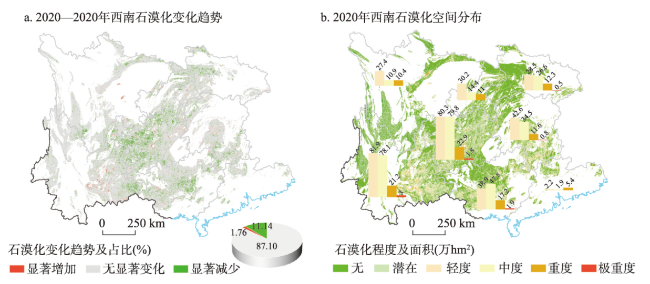
图2 2000—2020年西南石漠化年际变化率和各等级石漠化面积变化及占比Fig. 2 The annual change rate of rocky desertification in Southwest China and the change and proportion of rocky desertification areas in different grades in 2000-2020 |
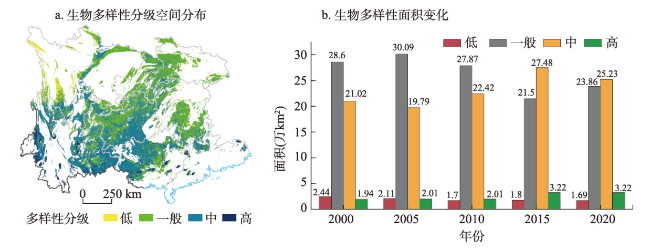
表6 生物多样性综合指数分级Tab. 6 Comprehensive index grading of biodiversity |
| 生物多样性等级 | BI | 生物多样性状况 |
|---|---|---|
| 高 | BI ≥ 0.6 | 物种高度丰富,植被生产力高,生境质量高,生态系统丰富多样,人类活动干扰极少,适宜生物生存繁衍。 |
| 中 | 0.4 ≤ BI < 0.6 | 物种较丰富,植被覆盖好,生境质量较高,生态系统类型较多,局部地区生物多样性丰富。 |
| 一般 | 0.2 ≤ BI < 0.4 | 物种较少,景观较为破碎,生境质量一般,人类干扰较大。 |
| 低 | BI < 0.2 | 物种相对贫乏,生境质量差,生态系统类型单一脆弱,生物多样性极低。 |
| [1] |
|
| [2] |
|
| [3] |
[周晋峰. 生态文明时代的生物多样性保护理念变革. 人民论坛·学术前沿, 2022(4): 16-23.]
|
| [4] |
|
| [5] |
|
| [6] |
|
| [7] |
|
| [8] |
|
| [9] |
|
| [10] |
|
| [11] |
|
| [12] |
|
| [13] |
|
| [14] |
|
| [15] |
|
| [16] |
[袁道先. 我国西南岩溶石山的环境地质问题. 世界科技研究与发展, 1997, 19(5): 41-43.]
|
| [17] |
[王世杰, 李阳兵. 喀斯特石漠化研究存在的问题与发展趋势. 地球科学进展, 2007, 22(6): 573-582.]
|
| [18] |
|
| [19] |
[陈飞, 周德全, 白晓永, 等. 典型喀斯特槽谷区石漠化时空演变及未来情景模拟. 农业资源与环境学报, 2018, 35(2): 174-180.]
|
| [20] |
|
| [21] |
|
| [22] |
[靖娟利, 邓棋方, 和彩霞, 等. 1999—2019年西南喀斯特地区NDVI时空变化及其气候驱动. 水土保持研究, 2023, 30(3): 232-239.]
|
| [23] |
[袁道先. 岩溶石漠化问题的全球视野和我国的治理对策与经验. 草业科学, 2008, 25(9): 19-25.]
|
| [24] |
|
| [25] |
|
| [26] |
|
| [27] |
|
| [28] |
|
| [29] |
|
| [30] |
|
| [31] |
|
| [32] |
|
| [33] |
|
| [34] |
|
| [35] |
[袁成军, 熊康宁, 容丽, 等. 喀斯特石漠化生态恢复中的生物多样性研究进展. 地球与环境, 2021, 49(3): 336-345.]
|
| [36] |
|
| [37] |
[吴克华, 熊康宁, 容丽, 等. 不同石漠化程度植被恢复综合治理过程特征: 以贵州省花江峡地区为例. 地球与环境, 2007, 35(4): 327-335.]
|
| [38] |
[张承琴, 王普昶, 龙翠玲, 等. 贵州喀斯特峰丛洼地不同石漠化等级植物群落物种组成和多样性特征. 西南大学学报(自然科学版), 2015, 37(6): 48-53.]
|
| [39] |
|
| [40] |
[种国双, 海月, 郑华, 等. 中国西南喀斯特石漠化治理现状及对策. 长江科学院院报, 2021, 38(11): 38-43.]
|
| [41] |
[杨渺, 肖皴, 欧阳志云, 等. 四川省生物多样性与生态系统多功能性分析. 生态学报, 2021, 41(24): 9738-9748.]
|
| [42] |
|
| [43] |
[朱华, 王洪, 李保贵, 等. 西双版纳森林植被研究. 植物科学学报, 2015, 33(5): 641-726.]
|
| [44] |
|
| [45] |
[张心茹, 曹茜, 季舒平, 等. 气候变化和人类活动对黄河三角洲植被动态变化的影响. 环境科学学报, 2022, 42(1): 56-69.]
|
| [46] |
|
| [47] |
|
| [48] |
|
| [49] |
|
| [50] |
|
| [51] |
|
/
| 〈 |
|
〉 |