



Evolution of homeland heritage and place reconstruction in ethnic villages in Wuling mountain area
Received date: 2022-01-25
Revised date: 2023-02-14
Online published: 2023-04-14
Supported by
National Natural Science Foundation of China(41901180)
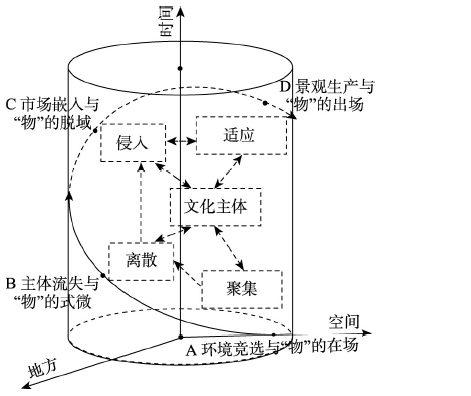
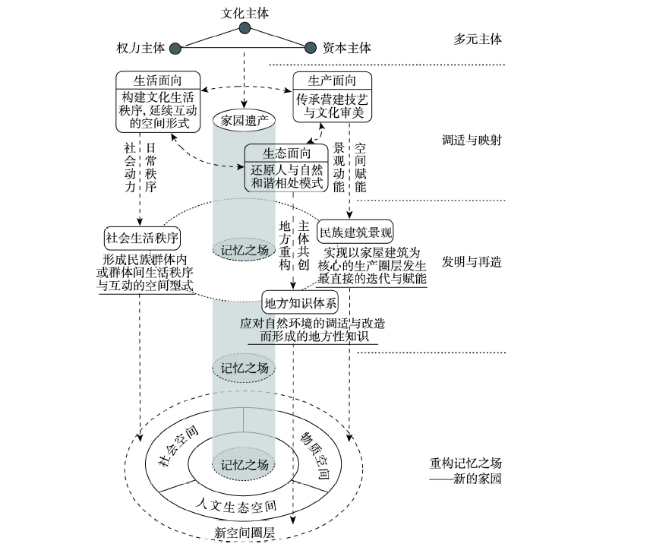
As the material carrier of native land, architectural heritage not only presents productive, living and ecological values in history, but also reflects changes of local people in mentality order and reproduces the character of symbolic communication of things due to its modernity practice, which reshapes material values and identities with the evolution of practice field. Diaojiaolou-the traditional stilted buildings, as a site of daily life practices for Chinese ethnic minorities, are mainly located in the Wuling mountain area, which contain local meanings on multiple levels, including material, institutional and spiritual significance. This paper constructed a dialectical framework of "time-space-place" from the perspective of "things", to dynamically investigate the interaction between homeland heritage and cultural subjects as well as the transformation of social order in the Wuling mountain area: (1) the presence of "things" represents the historical response to folk preservation and generation inheritance, carrying home culture and local memory; (2) The declining and disembedding of "things" implies the game and integration of macro power and individual behavior under the penetration of modernity, as well as the deconstruction, negotiation and reconstruction of local subjectivity; (3) The appearance of "things" suggests that the home is placed in a regional cultural value system at a deeper level, which shows up the spatial value of ethnic architecture, thus participating in the tourism context as a form of cultural capital. Furthermore, the paper tried to explore the reconstruction of the order of material, social and human ecological spaces of homeland heritage from a local perspective: (1) Spatial empowerment: landscape genes renew space value in the aspect of production; (2) Order reconstruction: social motivation activates space value in the aspect of life; (3) Local knowledge: multiple subjects nurture space value in the ecological aspect. Through the localization of "things", this study explores how "things", which have been hidden in the folk, attract multiple subjects to create a "field of memory" along with the modernization of ethnic areas, in order to achieve the order transformation from the daily "home" to the "place", thus exploring new paths for the survival of homeland heritage and the creation of "poetic dwelling"in China's ethnic areas, as well as promoting rural revitalization.
TAO Hui , ZHANG Mengzhen , LIU Jiaming . Evolution of homeland heritage and place reconstruction in ethnic villages in Wuling mountain area[J]. Acta Geographica Sinica, 2023 , 78(4) : 997 -1014 . DOI: 10.11821/dlxb202304014
表1 2012—2021年间重要访谈信息统计表Tab. 1 Statistics of important interview information over the period 2012-2021 |
| 访谈对象 | 访谈内容 | 访谈人次(人次) | 访谈时间(min) | 文稿字数(万字) |
|---|---|---|---|---|
| 彭家寨旅游公司负责成员共7人:副总裁1人、副总裁助理1人、彭家寨项目负责人5人(M1~M7) | ①“土家泛博物馆”项目规划、发展过程② 彭家寨的阶段性合作特征及约束和相应的解决方案 | 17 | 642 | 12.1 |
| 沙道沟镇政府、宣恩县文旅局、恩施州政协等机构工作人员8人(G8~G15) | ① 吊脚楼修缮历史及彭家寨情况介绍 ② 泛博物馆项目运作流程和沟通机制 | 16 | 698 | 11.8 |
| 普通村民28人(V16~V43) | ① 关于泛博物馆项目的见解 ② 项目如何带动村寨居民减贫 | 35 | 1043 | 15.7 |
| 总计 | 68 | 2383 | 39.6 | |
表2 彭家寨传统民居维修情况统计表Tab. 2 Statistics on the maintenance of traditional houses in Pengjiazhai |
| 修缮类型 | 修缮内容 | 修缮方案 | 具体措施 |
|---|---|---|---|
| 公共建筑 | 风雨桥、河道、铁索桥等 | 结构加固、景观整饰与风貌协调 | 清理河道污水管网,运用地势差将其修缮为水潭、跌水与卵石滩等生态景观 |
| 文保单位 | 以彭继权宅为首的21栋传统民居建筑 | 建筑群整体环境维护 单体建筑外立面整修、建筑高度控制 | 拆除临建棚舍、与传统建筑及山水景观极不协调的新建建筑,根据现存构件痕迹进行外立面的修复 |
| 改善内部空间结构、完善设施功能 | 更新老化的建筑材料,修补屋内木构件,刷防锈漆,并做防腐、防虫处理,并更新火塘屋等生活设施的现代化功能 |
注:数据来源于宣恩县文物局,作者整理。 |
| [1] |
|
| [2] |
[彭兆荣. 人类遗产与家园生态. 思想战线, 2005(6): 123-127, 135.]
|
| [3] |
|
| [4] |
[张爱武. 土家族吊脚楼研究综述. 贵州师范大学学报(社会科学版), 2011(3): 64-70.]
|
| [5] |
[刘守英, 王一鸽. 从乡土中国到城乡中国: 中国转型的乡村变迁视角. 管理世界, 2018, 34(10): 128-146, 232.]
|
| [6] |
|
| [7] |
|
| [8] |
[康德. 纯粹理性批判. 邓晓芒, 译. 北京: 商务印书馆, 2010.]
|
| [9] |
[胡塞尔. 纯粹现象学通论. 李幼燕, 译. 北京: 商务印书馆, 1992.]
|
| [10] |
[本雅明. 巴黎: 19世纪的首都. 刘北城, 译. 上海: 上海人民出版社, 2006.]
|
| [11] |
|
| [12] |
[彭兆荣, 葛荣玲. 遗事物语: 民族志对物的研究范式. 厦门大学学报(哲学社会科学版), 2009(2): 58-65.]
|
| [13] |
|
| [14] |
[李耕. 规矩、示能和氛围: 民居建筑遗产塑造社会的三个机制. 文化遗产, 2019(5): 61-70.]
|
| [15] |
|
| [16] |
[孙九霞, 周一. 日常生活视野中的旅游社区空间再生产研究: 基于列斐伏尔与德塞图的理论视角. 地理学报, 2014, 69(10): 1575-1589.]
|
| [17] |
[陶慧, 张梦真. 乡村遗产旅游地“三生”空间的主体价值重塑: 以广府古城为例. 旅游学刊, 2021, 36(5): 81-92.]
|
| [18] |
[斯特劳斯. 忧郁的热带. 王志明, 译. 北京: 三联书店, 2000.]
|
| [19] |
|
| [20] |
[孙九霞, 张倩. 旅游对傣族物质文化变迁及其资本化的影响: 以傣楼景观为例. 广西民族大学学报(哲学社会科学版), 2011, 33(3): 7-13.]
|
| [21] |
[黄华青. 空间作为能动者: 基于“空间志”的当代乡村变迁观察. 建筑学报, 2020(7): 14-19.]
|
| [22] |
|
| [23] |
[陆依依, 保继刚. 城市边缘区域“家”到“商业的家”的空间演变: 以西双版纳景洪市为例. 人文地理, 2018, 33(3): 145-151.]
|
| [24] |
[孙九霞, 许泳霞, 王学基. 旅游背景下传统仪式空间生产的三元互动实践. 地理学报, 2020, 75(8): 1742-1756.]
|
| [25] |
[蔡溢, 杨洋, 廖婧琳, 等. 何以为“家”? 西江苗寨居民家屋空间的旅游实践. 旅游学刊, 2022, 37(9): 27-40.]
|
| [26] |
[孙九霞, 周一. 遗产旅游地居民的地方认同: “碉乡”符号、记忆与空间. 地理研究, 2015, 34(12): 2381-2394.]
|
| [27] |
|
| [28] |
|
| [29] |
[麦肯齐. 城市社会学: 芝加哥学派城市研究. 宋俊岭, 郑也夫, 译. 北京: 商务印书馆, 2012.]
|
| [30] |
[张良皋, 李玉祥. 武陵土家. 北京: 三联书店, 2001: 87.]
|
| [31] |
|
| [32] |
|
| [33] |
|
| [34] |
[丁建军, 王璋, 余方薇, 等. 精准扶贫驱动贫困乡村重构的过程与机制: 以十八洞村为例. 地理学报, 2021, 76(10): 2568-2584.]
|
| [35] |
[田海林, 田晓梦. 民族地区脱贫攻坚与乡村振兴有效衔接的现实路径: 以武陵山片区为例. 中南民族大学学报(人文社会科学版), 2021, 41(5): 34-40.]
|
| [36] |
[孙九霞, 黄凯洁, 王学基. 基于地方实践的旅游发展与乡村振兴: 逻辑与案例. 旅游学刊, 2020, 35(3): 39-49.]
|
| [37] |
|
| [38] |
[王敏, 赵美婷, 朱竑. 广州河涌的自然社会构建与城市记忆. 地理学报, 2019, 74(2): 353-365.]
|
| [39] |
[戈大专, 陆玉麒, 孙攀. 论乡村空间治理与乡村振兴战略. 地理学报, 2022, 77(4): 777-794.]
|
| [40] |
[丁传标, 赵永琪, 陶伟. 城市化进程中家屋空间重构的过程、内容与逻辑: 以广州珠村为例. 地理科学, 2017, 37(9): 1326-1336.]
|
| [41] |
[郭文, 黄震方. 旅游与竹地摩梭人“家”空间的多维生产及身份认同建构. 地理研究, 2020, 39(4): 907-921.]
|
| [42] |
[黄锋, 保继刚. 旅游商业化“家空间”的代际权力关系与领域构建: 西双版纳傣族园案例. 地理科学进展, 2022, 41(5): 867-879.]
|
| [43] |
[王秀伟, 李晓军. 中国乡村旅游重点村的空间特征与影响因素. 地理学报, 2022, 77(4): 900-917.]
|
| [44] |
[皮埃尔·诺拉. 记忆之场:法国国民意识的文化社会史. 黄艳红, 译. 南京: 南京大学出版社, 2015: 47-62.]
|
| [45] |
|
| [46] |
[曾国军, 徐雨晨, 王龙杰, 等. 从在地化、去地化到再地化: 中国城镇化进程中的人地关系转型. 地理科学进展, 2021, 40(1): 28-39.]
|
| [47] |
[王新歌, 陈田, 林明水, 等. 国内外乡愁相关研究进展及启示. 人文地理, 2018, 33(5): 1-11.]
|
| [48] |
[马翀炜. 遭遇石头: 民俗旅游村的纯然物、使用物与消费符号. 思想战线, 2017, 43(5): 1-10.]
|
| [49] |
[胡最, 邓运员, 刘沛林, 等. 传统聚落文化景观基因的符号机制. 地理学报, 2020, 75(4): 789-803.]
|
| [50] |
[向远林, 曹明明, 秦进, 等. 基于精准修复的陕西传统乡村聚落景观基因变异性研究. 地理科学进展, 2020, 39(9): 1544-1556.]
|
| [51] |
|
| [52] |
[吴兴帜. “物的民族志”本土化书写: 以傣族织锦手工艺品为例. 云南师范大学学报(哲学社会科学版), 2017, 49(6): 49-55.]
|
| [53] |
|
| [54] |
|
| [55] |
|
/
| 〈 |
|
〉 |