



The rule cognition and theoretical construction of spatial pattern in China
Received date: 2020-07-09
Request revised date: 2021-09-24
Online published: 2022-02-25
Supported by
National Natural Science Foundation of China(42171171)
National Natural Science Foundation of China(42171173)
Copyright
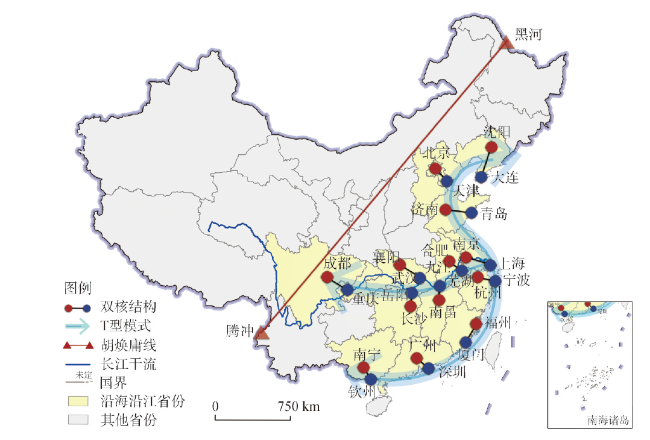
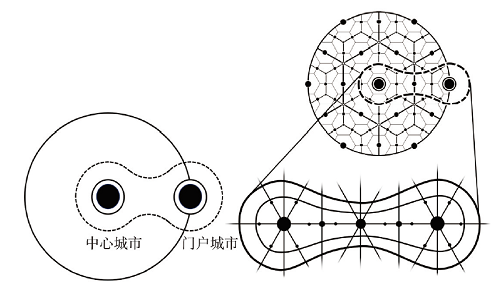
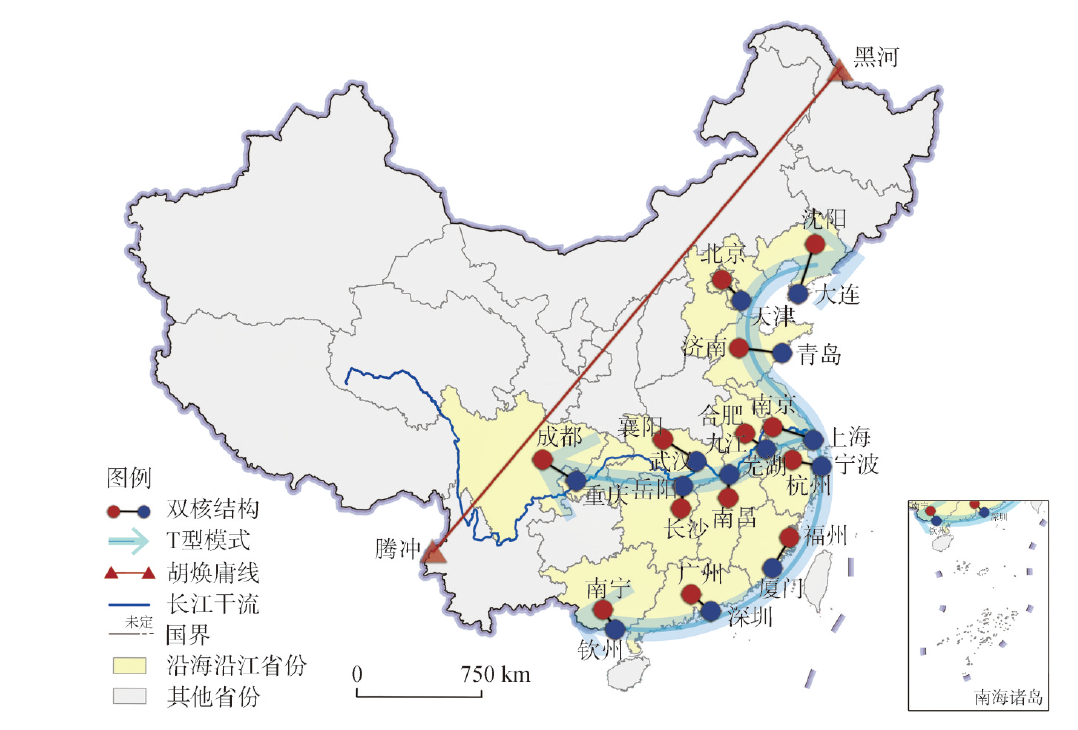
"Hu Huanyong Line", T-shaped development model, and dual-nuclei structure model can be roughly summarized as a "one-line, two-axis, and dual-nuclei" structure. They are all rule cognition and theoretical refinements on spatial pattern in China which were proposed by Chinese human geographers in different periods. "Hu Huanyong Line" is proposed based on the regular recognition of regional differences. This is the extension and expansion of geographical differentiation laws of physical geography in human geography, following the basic assumption of homogeneous regions. The discovery of the T-shaped model of Lu Dadao and the dual-nuclei structure of Lu Yuqi transcended the analytical thought of regional differentiation laws. They follow the basic assumptions of functional areas. Among them, the T-shaped model is the practical application of the point-axis system theory proposed by Lu Dadao in China. From the phenomenon perspective, the dual-nuclei structure is attached to the T-shaped development model, but subsequent research has completed the transformation from special to general. It has accomplished the whole process of scientific research in scientific discovery, mechanism analysis, mathematical derivation and practical application. Eventually, it becomes a regional spatial structure theory with strong broad applicability. From the theoretical level, "Hu Huanyong Line" based on the assumption of homogeneous region and T-shaped model based on the assumption of functional region belong to the analysis results of spatial differentiation law, but they can also be called theories. They are individual theories in geography, while the dual-nuclei structure theory belongs to a more general and applicable theory in the general scientific sense. Obviously, the trinity analysis of the "Hu Huanyong Line", the T-shaped model, and the dual-nuclei structure theory shows that, China is a country that is very suitable for regional analysis and geographical laws and theories refinement based on this. The research in this paper can provide research ideas and method references for the summary of regional spatial structure laws and theory refinement of human geography.
LU Yuqi . The rule cognition and theoretical construction of spatial pattern in China[J]. Acta Geographica Sinica, 2021 , 76(12) : 2885 -2897 . DOI: 10.11821/dlxb202112002
该文研究思路得到清华大学顾朝林教授启发;点轴理论和“T”型开发模式的相关资料由中国科学院地理科学与资源研究所陈明星研究员提供,特此致谢!
| [1] |
[
|
| [2] |
|
| [3] |
[陆玉麒, 董平. 区域空间结构模式的发生学解释: 区域双核结构模式理论地位的判别. 地理科学, 2011, 31(9): 1035-1042.]
|
| [4] |
[胡焕庸. 中国人口之分布: 附统计表与密度图. 地理学报, 1935, 2(2): 33-74.]
|
| [5] |
[胡焕庸, 胡崇庆. 我国人口的地区分布与今后发展. 人口学刊, 1986, 8(1): 13-17.]
|
| [6] |
[胡焕庸. 中国人口的分布、区划和展望. 地理学报, 1990, 45(2): 139-145.]
|
| [7] |
[胡焕庸. 中国人口地域分布. 科学, 2015, 67(1): 3-4.]
|
| [8] |
[陆大道. 工业的点轴开发模式与长江流域经济发展. 学习与实践, 1985(2): 37-39.]
|
| [9] |
[陆大道. 论区域的最佳结构与最佳发展: 提出“点一轴系统”和“T”型结构以来的回顾与再分析. 地理学报, 2001, 56(2): 127-135.]
|
| [10] |
[陆大道. 中国区域发展的新因素与新格局. 地理研究, 2003, 22(3): 261-271.]
|
| [11] |
[陆大道. 区域发展及其空间结构. 北京: 科学出版社, 1995.]
|
| [12] |
[陆大道. 2000年我国工业生产力布局总图的科学基础. 地理科学, 1986, 6(2): 110-118.]
|
| [13] |
[陆大道. 关于“点—轴”空间结构系统的形成机理分析. 地理科学, 2004, 22(1): 1-6.]
|
| [14] |
[陆大道. 区位论及区域研究方法. 北京: 科学出版社, 1988.]
|
| [15] |
[陆大道. 我国区域开发的宏观战略. 地理学报, 1987, 42(2): 97-105.]
|
| [16] |
[陆大道, 杨勤业, 吴绍洪, 等. 中国区域发展的理论与实践. 北京: 科学出版社, 2003.]
|
| [17] |
[陆大道, 等. 中国工业布局的理论与实践. 北京: 科学出版社, 1990.]
|
| [18] |
[陆大道, 刘毅, 樊杰. 我国区域政策实施效果与区域发展的基本态势. 地理学报, 1999, 54(6): 496-508.]
|
| [19] |
[陆大道, 刘卫东. 论我国区域发展与区域政策的地学基础. 地理科学, 2000, 20(6): 487-493.]
|
| [20] |
[刘卫东, 陆大道. 新时期我国区域空间规划的方法论探讨: 以“西部开发重点区域规划前期研究”为例. 地理学报, 2005, 60(6): 894-902.]
|
| [21] |
[梁进社. 中心地体系的替代性与点轴系统. 地理学报, 1998, 53(S1): 204-211.]
|
| [22] |
[陆玉麒. 论点—轴系统理论的科学内涵. 地理科学, 2002, 22(2): 136-143.]
|
| [23] |
[费孝通. 民族社会学要把宏观研究与微型研究结合起来. 中国社会科学, 1982(4): 155-156.]
|
| [24] |
[石硕. “藏彝走廊”: 一个独具价值的民族区域: 谈费孝通先生提出的“藏彝走廊”概念与区域. 藏学学刊, 2005(2): 8-17.]
|
| [25] |
[艾南山. 从地理学谈“藏彝走廊”. 藏学学刊, 2005(2): 77-80.]
|
| [26] |
[尹德挺, 袁尚. 新中国70年来人口分布变迁研究: 基于“胡焕庸线”的空间定量分析. 中国人口科学, 2019(5): 15-28, 126.]
|
| [27] |
[王铮, 夏海斌, 田园, 等. 胡焕庸线存在性的大数据分析: 中国人口分布特征的生态学及新经济地理学认识. 生态学报, 2019, 39(14): 5166-5177.]
|
| [28] |
[李莉, 张捷, 张卉, 等. 胡焕庸线简化解析几何模型与“胡焕庸线区位效应”: 以中国大陆旅游市场潜力为例. 经济地理, 2019, 39(4): 10-17, 25.]
|
| [29] |
[吴传清, 郑雷, 黄成. “胡焕庸线”假说及其新发展: 基于学说史视角的考察. 贵州社会科学, 2018(12): 137-144.]
|
| [30] |
[李佳洺, 陆大道, 徐成东, 等. 胡焕庸线两侧人口的空间分异性及其变化. 地理学报, 2017, 72(1): 148-160.]
|
| [31] |
[郭华东, 王心源, 吴炳方, 等. 基于空间信息认知人口密度分界线: “胡焕庸线”. 中国科学院院刊, 2016, 31(12): 1385-1394.]
|
| [32] |
|
| [33] |
|
| [34] |
[陆大道, 王铮, 封志明, 等. 关于“胡焕庸线能否突破”的学术争鸣. 地理研究, 2016, 35(5): 805-824.]
|
| [35] |
[陈明星, 李扬, 龚颖华, 等. 胡焕庸线两侧的人口分布与城镇化格局趋势: 尝试回答李克强总理之问. 地理学报, 2016, 71(2): 179-193.]
|
| [36] |
[吴瑞君, 朱宝树. 中国人口的非均衡分布与“胡焕庸线”的稳定性. 中国人口科学, 2016(1): 14-24, 126.]
|
| [37] |
[丁金宏, 何书金. 中国人口地理格局与城市化未来: 纪念胡焕庸线发现80周年学术研讨会在上海举行. 地理学报, 2015, 70(12): 1856.]
|
| [38] |
[戚伟, 刘盛和, 赵美风. “胡焕庸线”的稳定性及其两侧人口集疏模式差异. 地理学报, 2015, 70(4): 551-566.]
|
| [39] |
[刘鸿雁. 中国大规模造林变绿难以越过胡焕庸线. 中国科学: 地球科学, 2019, 49(11): 1831-1832.]
|
| [40] |
[陆玉麒. 区域发展中的空间结构研究. 南京: 南京师范大学出版社, 1998.]
|
| [41] |
[陆玉麒. 双核型空间结构模式的探讨. 地域研究与开发, 1998, 17(4): 44-48.]
|
| [42] |
[陆玉麒. 构建长江开发开放的新思路. 科技导报, 1998, 16(12): 59-61, 27.]
|
| [43] |
[董平, 陆玉麒. 双核型空间结构模式及其在世界地理研究中的应用. 世界地理研究, 2000, 9(1): 62-67.]
|
| [44] |
[陆玉麒, 魏也华. 中美经济地理横轴的比较研究. 科技导报, 1999, 17(5): 61-64.]
|
| [45] |
[董平, 陆玉麒. 法国的双核结构模式与区域发展. 世界地理研究, 2000, 9(4): 64-68.]
|
| [46] |
[陆玉麒. 区域双核结构模式的形成机理. 地理学报, 2002, 57(1): 85-95.]
|
| [47] |
[陆玉麒, 俞勇军. 区域双核结构模式的数学推导. 地理学报, 2003, 58(3): 406-414.]
|
| [48] |
[陆玉麒, 董平. 中国主要产业轴线的空间定位与发展态势: 兼论点—轴系统理论与双核结构模式的空间耦合, 地理研究, 2004, 23(4): 521-529.]
|
| [49] |
[陆玉麒. 连云港市的双核结构与区域发展探讨. 人文地理, 2002, 17(3): 1-4.]
|
| [50] |
[陆玉麒, 王颖. 双核结构模式与福建区域发展战略. 人文地理, 2003, 18(2): 1-6.]
|
| [51] |
[陆玉麒, 董平, 王颖. 双核结构模式与淮安区域发展. 人文地理, 2004, 19(1): 32-36.]
|
| [52] |
[盛科荣, 孙威. 规模经济、对外贸易与区域双核结构模式探讨: 以山东半岛济南—青岛双核结构为例. 地理科学进展, 2012, 31(12): 1636-1644.]
|
| [53] |
[徐海鑫, 马丽. 双核空间结构模式的理论创新与实践探索. 经济师, 2005(4): 27-28.]
|
| [54] |
[杨修志. 山东省城市体系中济—青双核结构的空间关系演变. 世界地理研究, 2008, 17(3): 100-106.]
|
| [55] |
[陆玉麒. 区域双核结构理论. 北京: 商务印书馆, 2016.]
|
/
| 〈 |
|
〉 |