



Basic theories and frontiers of poverty geography
Received date: 2020-08-20
Request revised date: 2021-06-20
Online published: 2021-12-22
Supported by
National Natural Science Foundation of China(41871183)
National Natural Science Foundation of China(41601172)
Strategic Priority Research Program of the Chinese Academy of Sciences(XDA23070301)
Copyright
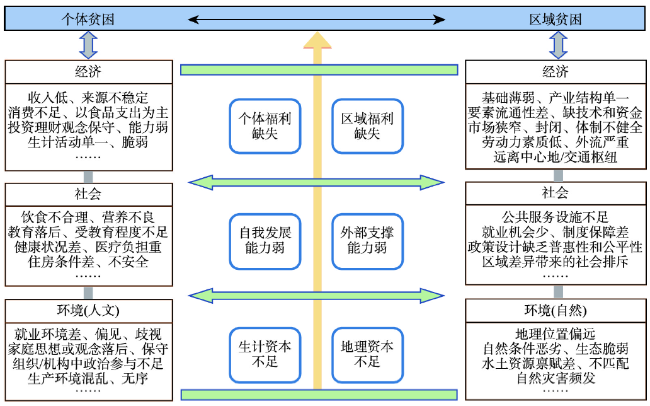
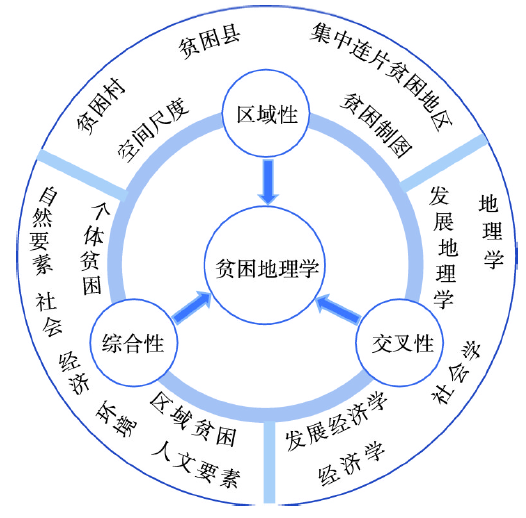
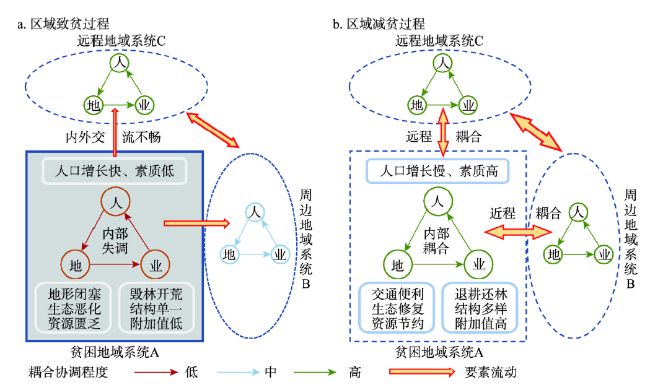
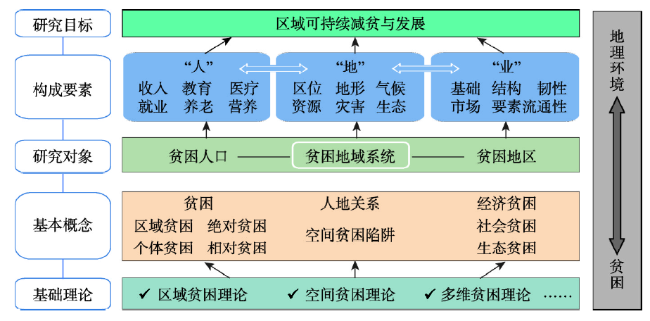
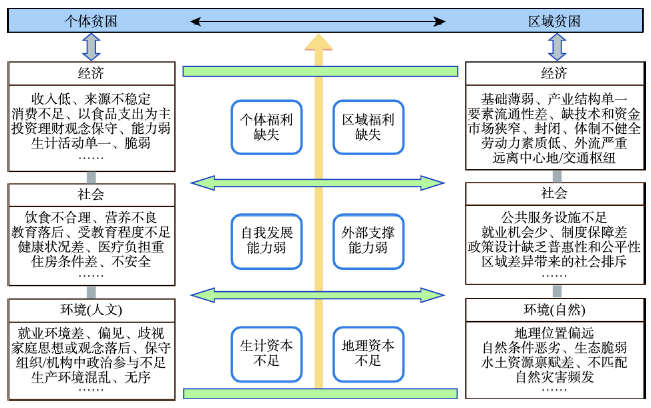
China's poverty alleviation practice has proved that geography has played an extremely important role in supporting anti-poverty targeting and poverty reduction decision-making. However, due to vague basic concepts, lagging basic theories, and an imperfect discipline system, "theoretical poverty" has become the biggest shortcoming restricting the innovation and development of poverty geography. Based on the analysis of the core concept of poverty, this paper systematically analyzed the nature, basic theory, research object, research content, and framework of poverty geography as a branch of the discipline, and put forward the frontier areas of future research on poverty geography. The results show that firstly, poverty refers to the state of inferiority, lack, or insufficiency of various welfares enjoyed by people compared to a certain standard, which has multidimensional, regional, and dynamic characteristics. In terms of measurement standards, absolute poverty emphasizes the minimum value, and relative poverty emphasizes the average value. In terms of target objects, poverty can be divided into individual poverty and regional poverty. The former focuses on the lack and deficiency of individual welfare or capability, while the latter focuses on the regional welfare behind individual welfare from the perspective of space. Secondly, poverty geography is a discipline that studies the formation, distribution, geographic characteristics of poverty-stricken areas, their relationship with the environment, and anti-poverty measures. It takes the impoverished areal system (IAS) as the research object and the poverty-environment nexus as the research core. It has comprehensive, cross-cutting, and regional characteristics, focusing on the study of regional poverty. The basic theories of poverty geography include spatial poverty theory, regional poverty theory, multidimensional poverty theory, and sustainable development theory. Its research content and framework include three dimensions (economic, social, and environmental poverty), two elements (nature and human), two types of objects (regional poverty and individual poverty), and two standards (absolute poverty and relative poverty). Thirdly, there is an urgent need to strengthen the basic research of poverty geography in terms of the evolution of IAS, regional poverty measurement, relative poverty targeting, poverty dynamic monitoring and simulation prediction, urban poverty and rural poverty, poverty alleviation effectiveness evaluation, transformation and development and revitalization path of poor areas. In the situation that we face new challenges of poverty reduction and development at home and abroad, there is an urgent need to constantly innovate and develop the fundamental theory of poverty geography, promote the globalization of China's poverty research, and contribute China's anti-poverty project to the eradication of global extreme poverty.
ZHOU Yang , LI Xunhuan . Basic theories and frontiers of poverty geography[J]. Acta Geographica Sinica, 2021 , 76(10) : 2407 -2424 . DOI: 10.11821/dlxb202110006
| [1] |
|
| [2] |
|
| [3] |
[ 方晓丹. 2019年全国农村贫困人口减少1109万人. http://www.stats.gov.cn/tjsj/sjjd/202001/t20200123_1724700.html 2020-06-20.]
|
| [4] |
[ 李寻欢, 周扬, 陈玉福. 区域多维贫困测量的理论与方法. 地理学报, 2020, 75(4):753-768.]
|
| [5] |
[ 周扬, 郭远智, 刘彦随. 中国县域贫困综合测度及2020年后减贫瞄准. 地理学报, 2018, 73(8):1478-1493.]
|
| [6] |
|
| [7] |
|
| [8] |
|
| [9] |
[ 郭熙保. 论贫困概念的内涵. 山东社会科学, 2005(12):49-54, 19.]
|
| [10] |
|
| [11] |
|
| [12] |
|
| [13] |
[ 王小林. 贫困测量: 理论与方法. 2 版. 北京: 社会科学文献出版社, 2017.]
|
| [14] |
|
| [15] |
|
| [16] |
|
| [17] |
Chronic Poverty Research Centre. The Chronic Poverty Report 2004-05. 2004.
|
| [18] |
[ 刘彦随, 周扬, 刘继来. 中国农村贫困化地域分异特征及其精准扶贫策略. 中国科学院院刊, 2016, 31(3):269-278.]
|
| [19] |
[ 姜德华, 张耀光, 杨柳, 等. 中国贫困地区类型划分及开发研究提要报告. 地理研究, 1988, 7(3):1-16.]
|
| [20] |
[ 周扬, 童春阳. 中国经济增长与公共投资的减贫效应测度研究. 经济经纬, 2019, 36(6):32-39.]
|
| [21] |
|
| [22] |
[ 丁建军, 冷志明. 区域贫困的地理学分析. 地理学报, 2018, 73(2):232-247.]
|
| [23] |
[ 周扬, 李寻欢, 童春阳, 等. 中国村域贫困地理格局及其分异机理. 地理学报, 2021, 76(4):903-920.]
|
| [24] |
|
| [25] |
Committee on Economic, Social and Cultural Rights. Substantive Issues Arising in the Implementation of the International Covenant on Economic, Social and Cultural Rights: Poverty and the International Covenant on Economic, Social and Cultural Rights. United Nations: Economic and Social Council, 2001.
|
| [26] |
[ 高更和, 侯景伟. 穷人地理学: 研究贫困问题的一个新视角. 南阳师范学院学报, 2008, 7(3):73-77.]
|
| [27] |
[ 周扬, 李寻欢. 平原农区贫困地理格局及其分异机制: 以安徽省利辛县为例. 地理科学, 2019, 39(10):1592-1601.]
|
| [28] |
[ 黄晗, 李寻欢, 周扬. 中国丘陵山区农村贫困时空格局及其演变机制研究: 以江西省于都县为例. 地理科学进展, 2020, 39(6):938-950.]
|
| [29] |
[ 郭熙保, 罗知. 论贫困概念的演进. 江西社会科学, 2005, 25(11):38-43.]
|
| [30] |
|
| [31] |
[ 陈宗胜, 沈扬扬, 周云波 中国农村贫困状况的绝对与相对变动: 兼论相对贫困线的设定. 管理世界, 2013(1):67-76, 187-188.]
|
| [32] |
|
| [33] |
|
| [34] |
|
| [35] |
|
| [36] |
|
| [37] |
|
| [38] |
|
| [39] |
|
| [40] |
|
| [41] |
|
| [42] |
|
| [43] |
|
| [44] |
|
| [45] |
|
| [46] |
|
| [47] |
|
| [48] |
[ 陈烨烽, 王艳慧, 赵文吉, 等. 中国贫困村致贫因素分析及贫困类型划分. 地理学报, 2017, 72(10):1827-1844.]
|
| [49] |
|
| [50] |
|
| [51] |
[ 童春阳, 周扬. 中国精准扶贫驻村帮扶工作成效及其影响因素. 地理研究, 2020, 39(5):1128-1138.]
|
| [52] |
[ 刘艳华, 徐勇. 中国农村多维贫困地理识别及类型划分. 地理学报, 2015, 70(6):993-1007.]
|
| [53] |
|
| [54] |
[ 郭远智, 周扬, 刘彦随. 中国农村人口外流的时空演化及其驱动机制. 地理科学, 2020, 40(1):50-59.]
|
| [55] |
|
| [56] |
|
| [57] |
|
| [58] |
|
| [59] |
|
| [60] |
[ 文琦, 施琳娜, 马彩虹, 等. 黄土高原村域多维贫困空间异质性研究: 以宁夏彭阳县为例. 地理学报, 2018, 73(10):1850-1864.]
|
| [61] |
|
| [62] |
[ 刘小鹏, 苏晓芳, 王亚娟, 等. 空间贫困研究及其对我国贫困地理研究的启示. 干旱区地理, 2014, 37(1):144-152.]
|
| [63] |
[ 刘小鹏, 李伟华, 王鹏, 等. 发展地理学视角下欠发达地区贫困的地方分异与治理. 地理学报, 2019, 74(10):2108-2122.]
|
| [64] |
[ 金贵, 邓祥征, 董寅, 等. 发展地理学视角下中国多维贫困测度及时空交互特征. 地理学报, 2020, 75(8):1633-1646.]
|
| [65] |
[ 邓祥征, 金贵, 何书金, 等. 发展地理学研究进展与展望. 地理学报, 2020, 75(2):226-239.]
|
| [66] |
|
| [67] |
[ 刘小鹏, 李永红, 王亚娟, 等. 县域空间贫困的地理识别研究: 以宁夏泾源县为例. 地理学报, 2017, 72(3):545-557.]
|
| [68] |
[ 吴传钧. 论地理学的研究核心: 人地关系地域系统. 经济地理, 1991, 11(3):1-6.]
|
| [69] |
|
| [70] |
|
| [71] |
[ 孙晶, 刘建国, 杨新军, 等. 人类世可持续发展背景下的远程耦合框架及其应用. 地理学报, 2020, 75(11):2408-2416.]
|
| [72] |
[ 傅伯杰. 地理学综合研究的途径与方法: 格局与过程耦合. 地理学报, 2014, 69(8):1052-1059.]
|
| [73] |
|
| [74] |
|
| [75] |
[ 周侃, 盛科荣, 樊杰, 等. 我国相对贫困地区高质量发展内涵及综合施策路径. 中国科学院院刊, 2020, 35(7):895-906.]
|
| [76] |
|
| [77] |
|
| [78] |
|
| [79] |
[ 袁媛, 古叶恒, 陈志灏. 中国城市贫困的空间差异特征. 地理科学进展, 2016, 35(2):195-203.]
|
| [80] |
[ 关信平. 中国城市贫困问题研究. 长沙: 湖南人民出版社, 1999.]
|
| [81] |
Ministry of Civil Affairs of China. China Civil Affairs Statistical Yearbook. China Social Publishing House, 2019.
[中华人民共和国民政部. 中国民政统计年鉴. 中国社会出版社, 2019.]
|
| [82] |
[ 郭远智, 周扬, 刘彦随. 贫困地区的精准扶贫与乡村振兴: 内在逻辑与实现机制. 地理研究, 2019, 38(12):2819-2832.]
|
| [83] |
[ 刘东生. 全球变化和可持续发展科学. 地学前缘, 2002, 9(1):1-9.]
|
/
| 〈 |
|
〉 |