



Approaches and models of 'Beautiful Cryosphere' integration into regional development, China
Received date: 2020-10-09
Request revised date: 2021-04-30
Online published: 2021-12-22
Supported by
Strategic Priority Research Program of the Chinese Academy of Sciences(XDA23060704)
Copyright
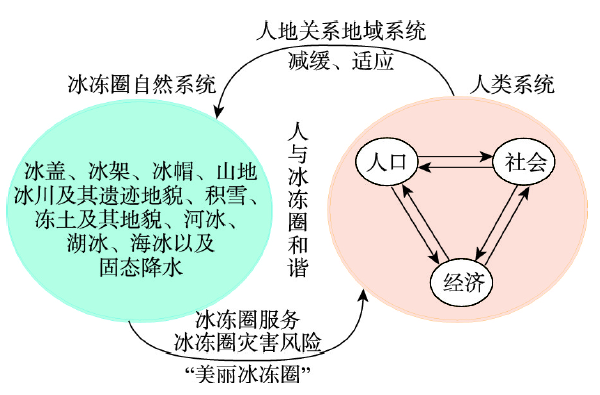
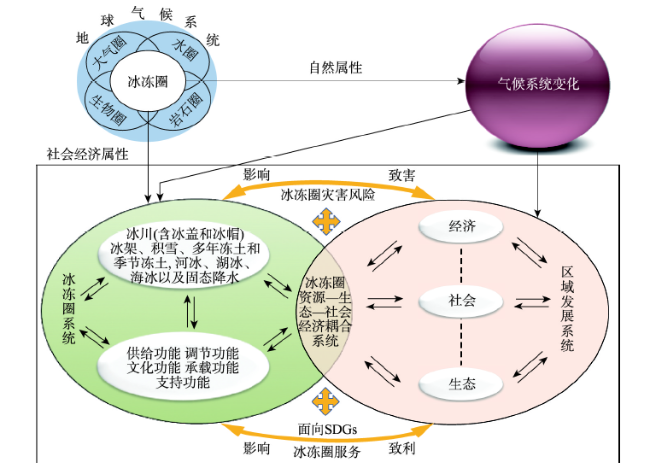
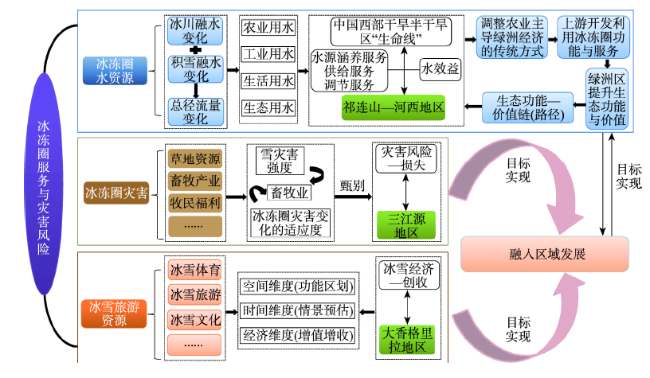
The basic connotation of "Beautiful Cryosphere (BC)" is firstly discussed in the paper. After that, the relationship between BC and regional sustainable development is analyzed from two aspects of natural and social economy attributes of the cryosphere, and from two lines of cryospheric profit and harm. BC, regional social and economic development, and human well-being constitute the cryosphere and huaman social and economic complex destiny community. There are significant regional differences for cryosphere changes and their effects in China. Therefore, the Qilian Mountains-Hexi Corridor region, the Three Rivers Source Region (Yangtze, Yellow and Lancang rivers) over the Tibetan Plateau and the Great Shangri-La region are selected to represent the impact area of cryospheric water resources, the cryospheric disaster affected area, and cryospheric tourism economic zone, respectively. This paper mainly focuses on the core issues of cryospheric water resources services and oasis economy, snow disaster risk and animal husbandry development, ice and snow tourism and regional economy, analyzes in detail the approaches and models of BC integration into regional development from the perspective of cryosphere service and disaster risk. In arid and semi-arid inland areas, the cryosphere resources are integrated into the oasis social and economic development mainly through water conservation, water supply and runoff regulation services, so we built a cryosphric water resource-supported development model. In the alpine region of the Tibetan Plateau, cryospheric ecological environment determines the vulnerability of animal husbandry economy, and cryospheric hazards negatively affects the animal husbandry economy, which is a kind of cryospheric ecology-supported and cryospheric disaster-influenced development model. The cryospheric tourism economic zone that directly depends on ice and snow resources can develop ice and snow tourism, which is a kind of tourism economy-driven development model based on cryosphere resources.
YANG Jianping , HA Lin , KANG Yunjie , XIAO Jie , CHEN Hongju , HE Qingshan . Approaches and models of 'Beautiful Cryosphere' integration into regional development, China[J]. Acta Geographica Sinica, 2021 , 76(10) : 2379 -2390 . DOI: 10.11821/dlxb202110004
| [1] |
[ 胡锦涛. 坚定不移沿着中国特色社会主义道路前进为全面建成小康社会而奋斗: 在中国共产党第十八次全国代表大会上的报告. 北京: 人民出版社, 2012.]
|
| [2] |
[ 习近平. 决胜全面建成小康社会夺取新时代中国特色社会主义伟大胜利: 在中国共产党第十九次全国代表大会上的报告. 北京: 人民出版社, 2017.]
|
| [3] |
Ministry of Ecology and Environment of the People's Repubilic of China. Outline of National Ecologically Vulnerable Areas Protection Planning (No.92). http://www.mee.gov.cn/gkml/hbb/bwj/200910/t20091022_174613.htm 2008.
[中华人民共和国生态环境部. 《全国生态脆弱区保护规划纲要》环发〔2008〕92号. http://www.mee.gov.cn/gkml/hbb/bwj/200910/t20091022_174613.htm 2008.]
|
| [4] |
[ 秦大河, 姚檀栋, 丁永建, 等. 冰冻圈科学概论. 北京: 科学出版社, 2018.]
|
| [5] |
IPCC. Climate Change 2007: The Physical Science Basis. Contribution of Working Group I to the Fourth Assessment Report of the Intergovernmental Panel on Climate Change Cambridge: Cambridge University Press, 2007.
|
| [6] |
[ 丁永建, 杨建平, 等. 中国冰冻圈变化的脆弱性与适应研究. 北京: 科学出版社, 2019.]
|
| [7] |
National Development and Reform Commission. "Ice and Snow Sports Development Planning (2016-2025)" Style Scripture No.645. https://www.ndrc.gov.cn/fzggw/jgsj/shs/sjdt/201611/t20161115_1121759.html 2016-11-25.
[中华人民共和国国家发展和改革委员会. 冰雪运动发展规划(2016—2025)》体经字[2016]645号. https://www.ndrc.gov.cn/fzggw/jgsj/shs/sjdt/201611/t20161115_1121759.html 2016-11-25.]
|
| [8] |
|
| [9] |
|
| [10] |
|
| [11] |
|
| [12] |
|
| [13] |
|
| [14] |
Committee on Himalayan Glaciers, Hydrology, Climate Change, and Implications for Water Security, Himalayan Glaciers: Climate Change, Water Resources, and Water Security. Washington D C: The National Academies Press, 2012.
|
| [15] |
|
| [16] |
|
| [17] |
IPCC. Climate Change 2014: Impacts, Adaptation and Vulnerability Cambridge: Cambridge University Press, 2014.
|
| [18] |
AMAP. Snow, Water, Ice and Permafrost in the Arctic (SWIPA) 2017. Arctic Monitoring and Assessment Programme (AMAP), Oslo, Norway, 2017.
|
| [19] |
|
| [20] |
|
| [21] |
|
| [22] |
AMAP. Climate Change Update 2019: An Update to Key Findings of Snow, Water, Ice and Permafrost in the Arctic (SWIPA) 2017. Arctic Monitoring and Assessment Programme (AMAP), Oslo, Norway, 2019.
|
| [23] |
|
| [24] |
|
| [25] |
|
| [26] |
|
| [27] |
[ 效存德, 王世金, 秦大河, 冰冻圈服务功能及其价值评估初探. 气候变化研究进展, 2016, 12(1):45-52.]
|
| [28] |
[ 效存德, 苏勃, 王晓明, 等. 冰冻圈功能及其服务衰退的级联风险. 科学通报, 2019, 64(19):1975-1984.]
|
| [29] |
|
| [30] |
|
| [31] |
|
| [32] |
|
| [33] |
|
| [34] |
|
| [35] |
|
| [36] |
[ 王世金, 效存德. 全球冰冻圈灾害高风险区: 影响与态势. 科学通报, 2019, 64(9):890-900.]
|
| [37] |
[ 徐中民, 程国栋. 可持续发展系统评价的属性细分理论与应用. 地理科学, 2001, 21(1):7-11.]
|
| [38] |
[ 林纾, 李红英, 党冰, 等. 甘肃河西走廊地区气候暖湿转型后的最新事实. 冰川冻土, 2014, 36(5):1111-1121.]
|
| [39] |
[ 丁永建, 张世强, 陈仁升. 水科学前沿丛书: 寒区水文导论. 北京: 寒科学出版社, 2017: 18.]
|
| [40] |
[ 陈仁升, 张世强, 阳勇, 等. 冰冻圈变化对中国西部寒区径流的影响. 北京: 科学出版社, 2019.]
|
| [41] |
[ 刘彩红, 余锦华, 方珂, 等. 青藏高原雪灾变化对热带海洋海温异常响应的数值模拟. 气象科学, 2020, 40(6):810-818.]
|
| [42] |
[ 鲁萌萌, 吴仁广, 杨崧, 等. 欧亚大陆冷季积雪与亚洲夏季风的关系: 区域特征与季节性. 大气科学学报, 2020, 43(1):93-103.]
|
| [43] |
[ 刘巧, 范继辉, 程根伟, 等. 川滇藏三省交界地区冰川旅游资源的特征及其开发. 国土与自然资源研究, 2006(1):63-64.]
|
| [44] |
China National Tourism Administration. Master Plan for Shangri-La Eco-Tourism Area of China (2007-2020). Beijing: China Travel & Tourism Press, 2008: 59-61.
[中华人民共和国国家旅游局. 中国香格里拉生态旅游区总体规划(2007—2020), 北京: 中国旅游出版社, 2008: 59-61.]
|
| [45] |
[ 王世金, 秦大河, 任贾文. 中国冰川旅游资源空间开发布局研究. 地理科学, 2012, 32(4):464-470.]
|
/
| 〈 |
|
〉 |