



Evaluating changes in ecological land and effect of protecting important ecological spaces in China
Received date: 2020-11-03
Request revised date: 2021-04-20
Online published: 2021-09-25
Supported by
National Key R&D Program of China(2017YFC0506606)
National Key R&D Program of China(2017YFC0506506)
National Key R&D Program of China(2016YFC0500206)
Copyright
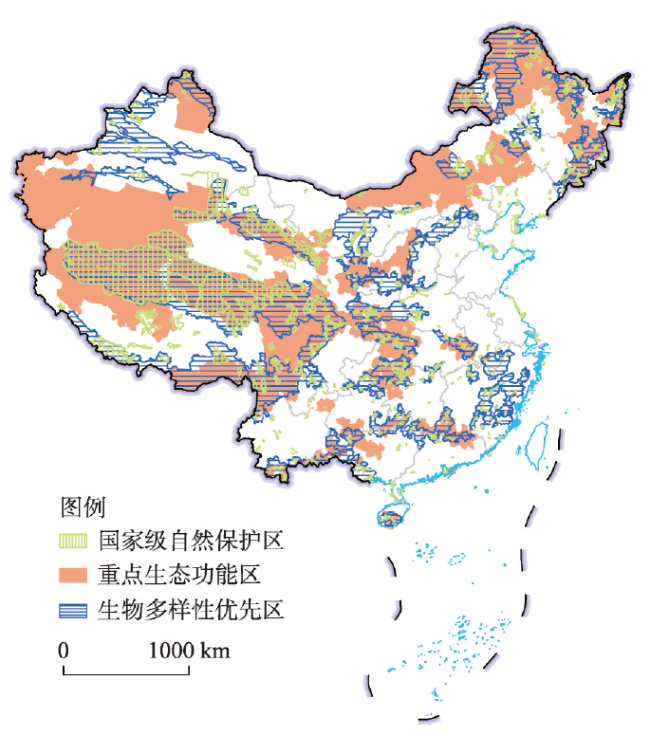
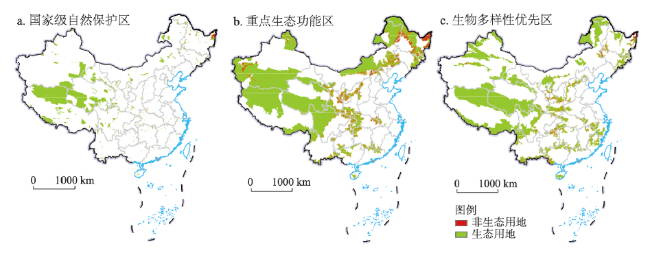
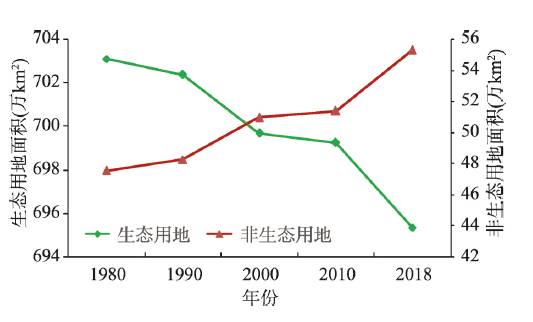
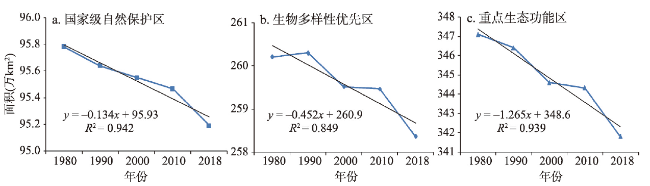
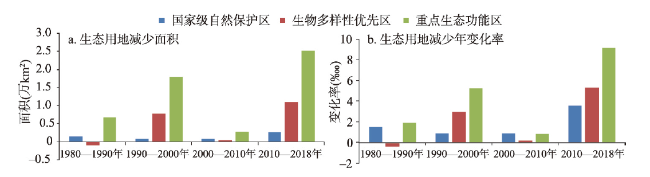
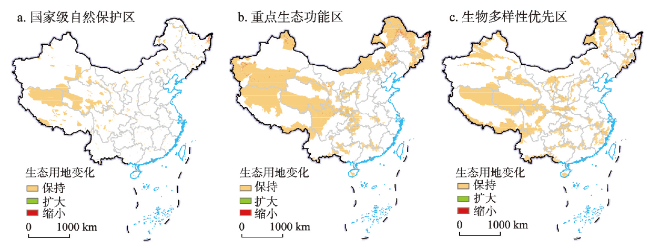
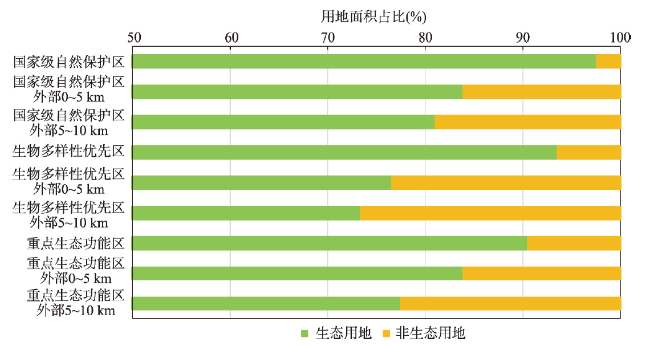
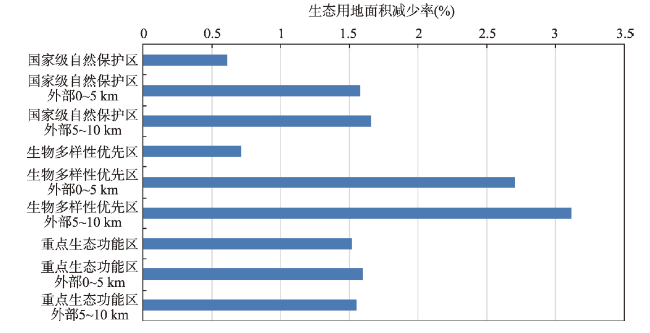
It is important to quantitatively analyze the effects of protecting important ecological spaces in China to ensure national ecological security. By considering changes in the ecological land, this study examines the effects of protecting three types of important natural ecological spaces in China. The results show that: (1) In 2018, the ratio of ecological land to important natural ecological spaces accounted for 92.64%. This land had a good ecological background that reflects the developmental orientation of important ecological spaces. (2) From 1980 to 2018, the area of ecological land in important ecological spaces shrank but the rate of reduction was lower than the national average, which shows the positive effect of regulating construction in natural ecological spaces. The restorative effects of ecological projects to convert farmland into forests and grasslands have been prominent. The expanded ecological land is mainly distributed in areas where such projects have been implemented, and the reduced area is concentrated in grain-producing regions of the Northeast China Plain and agricultural oases of Xinjiang. In the future, the government should focus on strengthening the management and control of these areas. (3) The area ratio of ecological land was the highest in national nature reserves. The rate of reduction in its area was the lowest and the trend of reduction was the smallest in national nature reserves, which reflects differences in the status of ecological protection among different spaces. (4) The ratio of ecological land to important ecological spaces was higher than that in the surrounding external space, and the rate of reduction in it was lower. Thus, the effects of internal and external protection had clear differences in terms of gradient.
GAO Jixi , LIU Xiaoman , WANG Chao , WANG Yong , FU Zhuo , HOU Peng , LYU Na . Evaluating changes in ecological land and effect of protecting important ecological spaces in China[J]. Acta Geographica Sinica, 2021 , 76(7) : 1708 -1721 . DOI: 10.11821/dlxb202107010
表1 生态用地、非生态用地与不同土地利用类型的对应关系Tabl. 1 Corresponding relationship between non-ecological land, ecological land and different land use types |
| 用地类型 | 对应的土地利用类型 |
|---|---|
| 生态用地 | 有林地、灌木林、疏林地、其它林地 |
| 高覆盖度草地、中覆盖度草地、低覆盖度草地 | |
| 河渠、湖泊、水库坑塘、永久性冰川雪地、滩涂、滩地 | |
| 沙地、戈壁、盐碱地、沼泽地、裸土地、裸岩石质地 | |
| 非生态用地 | 农业用地:水田、旱地 |
| 城镇用地:城镇、农村居民点、其它建设用地 |
表2 2018年3类重要生态空间内不同用地面积与占比统计(万km2)Tab. 2 The area and proportion of three types of important natural ecological space in 2018 (×104 km2) |
| 重要生态空间 | 非生态用地面积及比例 | 生态用地面积及比例 | 总计 |
|---|---|---|---|
| 国家级自然保护区 | 2.26 | 95.19 | 97.45 |
| (2.32) | (97.68) | ||
| 生物多样性优先区 | 17.53 | 258.37 | 275.9 |
| (6.35) | (93.65) | ||
| 重点生态功能区 | 35.48 | 341.81 | 377.29 |
| (9.40) | (90.60) | ||
| 三类重要生态空间 | 55.27 | 695.37 | 750.64 |
| 合计 | (7.36) | (92.64) |
注:括号内为面积占比(%)。 |
表3 1980—2018年3类重要生态空间内不同用地面积转移情况(万km2)Tab. 3 Land area transfer in three types of important natural ecological space from 1980 to 2018 (×104 km2) |
| 重要生态空间 | 1980年 | 2018年 | |||
|---|---|---|---|---|---|
| 生态用地 | 非生态用地 | ||||
| 农业用地 | 城镇用地 | ||||
| 国家级自然保护区 | 生态用地 | 94.75 | 0.98 | 0.05 | |
| 非生态用地 | 农业用地 | 0.38 | 1.15 | 0.03 | |
| 城镇用地 | 0.06 | 0.02 | 0.04 | ||
| 生物多样性优先区 | 生态用地 | 254.04 | 5.73 | 0.45 | |
| 非生态用地 | 农业用地 | 4.23 | 10.58 | 0.32 | |
| 城镇用地 | 0.10 | 0.12 | 0.33 | ||
| 重点生态功能区 | 生态用地 | 335.03 | 11.45 | 0.62 | |
| 非生态用地 | 农业用地 | 6.59 | 21.75 | 0.63 | |
| 城镇用地 | 0.20 | 0.34 | 0.70 | ||
| 3类重要生态空间合计 | 生态用地 | 683.82 | 18.16 | 1.12 | |
| 非生态用地 | 农业用地 | 11.20 | 33.47 | 0.99 | |
| 城镇用地 | 0.36 | 0.48 | 1.06 | ||
图4 1980—2018年不同重要生态空间内生态用地面积变化趋势Fig. 4 The change trend of ecological land in important natural ecological spaces in China from 1980 to 2018 |
表4 1980—2018年重要生态空间内生态用地面积变化Tab. 4 Change of area and proportion of ecological land in important natural ecological spaces from 1980 to 2018 |
| 变化情况 | 国家级自然保护区 | 生物多样性优先区 | 重点生态功能区 | |||||
|---|---|---|---|---|---|---|---|---|
| 面积(万km2) | 占比(%) | 面积(万km2) | 占比(%) | 面积(万km2) | 占比(%) | |||
| 保持 | 94.75 | 98.9 | 254.04 | 97.6 | 335.03 | 96.5 | ||
| 缩小 | 1.03 | 1.1 | 6.18 | 2.4 | 12.07 | 3.5 | ||
| 扩大 | 0.44 | 0.5 | 4.33 | 1.7 | 6.79 | 2.0 | ||
| [1] |
[ 高吉喜, 徐德琳, 乔青, 等. 自然生态空间格局构建与规划理论研究. 生态学报, 2020,40(3):749-755.]
|
| [2] |
Ministry of Land and Resources of the PRC. Natural Ecological Space Use Control (trial). 2017.
[国土资源部. 自然生态空间用途管制办法(试行). 2017.]
|
| [3] |
[ 祁帆, 李宪文, 刘康. 自然生态空间用途管制制度研究. 中国土地, 2016(12):21-23.]
|
| [4] |
General Office of the CPC Central Committee and General Office of the State Council of the PRC. Guiding opinions on the establishment of natural reserve system with national park as the main body. (2019-06-26). http://www.gov.cn/zhengce/2019-06/26/content_5403497.htm
[中共中央办公厅国务院办公厅. 关于建立以国家公园为主体的自然保护地体系的指导意见. (2019-06-26). http://www.gov.cn/zhengce/2019-06/26/content_5403497.htm
|
| [5] |
[ 唐芳林, 王梦君, 孙鸿雁. 自然保护地管理体制的改革路径. 林业建设, 2019(2):1-5.]
|
| [6] |
Sate Council of the PRC. The main functional area planning. 2010.
[国务院. 全国主体功能区规划. 2010.]
|
| [7] |
Ministry of Environment Protection, et al. China Biological Diversity Protection Action Plan (2011-2030). Beijing: China Environmental Science Press, 2011.
[环境保护部, 等. 中国生物多样性保护战略与行动计划(2011—2030年). 北京: 中国环境科学出版社, 2011.]
|
| [8] |
[ 侯鹏, 王桥, 房志, 等. 国家生态保护重要区域植被长势遥感监测评估. 生态学报, 2013,33(3):780-788.]
|
| [9] |
|
| [10] |
|
| [11] |
|
| [12] |
|
| [13] |
|
| [14] |
[ 范泽孟, 张轩, 李婧, 等. 国家级自然保护区土地覆盖类型转换趋势. 地理学报, 2012,67(12):1623-1633.]
|
| [15] |
[ 赵国松, 刘纪远, 匡文慧, 等. 1990—2010年中国土地利用变化对生物多样性保护重要区域的扰动. 地理学报, 2014,69(11):1640-1650.]
|
| [16] |
[ 徐洁, 谢高地, 肖玉, 等. 国家重点生态功能区生态环境质量变化动态分析. 生态学报, 2019,39(9):3039-3050.]
|
| [17] |
[ 黄麟, 曹巍, 吴丹, 等. 2000—2010年我国重点生态功能区生态系统变化状况. 应用生态学报, 2015,26(9):2758-2766.]
|
| [18] |
[ 侯鹏, 翟俊, 曹巍, 等. 国家重点生态功能区生态状况变化与保护成效评估: 以海南岛中部山区国家重点生态功能区为例. 地理学报, 2018,73(3):429-441.]
|
| [19] |
[ 祝萍, 黄麟, 肖桐, 等. 中国典型自然保护区生境状况时空变化特征. 地理学报, 2018,73(1):92-103.]
|
| [20] |
[ 璩路路, 刘彦随, 周扬, 等. 罗霄山区生态用地时空演变及其生态系统服务功能的响应: 以井冈山为例. 生态学报, 2019,39(10):3468-3481.]
|
| [21] |
[ 管青春, 郝晋珉, 石雪洁, 等. 中国生态用地及生态系统服务价值变化研究. 自然资源学报, 2018,33(2):195-207.]
|
| [22] |
[ 喻锋, 李晓波, 张丽君, 等. 中国生态用地研究: 内涵、分类与时空格局. 生态学报, 2015,35(14):4931-4943.]
|
| [23] |
[ 马童慧, 吕偲, 雷光春. 中国自然保护地空间重叠分析与保护地体系优化整合对策. 生物多样性, 2019,27(7):758-771.]
|
| [24] |
[ 刘纪远, 宁佳, 匡文慧, 等. 2010—2015年中国土地利用变化的时空格局与新特征. 地理学报, 2018,73(5):789-802.]
|
| [25] |
[ 刘纪远, 匡文慧, 张增祥, 等. 20世纪80年代末以来中国土地利用变化的基本特征与空间格局. 地理学报, 2014,69(1):3-14.]
|
| [26] |
[ 刘纪远, 刘文超, 匡文慧, 等. 基于主体功能区规划的中国城乡建设用地扩张时空特征遥感分析. 地理学报, 2016,71(3):355-369.]
|
| [27] |
[ 张增祥, 赵晓丽, 汪潇, 等. 中国土地利用遥感监测. 北京: 星球地图出版社, 2012.]
|
| [28] |
[ 刘纪远. 中国资源环境遥感宏观调查与动态研究. 北京: 中国科学技术出版社, 1996.]
|
| [29] |
|
| [30] |
[ 刘纪远, 张增祥, 庄大方, 等. 20世纪90年代中国土地利用变化时空特征及其成因分析. 地理研究, 2003,22(1):1-12.]
|
| [31] |
|
| [32] |
|
| [33] |
[ 杨荣金, 周申立, 王兴贵. 生态用地研究进展综述. 中国环境管理干部学院学报, 2011,21(2):33-35.]
|
| [34] |
[ 唐秀美, 陈百明, 路庆斌, 等. 北京市土地利用生态分类方法. 生态学报, 2011,31(14):3902-3909.]
|
| [35] |
[ 周朕, 蒙吉军, 齐杨, 等. 中国生态用地重要性及其格局优化研究进展. 生态学杂志, 2016,35(1):218-225.]
|
| [36] |
[ 彭建, 汪安, 刘焱序, 等. 城市生态用地需求测算研究进展与展望. 地理学报, 2015,70(2):333-346.]
|
| [37] |
[ 刘继来, 刘彦随, 李裕瑞. 中国“三生空间”分类评价与时空格局分析. 地理学报, 2017,72(7):1290-1304.]
|
| [38] |
[ 王静, 王雯, 祁元, 等. 中国生态用地分类体系及其1996—2012年时空分布. 地理研究, 2017,36(3):453-470.]
|
| [39] |
[ 龙花楼, 刘永强, 李婷婷, 等. 生态用地分类初步研究. 生态环境学报, 2015,24(1):1-7.]
|
| [40] |
[ 李广东, 方创琳. 城市生态—生产—生活空间功能定量识别与分析. 地理学报, 2016,71(1):49-65.]
|
| [41] |
[ 谢花林, 姚干, 何亚芬, 等. 基于GIS的关键性生态空间辨识: 以鄱阳湖生态经济区为例. 生态学报, 2018,38(16):5926-5937.]
|
| [42] |
[ 欧阳志云, 李小马, 徐卫华, 等. 北京市生态用地规划与管理对策. 生态学报, 2015,35(11):3778-3787.]
|
| [43] |
[ 安国强. 基于EKC&Lorenz Curve的山东省生态用地时空演变及保护区划研究. 中国土地科学, 2018,32(9):89-96.]
|
| [44] |
[ 文博, 朱高立, 夏敏, 等. 基于景观安全格局理论的宜兴市生态用地分类保护. 生态学报, 2017,37(11):3881-3891.]
|
| [45] |
[ 韩学敏, 濮励杰, 朱明, 等. 环太湖地区有效生态用地面积的测算分析. 中国农学通报, 2010,26(22):301-305.]
|
| [46] |
[ 张红旗, 王立新, 贾宝全. 西北干旱区生态用地概念及其功能分类研究. 中国生态农业学报, 2004,12(2):10-13.]
|
| [47] |
[ 邓红兵, 陈春娣, 刘昕, 等. 区域生态用地的概念及分类. 生态学报, 2009,29(3):1519-1524.]
|
| [48] |
[ 周焱, 蔡学成, 谢元贵, 等. 典型岩溶地区生态用地研究: 以清镇市为例. 中国土地科学, 2006,20(5):38-41, 62.]
|
| [49] |
[ 俞孔坚, 乔青, 李迪华, 等. 基于景观安全格局分析的生态用地研究: 以北京市东三乡为例. 应用生态学报, 2009,20(8):1932-1939.]
|
| [50] |
[ 费建波, 夏建国, 胡佳, 等. 生态空间与生态用地国内研究进展. 中国生态农业学报, 2019,27(11):1626-1636.]
|
| [51] |
[ 岳健, 张雪梅. 关于我国土地利用分类问题的讨论. 干旱区地理, 2003,26(1):78-88.]
|
| [52] |
[ 徐健, 周寅康, 金晓斌, 等. 基于生态保护对土地利用分类系统未利用地的探讨. 资源科学, 2007,29(2):137-141.]
|
| [53] |
[ 赵丹, 李锋, 王如松. 城市生态用地的概念及分类探讨. 中国人口·资源与环境, 2009,19(6):337-342.]
|
/
| 〈 |
|
〉 |