



Coagglomeration and spatial relatedness of China's industry
Received date: 2020-02-23
Request revised date: 2020-12-08
Online published: 2021-06-25
Supported by
National Social Science Foundation of China(19CJY002)
Copyright
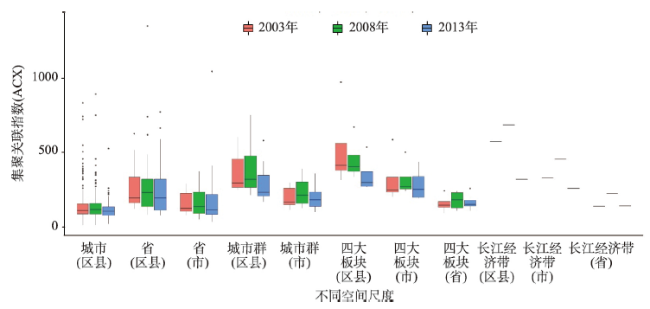
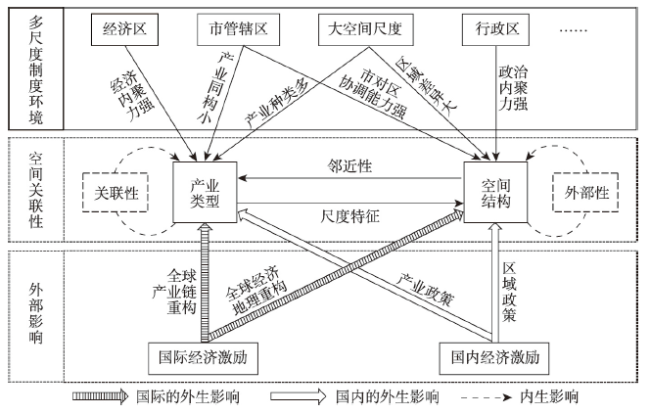
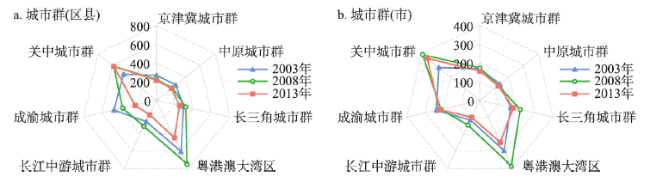
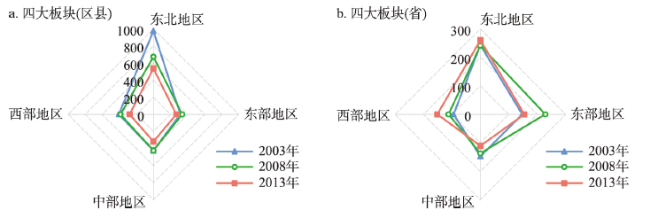
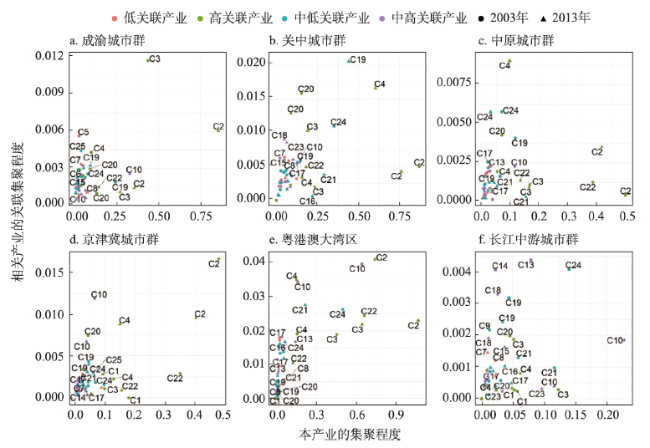
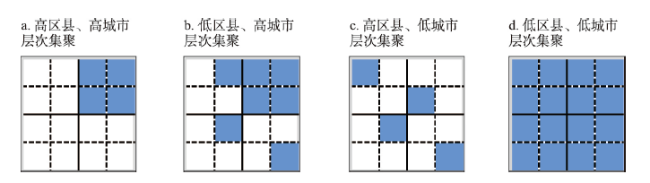
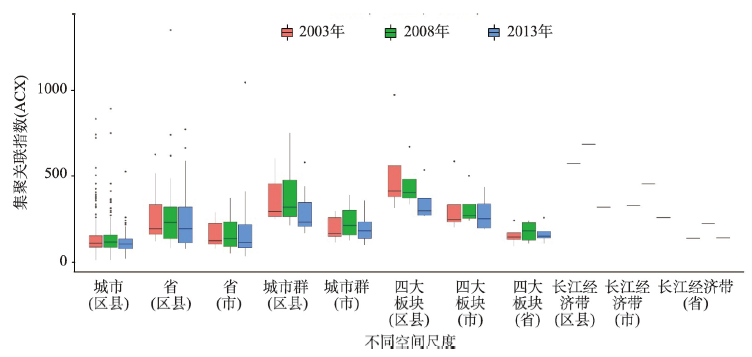
In order to promote the formation of a regional economic location with complementary advantages and high-quality development, it is necessary to examine the spatial pattern of Chinese industry from the perspective of industrial relatedness. Agglomeration is a common spatial pattern of industry. We construct two indices by combining coagglomeration and input-output linkages to analyze spatial relatedness. The first index is used to measure relatedness of agglomerated industries (hereafter ACX index). The second index is used to measure agglomeration of related industries (hereafter CXI index). Then, we use two-digit data from Chinese industrial enterprises database and measure the proposed indices to answer the following 2 questions: (1) whether the spatial relatedness is different at different spatial scales, and (2) what makes the difference in spatial relatedness. We find that more coagglomerations in a region do not mean that the ACX index is large. The ACX index of Chinese industry presents an inverted U-shaped distribution from 2003 to 2013. Comparing different spatial scales, we find that there is a positive correlation between the ACX index and size of the researched space, however, there is a negative correlation between ACX index and size of the basic unit. Comparing similar spatial scales, we find the ACX index is larger in city clusters and the Yangtze Economic Belt. These differences are mainly due to the existing regional governance system, the industrial composition of the region and external shocks. Different regions and industrial composition will evolve into different industrial spatial patterns. Therefore, it is necessary to create networks of cities and towns based on city clusters and the Yangtze River Economic Belt, so as to enhance industrial division and urban cooperation. In this way, the optimal regional economic location and coordinated regional development would be achieved.
ZHANG Keyun , ZHU Chunxiao . Coagglomeration and spatial relatedness of China's industry[J]. Acta Geographica Sinica, 2021 , 76(4) : 1019 -1033 . DOI: 10.11821/dlxb202104016
表1 文中涉及的11种空间尺度Tab. 1 11 spatial scales in this paper |
| 基本单元 | 研究空间 | ||||
|---|---|---|---|---|---|
| 市 | 省 | 城市群 | 长江经济带 | 四大板块 | |
| 区县 | √ | √ | √ | √ | √ |
| 市 | - | √ | √ | √ | √ |
| 省 | - | - | - | √ | √ |
注:“√”表示文中涉及的空间尺度,如第一个“√”表示本文研究了市中的产业在区县层次的空间关联性。 |
表2 文中涉及的25个产业名称及代码Tab. 2 Names and codes of 25 industries in this paper |
| 代码 | 产业名称 | 代码 | 产业名称 | 代码 | 产业名称 |
|---|---|---|---|---|---|
| C1 | 煤炭开采和洗选业 | C11 | 化学工业 | C20 | 仪器仪表及文化办公用机械 制造业 |
| C2 | 石油和天然气开采业 | C12 | 非金属矿物制品业 | ||
| C3 | 金属矿采选业 | C13 | 金属冶炼及压延加工业 | C21 | 其他制造业 |
| C4 | 非金属矿采选业 | C14 | 金属制品业 | C22 | 废弃资源和废旧材料回收加 |
| C5 | 食品制造及烟草加工业 | C15 | 通用设备制造业 | 工业 | |
| C6 | 纺织业 | C16 | 专用设备制造业 | C23 | 电力、热力的生产和供应业 |
| C7 | 服装皮革羽绒及其制品业 | C17 | 交通运输设备制造业 | C24 | 燃气生产和供应业 |
| C8 | 木材加工及家具制造业 | C18 | 电气、机械及器材制造业 | C25 | 水的生产和供应业 |
| C9 | 造纸业及文教用品制造业 | C19 | 通讯设备、计算机及其他电子设备制造业 | ||
| C10 | 石油加工、炼焦及核燃料加工业 |
注:2012年后通用、专用设备制造业拆分为通用设备制造业(C15)和专用设备制造业(C16),故在2003—2011年共研究了24个产业,在2012年和2013年共研究了25个产业。 |
| [1] |
[ 习近平. 推动形成优势互补高质量发展的区域经济布局. 求是, 2019(24):4-9.]
|
| [2] |
[ 吴三忙, 李善同. 中国制造业地理集聚的时空演变特征分析: 1980—2008. 财经研究, 2010,36(10):4-14.]
|
| [3] |
[ 赵金丽, 张落成. 长三角地区制造业格局演变与优势变化. 中国人口·资源与环境, 2013,23(S2):143-146.]
|
| [4] |
[ 郑艳婷, 王韶菲, 戴荔珠, 等. 长江中游地区制造业企业时空演化格局. 经济地理, 2018,38(5):117-125.]
|
| [5] |
[ 韩增林, 杨文毅, 郭建科, 等. 环渤海地区临港石化产业集聚水平测度. 地理科学, 2017,37(8):1135-1144.]
|
| [6] |
[ 贺灿飞, 朱向东, 孔莹晖, 等. 集聚经济、政策激励与中国计算机制造业空间格局: 基于贸易数据的实证研究. 地理科学, 2018,38(10):1579-1588.]
|
| [7] |
|
| [8] |
|
| [9] |
|
| [10] |
|
| [11] |
[ 路江涌, 陶志刚. 中国制造业区域聚集及国际比较. 经济研究, 2006,41(3):103-114.]
|
| [12] |
[ 文东伟, 冼国明. 中国制造业产业集聚的程度及其演变趋势: 1998—2009年. 世界经济, 2014,37(3):3-31.]
|
| [13] |
[ 李瑞琴, 孙浦阳. 地理集聚与企业的自选择效应: 基于上、下游关联集聚和专业化集聚的比较研究. 财贸经济, 2018,39(4):114-129.]
|
| [14] |
|
| [15] |
[ 马国霞, 石敏俊, 李娜. 中国制造业产业间集聚度及产业间集聚机制. 管理世界, 2007(8):58-65.]
|
| [16] |
[ 陈曦, 朱建华, 李国平. 中国制造业产业间协同集聚的区域差异及其影响因素. 经济地理, 2018,38(12):104-110.]
|
| [17] |
|
| [18] |
|
| [19] |
|
| [20] |
[ 曹玉平. 空间经济分布结构的测度方法及其评述. 经济问题探索, 2016(8):185-190.]
|
| [21] |
|
| [22] |
[ 贺灿飞, 潘峰华, 孙蕾. 中国制造业的地理集聚与形成机制. 地理学报, 2007,62(12):1253-1264.]
|
| [23] |
[ 刘守英. 土地制度与中国发展. 北京: 中国人民大学出版社, 2018.]
|
| [24] |
[ 孟美侠, 曹希广, 张学良. 开发区政策影响中国产业空间集聚吗: 基于跨越行政边界的集聚视角. 中国工业经济, 2019(11):79-97.]
|
| [25] |
|
| [26] |
|
| [27] |
[ 毛熙彦, 贺灿飞. 区域发展的“全球—地方”互动机制研究. 地理科学进展, 2019,38(10):1449-1461.]
|
| [28] |
|
| [29] |
[ 贺灿飞, 朱彦刚, 朱晟君. 产业特性、区域特征与中国制造业省区集聚. 地理学报, 2010,65(10):1218-1228.]
|
| [30] |
[ 宋凌云, 王贤彬. 重点产业政策、资源重置与产业生产率. 管理世界, 2013(12):63-77.]
|
| [31] |
[ 陆铭. 空间的力量: 地理、政治与城市发展. 上海: 格致出版社, 2013.]
|
| [32] |
|
| [33] |
|
| [34] |
Institute of Industrial Economics of CASS. China's Industrial Development Report (2019). Beijing: Economic Management Press, 2020.
[ 中国社会科学院工业经济研究所. 中国工业发展报告2019. 北京: 经济管理出版社, 2020.]
|
| [35] |
[ 蔡之兵. 高质量发展的区域经济布局的形成路径: 基于区域优势互补的视角. 改革, 2020(8):132-146.]
|
/
| 〈 |
|
〉 |