



Coupled modes of grain yield and agricultural labor changes and rural development types at county level in Northeast China
Received date: 2019-01-04
Request revised date: 2020-04-03
Online published: 2020-12-25
Supported by
National Natural Science Foundation of China(42071223)
National Natural Science Foundation of China(41630749)
Copyright
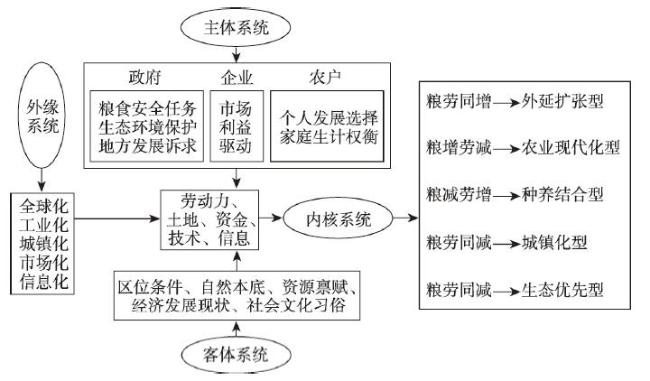
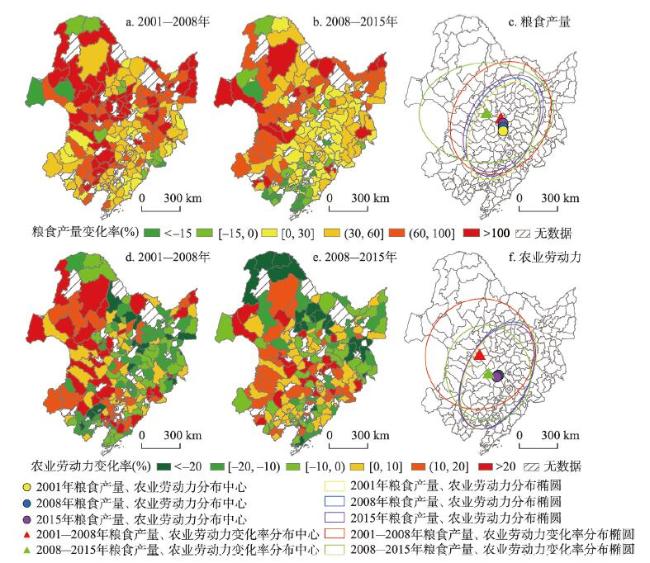
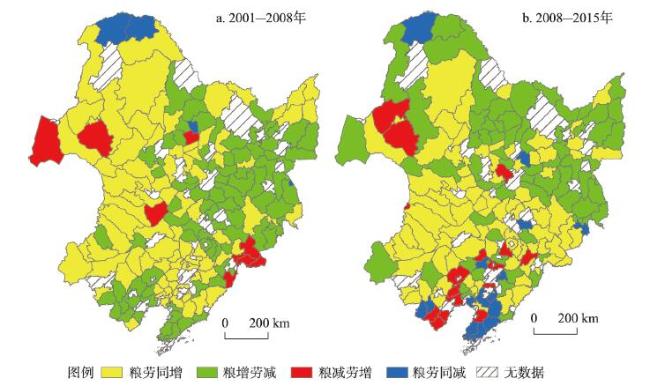
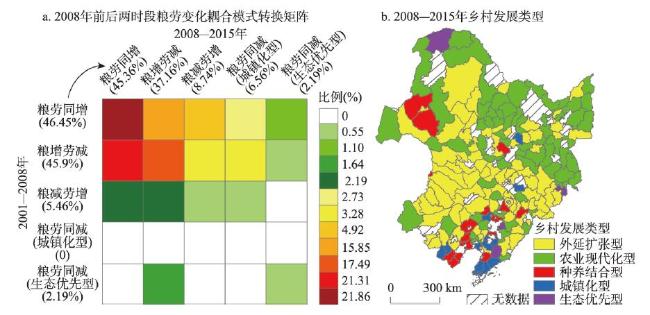
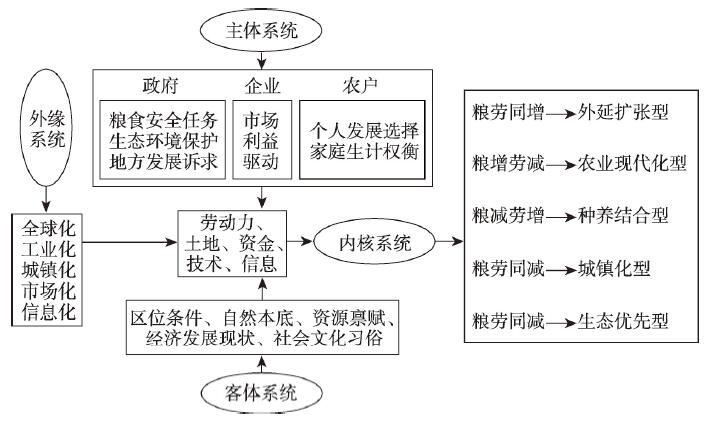
Rural revitalization needs to recognize and address the diversity of rural areas. Based on statistical data of grain yield and agricultural labor, this paper analyzes the coupled modes of the changes of grain yield and agricultural labor as well as their representations of rural development typology of 183 counties in Northeast China by using standard deviation ellipse, non-parametric test, and so on. The results show that: (1) during 2001-2015, the coupled mode of grain yield and agricultural labor changes of the whole study region turned in 2008. During 2001-2008, its grain yield increased while agricultural labor decreased; but during 2008-2015, both its grain yield and agricultural labor increased. Actually, this is due to degradation that resulted from the comprehensive interactions of many factors. (2) At county level, the proportion of grain yield increased while agricultural labor decreased counties in Northeast China shrank from 45.90% in 2001-2008 to 37.16% in 2008-2015, and the numbers of grain yield decreased while agricultural labor increased counties and grain yield and agricultural labor both decreased counties grew obviously. Spatially, the coupled modes of grain yield and agricultural labor changes evolved in differentiated patterns. (3) Based on the coupled modes of grain yield and agricultural labor changes and other supplementary indicators, this paper classifies the rural development typology at county level in Northeast China into five categories: extensive expansion type, agriculture modernization type, planting-breeding incorporated type, urbanizing type, and eco-environment prioritized type. The results show that these rural development types have certain hierarchical nature and present a structural evolution. Therefore, the coupled modes of grain yield and agricultural labor changes can represent the rural development typology well. (4) Different rural development types in Northeast China are facing different constraints and opportunities. In the light of these facts, this paper proposes the differential promotion strategies targeting specific rural development types. The approaches and strategies developed in this paper could be applied in other regions of China to analyze and address the diversity of rural areas.
FANG Yangang , LIU Jianzhi . Coupled modes of grain yield and agricultural labor changes and rural development types at county level in Northeast China[J]. Acta Geographica Sinica, 2020 , 75(10) : 2241 -2255 . DOI: 10.11821/dlxb202010014
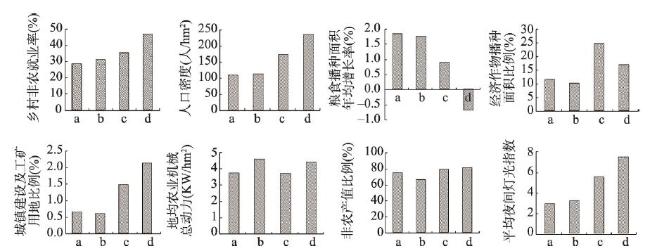
图6 2008—2015年东北地区县域乡村发展类型核心特征均值分布注:a. 外延扩张型,b. 农业现代化型,c. 种养结合型,d. 城镇化型;因生态优先型县域仅漠河、抚顺县、龙井、岫岩满族自治县4个,样本数量过少,故未做分析。 Fig. 6 Distribution of the mean value of the core features of rural development types at county level in Northeast China during 2008-2015 |
表1 非参数检验与秩变换分析法结果汇总表Tab. 1 Summary of nonparametric test and rank transformation analysis results |
| 乡村发展类型 | 变量 | H统计量 | 秩均值 | 变量 | H统计量 | 秩均值 |
|---|---|---|---|---|---|---|
| 外延扩张型 | 乡村非农就业率 | 24.880** | 78.4578c-d- | 城镇建设及工矿用地比例 | 24.641** | 86.7952c-d- |
| 农业现代化型 | 86.9412d- | 77.2500c-d- | ||||
| 种养结合型 | 112.8125a+d- | 117.1250a+b+ | ||||
| 城镇化型 | 154.7273a+b+c+ | 145.4546a+b+ | ||||
| 外延扩张型 | 人口密度 | 24.766** | 83.8434c+d+ | 地均农业机械总动力 | 6.055 | — |
| 农业现代化型 | 79.3235c+d+ | |||||
| 种养结合型 | 120.0625a-b- | |||||
| 城镇化型 | 150.6364a-b- | |||||
| 外延扩张型 | 粮食播种面积 年均增长率 | 13.074** | 95.5663d+ | 非农产值比例 | 17.091** | 97.2289b+ |
| 农业现代化型 | 94.4638d+ | 70.5441a-c-d- | ||||
| 种养结合型 | 83.6250d+ | 110.0625b+ | ||||
| 城镇化型 | 41.8333a-b-c- | 118.4546b+ | ||||
| 外延扩张型 | 经济作物播种 面积比例 | 20.046** | 88.7229c- | 平均夜间灯光指数 | 20.926** | 79.5301c+d+ |
| 农业现代化型 | 75.8824c-d- | 86.3677c+d+ | ||||
| 种养结合型 | 134.7500a+b+ | 115.1250a-b- | ||||
| 城镇化型 | 113.7273b+ | 146.8182a-b- |
注:*、**分别表示变量通过5%、1%的显著性检验;秩均值中的上标表示该类型县域与字母表征的县域乡村发展类型在此项指标上的差异通过5%的显著性检验,字母含义与图6相同。如“a+”表示该类型县域的此项指标显著高于外延扩张型,“b-”表示该类型县域的此项指标显著低于农业现代化型。因生态优先型县域仅漠河、抚顺县、龙井、岫岩满族自治县4个,样本数量过少,故未做检验。 |
| [1] |
[ 迈克尔·托达罗, 陆大道 . 发展经济学. 北京: 机械工业出版社, 2014: 200-227.]
|
| [2] |
|
| [3] |
|
| [4] |
[ 姚士谋, 陆大道, 王聪 , 等. 中国城镇化需要综合性的科学思维: 探索适应中国国情的城镇化方式. 地理研究, 2011,30(11):1947-1955.]
|
| [5] |
[ 刘彦随 . 中国新时代城乡融合与乡村振兴. 地理学报, 2018,73(4):637-650.]
|
| [6] |
[ 刘守英, 王一鸽 . 从乡土中国到城乡中国: 中国转型的乡村变迁视角. 管理世界, 2018,34(10):128-146.]
|
| [7] |
|
| [8] |
[ 刘成武, 黄利民 . 农地边际化过程中农户土地利用行为变化及其对粮食生产的影响. 地理研究, 2015,34(12):2268-2282.]
|
| [9] |
|
| [10] |
[ 刘彦随, 李裕瑞 . 中国县域耕地与农业劳动力变化的时空耦合关系. 地理学报, 2010,65(12):1602-1612.]
|
| [11] |
|
| [12] |
|
| [13] |
|
| [14] |
|
| [15] |
|
| [16] |
|
| [17] |
|
| [18] |
|
| [19] |
[ 李升发, 李秀彬 . 中国山区耕地利用边际化表现及其机理. 地理学报, 2018,73(5):803-817.]
|
| [20] |
|
| [21] |
|
| [22] |
|
| [23] |
|
| [24] |
[ 戈大专, 龙花楼, 张英男 , 等. 中国县域粮食产量与农业劳动力变化的格局及其耦合关系. 地理学报, 2017,72(6):1063-1077.]
|
| [25] |
[ 黄季焜 . 四十年中国农业发展改革和未来政策选择. 农业技术经济, 2018(3):4-15.]
|
| [26] |
[ 黄宗智, 彭玉生 . 三大历史性变迁的交汇与中国小规模农业的前景. 中国社会科学, 2007(4):74-88.]
|
| [27] |
[ 蔡昉 . 农业劳动力转移潜力耗尽了吗? 中国农村经济, 2018(9):2-13.]
|
| [28] |
The State Council of China. Strategic Planning for Rural Revitalization (2018-2022). Beijing: People's Publishing House, 2018: 21-23.
[ 中共中央国务院. 乡村振兴战略规划(2018—2022). 北京: 人民出版社, 2018: 21-23.]
|
| [29] |
[ 龙花楼, 屠爽爽 . 论乡村重构. 地理学报, 2017,72(4):563-576.]
|
| [30] |
[ 龙花楼, 屠爽爽 . 乡村重构的理论认知. 地理科学进展, 2018,37(5):581-590.]
|
| [31] |
[ 杨忍, 刘彦随, 龙花楼 , 等. 中国乡村转型重构研究进展与展望: 逻辑主线与内容框架. 地理科学进展, 2015,34(8):1019-1030.]
|
| [32] |
[ 戈大专, 龙花楼, 李裕瑞 , 等. 城镇化进程中我国粮食生产系统多功能转型时空格局研究: 以黄淮海地区为例. 经济地理, 2018,38(4):147-156.]
|
| [33] |
[ 赵璐, 赵作权 . 基于特征椭圆的中国经济空间分异研究. 地理科学, 2014,34(8):979-986.]
|
| [34] |
[ 张文彤, 闫杰 . SPSS统计分析基础教程. 北京: 高等教育出版社, 2004: 289-298.]
|
| [35] |
[ 戚伟, 刘盛和, 金凤君 . 东北三省人口流失的测算及演化格局研究. 地理科学, 2017,37(12):1795-1804.]
|
| [36] |
[ 樊琦, 祁迪, 李霜 . 玉米临时收储制度的改革与转型研究. 农业经济问题, 2016(8):74-81.]
|
| [37] |
[ 于婷婷, 宋玉祥, 浩飞龙 , 等. 东北三省人口分布空间格局演化及其驱动因素研究. 地理科学, 2017,37(5):709-717.]
|
| [38] |
[ 陈玉洁, 张平宇, 刘世薇 , 等. 东北西部粮食生产时空格局变化及优化布局研究. 地理科学, 2016,36(9):1397-1407.]
|
| [39] |
[ 房艳刚, 刘继生 . 基于多功能理论的中国乡村发展多元化探讨: 超越“现代化”发展范式. 地理学报, 2015,70(2):257-270.]
|
/
| 〈 |
|
〉 |