



Policy mobility of China's overseas industrial zones in the lens of partnership: A case study of Thai-Chinese Rayong Industrial Zone
Received date: 2019-10-08
Request revised date: 2020-05-08
Online published: 2020-08-25
Supported by
National Natural Science Foundation of China(41701131)
International Cooperation Bureau of Chinese Academy of Sciences(XDA20010103)
Strategy Priority Research Program of Chinese Academy of Sciences(17VDL008)
Copyright
Policy mobility research has become an important subfield in political geography. Overseas industrial zones serve as burgeoning case areas to testify the theoretical framework of policy mobility, whose development is a key component of the Belt and Road Initiative and an expected experimental way to promote inclusive globalization. The highlight of this paper is the role that the partnership plays for multi-scalar actors in the process of policy mobility when it comes to the overseas industrial zones. In this paper, we interpret Thai-Chinese Rayong Industrial Zone's evolving strategies and development trajectory through two interrelated conceptual lenses, namely, policy mobility and partnership. It is emphasized that the policy mobility of overseas industrial zones is a multi-scalar process of gradual advancement, and the partnership plays an important role in policy mobility. This paper systematically analyzes the institutional background and main partners of Thai-Chinese Rayong Industrial Zone. Policy mobility in terms of tax, land, talent and other elements are shaped and accelerated by the interactions and partnership between Thai and Chinese central governments, local governments, and leading enterprises. Finally, the policy recommendations are proposed for the sustainable development of China's overseas industrial zones in the context of Belt and Road Initiative.
SONG Tao , LIU Weidong , GAO Boyang , LIU Zhigao , ZHENG Zhi . Policy mobility of China's overseas industrial zones in the lens of partnership: A case study of Thai-Chinese Rayong Industrial Zone[J]. Acta Geographica Sinica, 2020 , 75(6) : 1199 -1209 . DOI: 10.11821/dlxb202006008
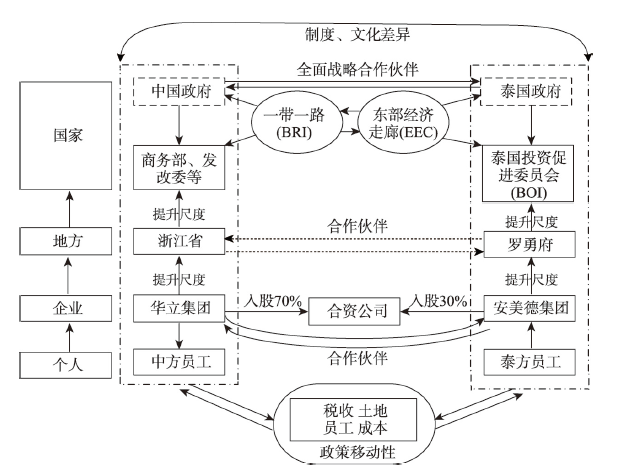
表1 泰中罗勇工业园的战略合作伙伴关系Tab. 1 Strategic cooperative partnership in Thai-Chinese Rayong Industrial Zone |
| 泰国 | 中国 | |
|---|---|---|
| 国家层面 | 泰国投资促进委员会(The Board of Investment, BOI) | 中国商务部等 |
| 省级层面 | 罗勇府 | 浙江省 |
| 公司层面 | A企业 | H企业 |
| 合资公司(泰中罗勇工业园开发有限公司) | 泰方占股30% | 中方占股70% |
| 分工 | 泰方重点承担园区的基础设施建设工作,包括园区供水、供电、道路、厂房等;土地供给及永久所有权;泰籍员工的招聘等。 | 企业选择与业态控制;面向中国企业提供“一站式”服务,包括公司注册、税务、开户和BOI资质证书申领等,提供目标市场、产业政策、法律法规、优惠政策、税务金融、劳动力招聘等咨询服务。 |
表2 泰中罗勇工业园的政策移动性Tab. 2 Policy mobility in Thai-Chinese Rayong Industrial Zone |
| 类型 | 政策集合 |
|---|---|
| 税收 | 企业所得税最高8年全免(分行业差异化优惠,如知识型、高科技产业免8年企业所得税) 免缴进口机器关税8年 以外销为目的的进口原材料免缴关税5年等 |
| 成本 | 交通、水、电等费用作为成本自所得税中双倍扣除,初次销售之日起为期10年 基础设施的安装和建设费的25%在利润中扣除,从有收入之日起10年内 |
| 外汇 | 区内企业自由外汇汇出 |
| 雇员 | 可携入外籍技工或专家及其配偶 |
| 土地 | 外籍人士可拥有土地所有权 |
| [1] |
[ 习近平. 论坚持推动构建人类命运共同体. 北京: 中央文献出版社, 2018.]
|
| [2] |
[ 刘卫东. “一带一路”战略的科学内涵与科学问题. 地理科学进展, 2015,34(5):538-544.]
|
| [3] |
[ 刘卫东, 等. “一带一路”: 引领包容性全球化. 北京: 商务印书馆, 2017.]
|
| [4] |
[ 曾刚, 赵海, 胡浩, 等. ‘一带一路’倡议下中国海外园区建设与发展报告(2018). 北京: 中国社会科学出版社, 2018.]
|
| [5] |
[ 刘卫东, 等. “一带一路”建设进展第三方评估报告(2013—2018年). 北京: 商务印书馆, 2019.]
|
| [6] |
|
| [7] |
[ 孟广文, 王洪玲, 杨爽. 天津自由贸易试验区发展演化动力机制. 地理学报, 2015,70(10):1552-1565.]
|
| [8] |
|
| [9] |
|
| [10] |
|
| [11] |
|
| [12] |
[ 刘云刚, 叶清露. 中国城市基层地域的领域化与领域政治. 地理学报, 2015,70(2):283-296.]
|
| [13] |
|
| [14] |
|
| [15] |
|
| [16] |
|
| [17] |
|
| [18] |
|
| [19] |
|
| [20] |
|
| [21] |
|
| [22] |
|
| [23] |
|
| [24] |
|
| [25] |
|
| [26] |
|
| [27] |
[ 刘云刚, 王丰龙. 尺度的人文地理学内涵与尺度政治: 基于1980年代以来英语圈人文地理学的尺度研究. 人文地理, 2011,26(3):1-6.]
|
| [28] |
|
| [29] |
|
| [30] |
|
| [31] |
|
| [32] |
|
| [33] |
[ 苗长虹, 魏也华, 吕拉昌. 新经济地理学. 北京: 科学出版社, 2011.]
|
| [34] |
|
| [35] |
|
| [36] |
|
| [37] |
|
| [38] |
[ 梁育填, 周政可, 刘逸. 东南亚华人华侨网络与中国企业海外投资的区位选择关系研究. 地理学报, 2018,73(8):1449-1461.]
|
/
| 〈 |
|
〉 |