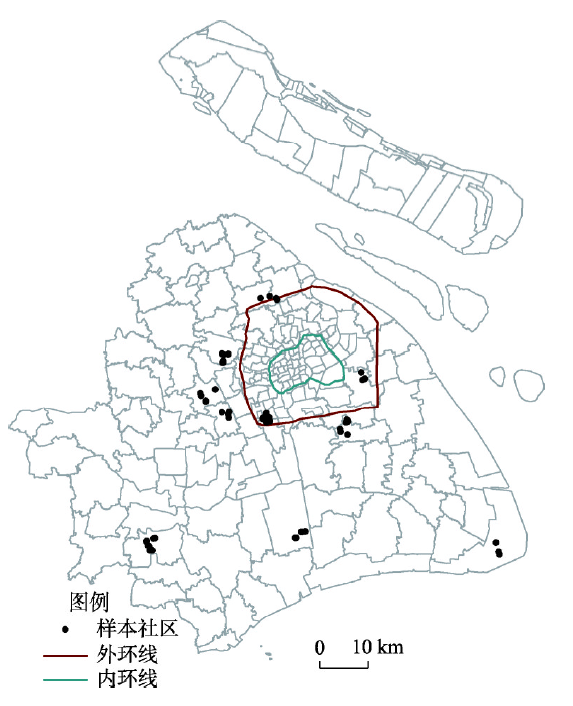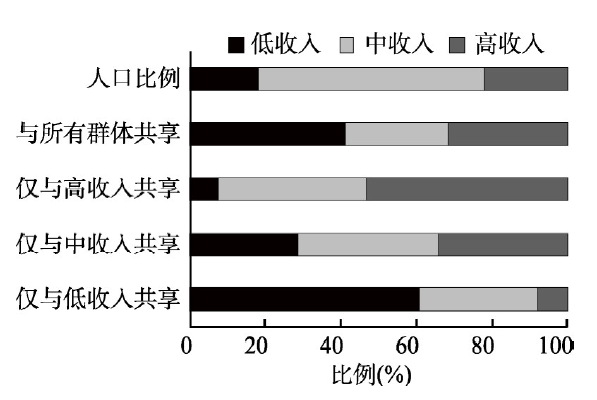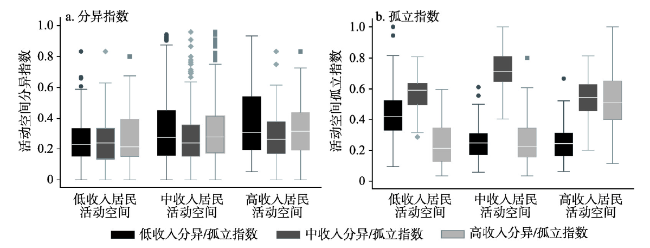




Activity space-based segregation among neighbors and its influencing factors: An analysis based on shared activity spaces in suburban Shanghai
Received date: 2018-11-27
Request revised date: 2019-12-22
Online published: 2020-06-25
Supported by
National Natural Science Foundation of China(41971200)
National Natural Science Foundation of China(41871166)
Fundamental Research Funds for the Central Universities(2018ECNU-QKT001)
Copyright
Socio-spatial segregation is an important research topic in urban social geography. Most of the research pays more attention to the residential differentiation and segregation of different groups and proposes that geographical segregation exacerbates the social isolation between disadvantaged groups and other social classes. However, most existing research ignores the spatial differentiation that people suffer from in their daily lives and discusses little about segregation in nonresidential spaces. In the context of increasing mobility, even residents living in the same neighborhood face different degrees of segregation due to differences in the choice of venues, resulting in a lower likelihood of social interaction. Therefore, recent research suggests that it is necessary to pay attention to the differentiation and segregation faced by residents in daily activity spaces and to understand social space from a more comprehensive perspective. However, due to the constraints of data and methods, only a few prior studies have quantitatively measured the activity space segregation of residents living in the same neighborhoods. In particular, there is currently no research focusing on whether policy and planning can effectively reduce activity space segregation. This study intends to solve the problem of socio-spatial segregation in the daily lives of different residents in the same neighborhood through the measurement of activity space. Taking the suburbs of Shanghai as an example, this study analyzes the degree of overlap between residents and other social groups in activity spaces, calculates the "shared activity space" index among individuals, and calculates an individual-scale activity space differentiation index and isolation index on this basis to measure the isolation of different income groups within the community. This indicates that there is indeed segregation between different groups, and the degree of segregation is influenced by individual socio-economic attributes, the mix of residential groups, and the spatial distribution of urban facilities. Living in a neighborhood with high population density, a high social mix, a good community business configuration, and sufficient public space can indeed increase the sharing of residents' activity spaces, while nearby shopping centers will cause isolated activity spaces.
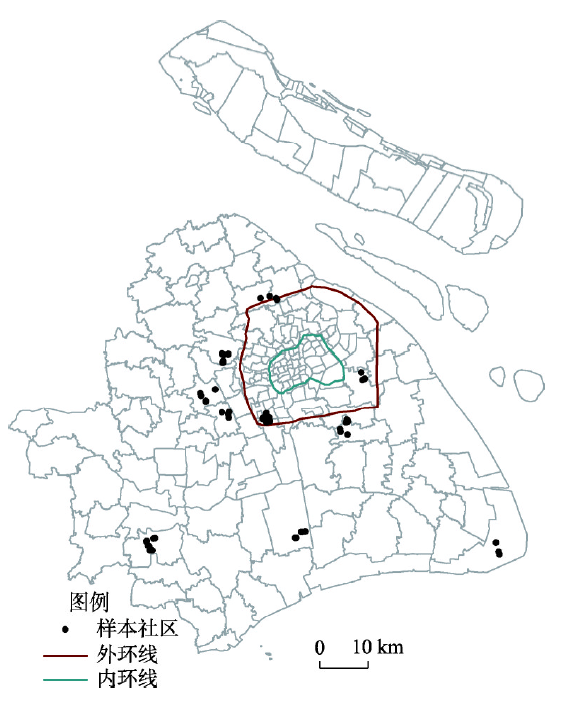
Key words: behavior geography; social space; activity space; segregation; Shanghai
TA Na , SHEN Yue . Activity space-based segregation among neighbors and its influencing factors: An analysis based on shared activity spaces in suburban Shanghai[J]. Acta Geographica Sinica, 2020 , 75(4) : 849 -859 . DOI: 10.11821/dlxb202004013
表1 基于空间与基于人的社会空间分异度量Tab. 1 Place-based and people-based social-spatial differentiation |
| 基于空间的度量 | 基于人的度量 | |
|---|---|---|
| 背景 | 城市化背景下中国城市社会分异出现,并通过住房选择在空间中表现出来 | 社会转型背景下中国城市生活方式差异出现,并通过日常活动的空间选择表现出来 |
| 假设 | 居住在同一社区的居民不存在隔离,社区间的差异带来了社会空间隔离 | 即使居住在同一社区的居民也可能存在日常生活中的隔离,活动空间中的接触能减少隔离 |
| 关注点 | 住房的空间分选过程 | 行为动态过程 |
| 时空间尺度 | 中长期、宏观 | 短期、微观 |
| 研究单元 | 社区或居住空间 | 活动空间 |
| 空间单元测量方法 | 居住社区、以家为中心的缓冲区 | 标准椭圆、最小凸多边形、最短路径面积、轨迹缓冲区等 |
| 影响因素 | 社区类型、个体社会经济属性、社区建成环境等 | 社区建成环境、个体社会经济属性、个体偏好等 |
表2 样本社会经济属性Tab. 2 Social-economic characteristics of samples |
| 类别 | 样本量(人) | 比例(%) | |
|---|---|---|---|
| 总样本 | 748 | 100 | |
| 性别 | 男 | 388 | 51.87 |
| 女 | 360 | 48.13 | |
| 教育程度 | 初中及以下 | 138 | 18.45 |
| 高中中专职高 | 154 | 20.59 | |
| 大专大学 | 419 | 56.01 | |
| 研究生及以上 | 37 | 4.95 | |
| 年龄(岁) | 18~29 | 178 | 23.80 |
| 30~39 | 283 | 37.83 | |
| 40~49 | 199 | 26.60 | |
| 50~60 | 88 | 11.77 | |
| 户口类型 | 上海 | 382 | 51.07 |
| 外地城市 | 212 | 28.34 | |
| 外地农村 | 154 | 20.59 | |
| 人均月收入 (元) | ≤ 2500 | 128 | 17.11 |
| 2501~7500 | 444 | 59.36 | |
| ≥ 7501 | 176 | 23.53 |
表3 不同收入群体的活动空间共享度及其差异检验Tab. 3 Shared activity spaces among income groups and Tukey's range test |
| 群体差异 | 群体1占比(%) | 群体2占比(%) | 活动空间共享度差异(%) | P值 |
|---|---|---|---|---|
| 中收入—低收入 | 31.24 | 40.62 | -9.38 | 0.000 |
| 高收入—低收入 | 34.75 | 40.62 | -5.87 | 0.007 |
| 高收入—中收入 | 34.75 | 31.24 | 3.51 | 0.047 |
表4 居民活动空间共享度影响因素指标及描述性统计Tab. 4 The descriptive statistics of the variables in the study |
| 变量 | 意义 | 均值 | 标准差 |
|---|---|---|---|
| 收入 | 居民平均月收入:1:低收入;2:中收入;3:高收入 | 2.06 | 0.02 |
| 户口 | 1:本地户口;2:外地城市户口;3:外地农村户口 | 1.69 | 0.03 |
| 女性 | 1:女性;0:男性 | 0.48 | 0.02 |
| 年龄 | 单位:岁 | 37.09 | 0.36 |
| 有正式就业 | 1:有正式就业;0:无正式就业 | 0.86 | 0.01 |
| 汽车所有权 | 1:有;0:无 | 0.62 | 0.02 |
| 居住两年以下 | 1:居住两年以下;0:居住两年以上 | 0.31 | 0.02 |
| 住房所有权 | 1:有住房所有权;0:无住房所有权 | 1.36 | 0.02 |
| 社区有围墙 | 1:有;0:无 | 0.93 | 0.01 |
| 社区有公共空间 | 如运动场、小广场等,1:有;0:无 | 0.93 | 0.01 |
| 社区有室内活动设施 | 如健身房、棋牌室等,1:有;0:无 | 0.70 | 0.02 |
| 社区有零售商业 | 如菜市场、小卖部等,1:有;0:无 | 0.62 | 0.02 |
| 社区社会混合度 | 根据六普数据计算社区不同教育水平人群的熵值来衡量社区混合程度,数值越高、社区居民组成混合程度越高 | 0.44 | 0.01 |
| 社区人口密度 | 社区人口数量除以社区面积计算,单位:万人/km2 | 1.91 | 0.08 |
| 周边便利店密度 | 社区周边3 km范围内便利店密度,单位:个/km2 | 5.25 | 0.13 |
| 周边餐饮设施密度 | 社区周边3 km范围内餐饮设施密度,单位:个/km2 | 48.48 | 0.95 |
| 周边超市密度 | 社区周边3 km范围内超市密度,单位:个/km2 | 4.40 | 0.11 |
| 周边公园广场密度 | 社区周边3 km范围内公园广场密度,单位:个/km2 | 0.28 | 0.01 |
| 周边购物中心密度 | 社区周边3 km范围内购物中心密度,单位:个/km2 | 0.30 | 0.01 |
| 周边室内体育休闲设施密度 | 社区周边3 km范围内室内体育休闲设施密度,单位:个/km2 | 8.01 | 0.20 |
| 到城市中心的距离 | 到人民广场的距离,对数形式 | 3.11 | 0.02 |
表5 活动空间共享度影响因素多层次序logit模型Tab. 5 Multilevel ordered logit model on shared activity space |
| 模型1:总体活动空间共享度 | 模型2:低收入居民活动空间共享度 | 模型3:中收入居民活动空间共享度 | 模型4:高收入居民活动空间共享度 | ||||||||
|---|---|---|---|---|---|---|---|---|---|---|---|
| 系数 | P值 | 系数 | P值 | 系数 | P值 | 系数 | P值 | ||||
| 收入(低收入为参照) | |||||||||||
| 中收入 | -1.34 | 0.000 | |||||||||
| 高收入 | -1.04 | 0.000 | |||||||||
| 户口(本地户口为参照) | |||||||||||
| 外地城市户口 | 0.59 | 0.004 | 0.97 | 0.158 | 0.75 | 0.006 | -0.06 | 0.887 | |||
| 外地农村户口 | 0.22 | 0.357 | -0.06 | 0.915 | 0.64 | 0.049 | -0.26 | 0.651 | |||
| 女性 | 0.19 | 0.213 | 0.16 | 0.717 | 0.16 | 0.433 | 0.09 | 0.784 | |||
| 年龄 | 0.00 | 0.884 | 0.00 | 0.855 | 0.00 | 0.884 | -0.01 | 0.560 | |||
| 有正式就业 | 0.44 | 0.065 | 0.51 | 0.264 | 0.60 | 0.082 | -0.45 | 0.583 | |||
| 汽车所有权 | -0.34 | 0.045 | -0.13 | 0.750 | -0.27 | 0.242 | -0.49 | 0.263 | |||
| 居住两年以下 | -0.29 | 0.125 | 0.07 | 0.882 | -0.36 | 0.156 | -0.73 | 0.071 | |||
| 住房所有权 | -0.38 | 0.061 | -0.71 | 0.189 | -0.54 | 0.049 | 0.19 | 0.670 | |||
| 社区有围墙 | -2.29 | 0.023 | -1.49 | 0.339 | -1.93 | 0.078 | -4.89 | 0.024 | |||
| 社区有公共空间 | 2.63 | 0.005 | 4.16 | 0.005 | 2.07 | 0.043 | 3.82 | 0.100 | |||
| 社区有室内活动设施 | 0.49 | 0.284 | -0.72 | 0.359 | 0.57 | 0.263 | 1.35 | 0.047 | |||
| 社区有零售商业 | 0.92 | 0.022 | 0.06 | 0.934 | 0.78 | 0.075 | 1.85 | 0.002 | |||
| 社区社会混合度 | 3.86 | 0.029 | 1.71 | 0.533 | 4.01 | 0.039 | 5.06 | 0.058 | |||
| 社区人口密度 | 0.30 | 0.002 | 0.29 | 0.058 | 0.22 | 0.046 | 0.60 | 0.001 | |||
| 周边公园广场密度 | 0.20 | 0.797 | -1.40 | 0.326 | 0.83 | 0.338 | -0.70 | 0.501 | |||
| 周边购物中心密度 | -4.10 | 0.000 | -2.83 | 0.122 | -5.32 | 0.000 | -3.49 | 0.009 | |||
| 到城市中心的距离 | -1.38 | 0.002 | -2.72 | 0.000 | -1.53 | 0.002 | -1.17 | 0.091 | |||
| 门槛值1 | -5.06 | 0.011 | -10.65 | 0.003 | -4.80 | 0.034 | -4.11 | 0.232 | |||
| 门槛值2 | -2.18 | 0.271 | -7.43 | 0.030 | -1.72 | 0.443 | -1.11 | 0.746 | |||
| 门槛值3 | 0.37 | 0.852 | -4.85 | 0.149 | 0.99 | 0.661 | 1.87 | 0.583 | |||
| var(_cons) | 1.00 | 1.41 | 1.06 | 1.05 | |||||||
| Waldchi2 | 91.63 | 27.03 | 53.72 | 34.38 | |||||||
| Loglikelihood | -758.31 | -134.01 | -432.54 | -175.72 | |||||||
| [1] |
|
| [2] |
|
| [3] |
|
| [4] |
|
| [5] |
[ 石恩名, 刘望保, 唐艺窈 . 国内外社会空间分异测度研究综述. 地理科学进展, 2015,34(7):818-829.]
|
| [6] |
|
| [7] |
[ 李志刚, 吴缚龙, 肖扬 . 基于全国第六次人口普查数据的广州新移民居住分异研究. 地理研究, 2014,33(11):2056-2068.]
|
| [8] |
[ 何深静, 刘玉亭, 吴缚龙 , 等. 中国大城市低收入邻里及其居民的贫困集聚度和贫困决定因素. 地理学报, 2010,65(12):1464-1475.]
|
| [9] |
|
| [10] |
|
| [11] |
|
| [12] |
|
| [13] |
|
| [14] |
|
| [15] |
[ 周素红, 闫小培 . 广州城市空间结构与交通需求关系. 地理学报, 2005,60(1):131-142.]
|
| [16] |
[ 柴彦威, 沈洁 . 基于居民移动: 活动行为的城市空间研究. 人文地理, 2006,21(5):108-112, 54.]
|
| [17] |
[ 甄峰, 魏宗财, 杨山 , 等. 信息技术对城市居民出行特征的影响: 以南京为例. 地理研究, 2009,28(5):1307-1317.]
|
| [18] |
|
| [19] |
|
| [20] |
|
| [21] |
[ 申悦, 柴彦威 . 基于日常活动空间的社会空间分异研究进展. 地理科学进展, 2018,37(6):853-862.]
|
| [22] |
|
| [23] |
|
| [24] |
|
| [25] |
|
| [26] |
|
| [27] |
|
| [28] |
[ 塔娜, 柴彦威, 关美宝 . 北京郊区居民日常生活方式的行为测度与空间—行为互动. 地理学报, 2015,70(8):1271-1280.]
|
| [29] |
|
| [30] |
[ 贺霞旭, 刘鹏飞 . 中国城市社区的异质性社会结构与街坊/邻里关系研究. 人文地理, 2016,31(6):1-9.]
|
| [31] |
[ 王宁 . 大型居住社区的公共空间营造与邻里关系重构: 以上海市X大型居住社区为个案. 江汉大学学报(社会科学版), 2018,35(2):42-47.]
|
| [32] |
[ 干迪, 王德, 朱玮 . 上海市近郊大型社区居民的通勤特征: 以宝山区顾村为例. 地理研究, 2015,34(8):1481-1491.]
|
| [33] |
[ 段雪辉 . 大型居住社区居民社区满意度研究. 城市观察, 2016,41(1):85-95.]
|
| [34] |
|
| [35] |
[ 钟炜菁, 王德 . 基于居民行为周期特征的城市空间研究. 地理科学进展, 2018,37(8):1106-1118.]
|
| [36] |
[ 代丹丹, 周春山 . 广州市中产阶层日常活动的时空间特征. 人文地理, 2017,32(4):45-53.]
|
| [37] |
[ 宋伟轩, 毛宁, 陈培阳 , 等. 基于住宅价格视角的居住分异耦合机制与时空特征: 以南京为例. 地理学报, 2017,72(4):589-602.]
|
/
| 〈 |
|
〉 |