



Spatial heterogeneity of the effects of mountainous city patternon catering industry location
Received date: 2018-09-05
Request revised date: 2019-05-01
Online published: 2019-06-20
Supported by
National Social Science Fund of China(16XSH001)
Copyright
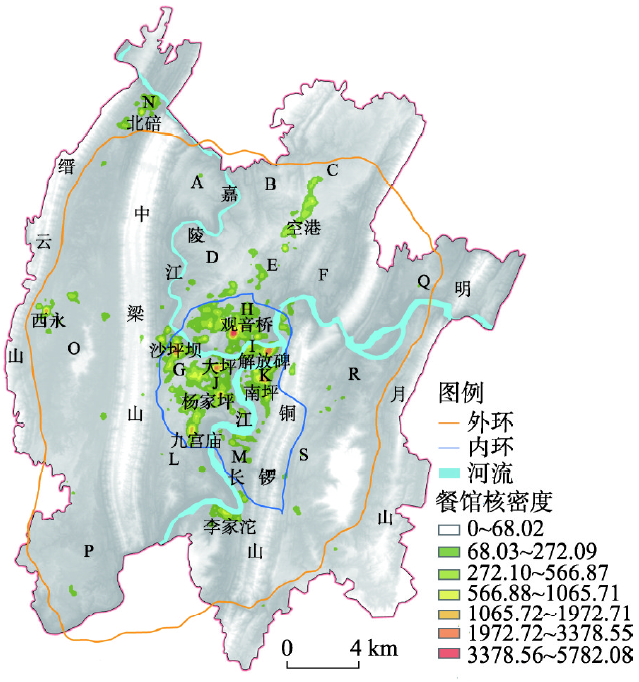
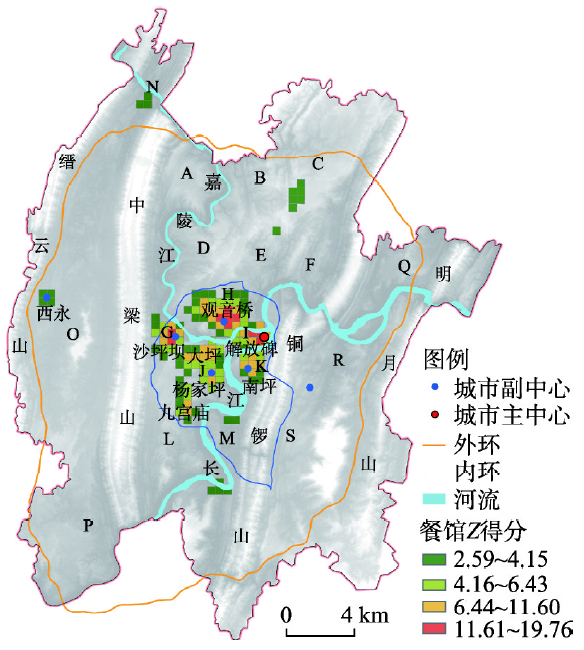
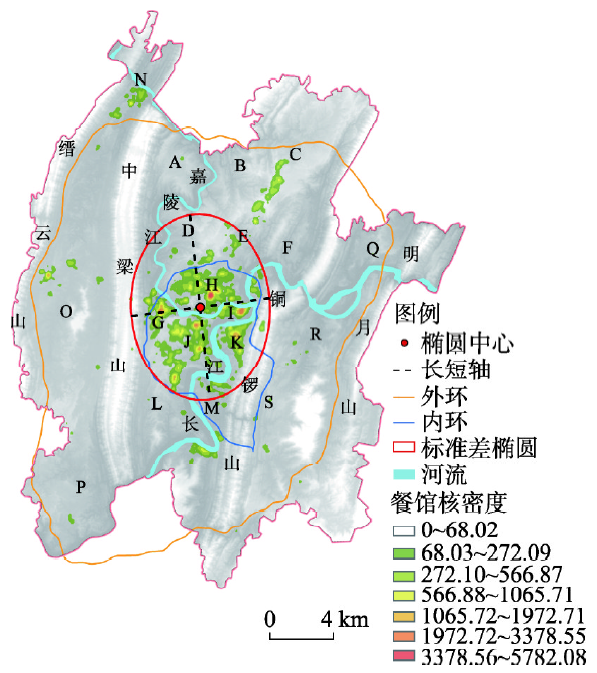
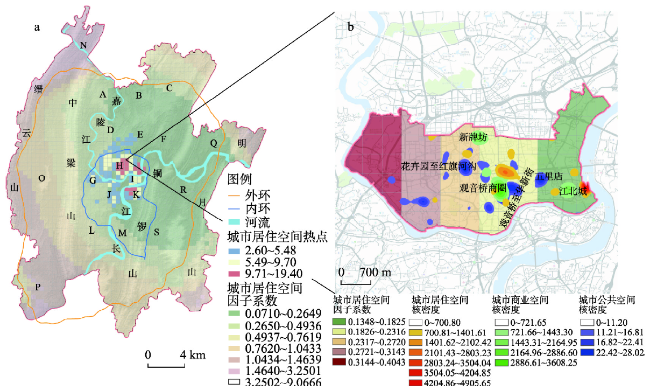
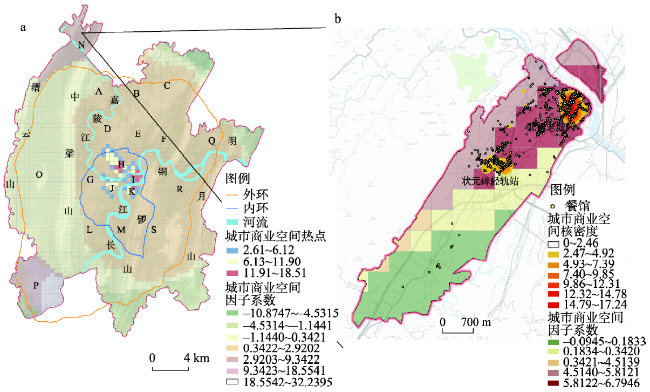
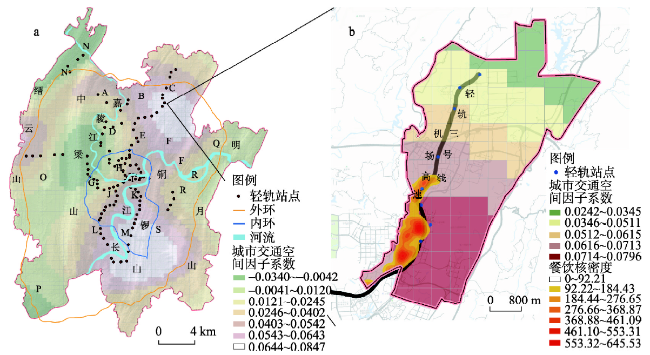
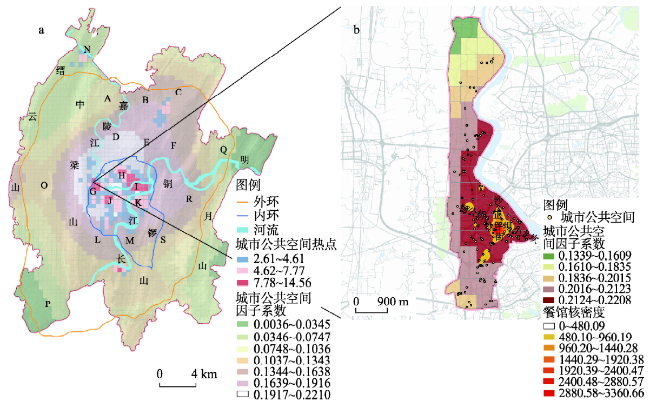
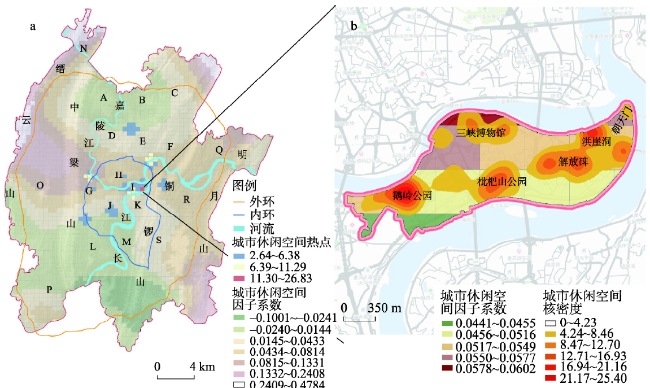
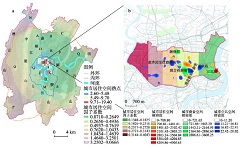
Accurately and effectively estimating the effects of urban pattern on industrial location is always an important issue that has received much attention in urban geography. However, current studies have mainly focused on the influence of a single type of urban functional spaces on industrial location using statistical data based on administrative units. And these studies have not conducted in-depth research into the spatial heterogeneity of influences. Against the existing shortcomings, taking the central Chongqing as an example, this research aimed to investigate how different urban functional spaces influenced the catering industry distribution based on kernal density, spatial autocorrelation and geographic weighted regression from point of interest (POI) data. The research reveals the following points: (1) the spatial distribution of restaurants was characterized by a multi-center spatial structure of "one main, two subs and four third-level centers", which directly reflected the urban pattern. (2) Not only the scale of restaurant agglomeration was closely related to urban expansion sequence, but also the direction of restaurant agglomeration was consistent with urban expansion direction. (3) The urban functional spaces had different or even opposite influences on the restaurant distribution in different city groups. The effect of residential space on the restaurant distribution was all positive, which increased from the central to the peripheral groups. The influence of commercial space on restaurant distribution was weakened from the inside to the outside of the barrier of the mountains, but there might be a phenomenon of commercial dependence in the groups where the location was isolated and the business development was immature. Since the restaurants in the peripheral groups was more dependent on the transport accessibility, the effect of urban traffic space on restaurant distribution in the peripheral groups was greater than that in the central groups, which resulted in a phenomenon of traffic dependence. The urban public space in central groups played a greater role in promoting restaurant assembled than that of the peripheral groups on account of high-quality public service in central groups. The influence of urban leisure space on restaurant distribution was related to the number and popularity of scenic spots. (4) Moreover, different urban functional spaces had different influences on the spatial distribution of restaurants, and urban commercial space had the greatest impact due to its high density of urban construction and population density. This study is especially valuable for understanding the function mechanism of urban pattern on industrial location and providing a scientific basis for making rational urban development plan.
TU Jianjun , TANG Siqi , ZHANG Qian , WU Yue , LUO Yunchao . Spatial heterogeneity of the effects of mountainous city patternon catering industry location[J]. Acta Geographica Sinica, 2019 , 74(6) : 1163 -1177 . DOI: 10.11821/dlxb201906007
表1 城市空间分类表Tab. 1 Classification of urban space |
| 城市空间类型 | POI类型 | 城市用地类型 |
|---|---|---|
| 城市居住空间 | 住宅区 | 住宅用地 |
| 城市商业空间 | 大型超市、购物中心、便利店、写字楼 | 商业设施用地、商务设施用地 |
| 城市交通空间 | 轻轨站 | 城市轨道交通用地 |
| 城市公共空间 | 小学、中学、大学、综合医院、专科医院 | 教学科研用地、医疗卫生用地 |
| 城市休闲空间 | 公园、景点 | 公园绿地、文物古迹用地 |
表2 OLS模型参数估计及检验结果Tab. 2 Parameter estimation and test results of the OLS model |
| 影响因子 | 估计系数 | VIF |
|---|---|---|
| 城市居住空间(RES) | 0.243*** | 1.427 |
| 城市商业空间(CBD) | 0.508*** | 1.299 |
| 城市交通空间(TRA) | 0.038*** | 1.299 |
| 城市公共空间(COM) | 0.177*** | 1.782 |
| 城市休闲空间(REL) | 0.035*** | 1.043 |
| 常数项 | -0.002** | |
| 校正可决系数(调整R2) | 0.706 |
注:***、**、*分别表示P < 0.001、P < 0.01、P < 0.05的显著性水平。 |
表3 GWR模型参数估计及检验结果Tab. 3 Parameter estimation and test results of the GWR model |
| 模型参数 | Bandwidth | Residual Squares | Sigma | AICc | R2 | Adjusted R2 |
|---|---|---|---|---|---|---|
| 数值 | 8452.08 | 1.39 | 0.02 | -13061.22 | 0.75 | 0.74 |
表4 GWR模型回归系数的描述性统计分析Tab. 4 Descriptive statistical analysis of the regression coefficients in the GWR model |
| 影响因子 | 平均值 | 最小值 | 下四分位数 | 中值 | 上四分位数 | 最大值 |
|---|---|---|---|---|---|---|
| RES | 0.6338 | 0.0710 | 2.3199 | 4.5688 | 6.8177 | 9.0666 |
| CBD | 2.1091 | -10.8747 | -2.2365 | 4.5591 | 15.6256 | 32.2395 |
| TRA | 0.0320 | -0.0340 | -0.0006 | 0.0261 | 0.0537 | 0.0847 |
| COM | 0.1207 | 0.0036 | 0.0739 | 0.1217 | 0.1664 | 0.2210 |
| REL | 0.0500 | -0.1001 | 0.0264 | 0.0955 | 0.2282 | 0.4784 |
| 常数 | -0.0014 | -0.0056 | -0.0040 | -0.0023 | -0.0006 | 0.0010 |
The authors have declared that no competing interests exist.
作者已声明无竞争性利益关系。
| [1] |
[ 吴一洲, 吴次芳, 贝涵璐 . 转型期杭州城市写字楼空间分布特征及其机制. 地理学报, 2010,65(8):973-982.]
|
| [2] |
[ 王朝辉, 陆林, 方婷 , 等. 世博建设期上海市旅游住宿产业空间格局演化. 地理学报, 2012,67(10):1423-1437.]
|
| [3] |
[ 周麟, 沈体雁 . 大城市内部服务业区位研究进展. 地理科学进展, 2016,35(4):409-419.]
|
| [4] |
[ 杨吾扬, 梁进社 . 高等经济地理学. 北京: 北京大学出版社, 2004: 164-168]
|
| [5] |
|
| [6] |
|
| [7] |
[ 楚波, 梁进社 . 基于OPM模型的北京制造业区位因子的影响分析. 地理研究, 2007,26(4):721-732.]
|
| [8] |
|
| [9] |
|
| [10] |
|
| [11] |
|
| [12] |
[ 夏令军, 刘艳芳, 刘国炜 . 中国地级城市餐饮业分布格局及影响因素: 基于“大众点评网”数据的实证研究. 经济地理, 2018,38(5):133-141.]
|
| [13] |
|
| [14] |
|
| [15] |
|
| [16] |
|
| [17] |
|
| [18] |
|
| [19] |
|
| [20] |
[ 舒舍玉, 王润, 孙艳伟 , 等. 城市餐饮业的空间格局及影响因素分析: 厦口市为例. 热带地理, 2012,32(2):134-140.]
|
| [21] |
[ 谭欣, 黄大全, 赵星烁 . 北京市主城区餐馆空间分布格局研究. 旅游学刊, 2016,31(2):75-85.]
|
| [22] |
[ 张旭, 徐逸伦 . 南京市餐饮设施空间分布及其影响因素研究. 热带地理, 2009,29(4):362-367.]
|
| [23] |
[ 曾国军, 陆汝瑞 . 星巴克在中国大陆的空间扩散特征与影响因素研究. 地理研究, 2017,36(1):188-202.]
|
| [24] |
|
| [25] |
[ 陈玉福, 董鸣 . 生态学系统的空间异质性. 生态学报, 2003,23(2):346-352.]
|
| [26] |
[ 李栋科, 丁圣彦, 梁国付 , 等. 基于移动窗口法的豫西山地丘陵地区景观异质性分析. 生态学报, 2014,34(12):3414-3424.]
|
| [27] |
|
| [28] |
[ 张俊峰, 张安录 . 武汉城市圈土地资源空间异质性及其效应分析. 农业现代化研究, 2014,35(4):424-429.]
|
| [29] |
[ 仇方道, 金娜, 袁荷 , 等. 徐州都市圈产业结构转型城镇空间响应的时空异质性. 地理科学, 2017,37(10):1459-1468.]
|
| [30] |
[ 张骞, 高明, 杨乐 , 等. 1988-2013年重庆市主城九区生态用地空间结构及其生态系统服务价值变化. 生态学报, 2017,37(2):566-575.]
|
| [31] |
[ 禹文豪, 艾廷华, 杨敏 , 等. 利用核密度与空间自相关进行城市设施兴趣点分布热点探测. 武汉大学学报(信息科学版), 2016,41(2):221-227.]
|
| [32] |
|
| [33] |
[ 段亚明, 刘勇, 刘秀华 , 等. 基于POI大数据的重庆主城区多中心识别. 自然资源学报, 2018,33(5):788-800.]
|
| [34] |
|
| [35] |
|
| [36] |
|
| [37] |
|
| [38] |
[ 浩飞龙, 王士君, 冯章献 , 等. 基于POI数据的长春市商业空间格局及行业分布. 地理研究, 2018,37(2):366-378.]
|
| [39] |
|
| [40] |
[ 顾朝林, 甄峰, 张京祥 . 集聚与扩散:城市空间结构新论. 南京: 东南大学出版社, 2000: 5-8.]
|
| [41] |
[ 申庆喜, 李诚固, 刘倩 . 基于服务设施布局视角的城市空间结构研究: 以长春主城区为例. 经济地理, 2017,37(3):129-135.]
|
/
| 〈 |
|
〉 |