



A proposal for geography of unification: The lessons from German Unification
Received date: 2018-01-11
Request revised date: 2019-03-11
Online published: 2019-04-23
Supported by
National Natural Science Foundation of China, No.41701180
Copyright
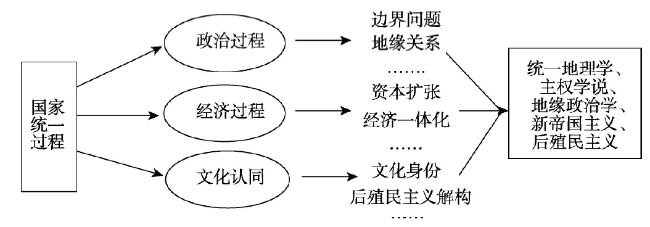
National unification is a crucial issue for regional stability and national rejuvenation, which is, however, out sight of the mainstream geographers in China. In fact, human geography has a more comprehensive and systematic theoretical framework for interpreting the process of national unification than political science and law studies have, especially due to the rapid rise of political geography. This paper aims to probe into the mechanism and implications of national unification based on a series of theoretical establishments, such as state sovereignty, geopolitics, post colonialism, and new imperialism. We attempt to deconstruct the process of national unification into three-dimensional restructuring of space, namely, geo-political relationship, capital space, and cultural identification. The case of Germany's unification in 1990 represents the process of unification after the collapse of the Berlin wall, which can be regarded, first, as a result of upheaval of international political pattern, say, the end of the Cold War, due to the decline of the former Soviet Union while the rise of neoliberal capitalists. Second, the unification of Germany is a durable process that takes place in economic integration between West and East Germany, during which the capitalist imperialism has been playing an invisible role in speeding up barbarous expansion of capital. Third, the cultural imperialism that has permeated into the people's ideology and perception of state has been chronically influencing the formation of the identity as "one Germany".
Key words: geopolitics; national unification; economic integration; cultural identity
HE Jinliao , Hans GEBHARDT , HUANG Xianjin , ZENG Gang . A proposal for geography of unification: The lessons from German Unification[J]. Acta Geographica Sinica, 2019 , 74(4) : 770 -779 . DOI: 10.11821/dlxb201904011
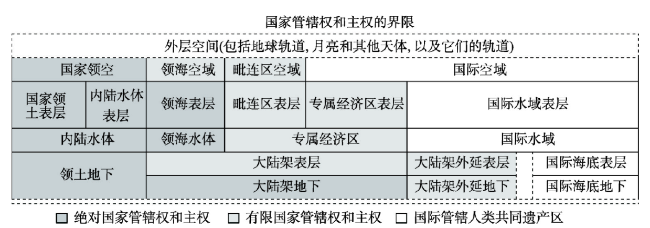
Fig. 1 National territory of jurisdiction and sovereignty图1 国家领土主权和管辖权范围界定 |
Fig. 2 Explanation framework of national unification based on geographical perspective图2 国家统一的地理学解释框架 |
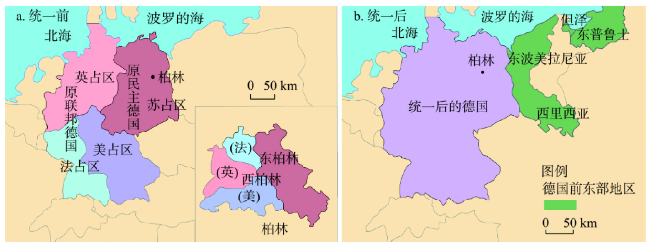
Fig. 3 The change of geo-political pattern after the unification of Germany图3 德国统一前后的政治版图变化 |
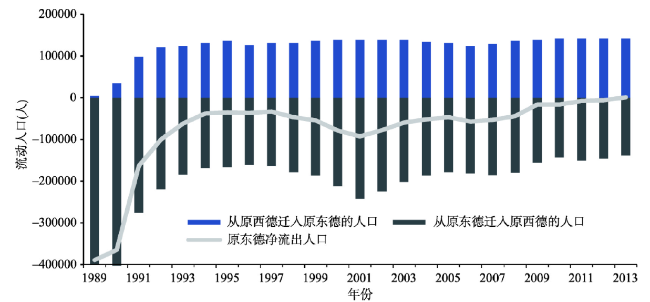
Fig. 4 Migration of population between West and East Germany from 1989 to 2013图4 1989-2013年德国统一后东西部劳动力流动状况 |
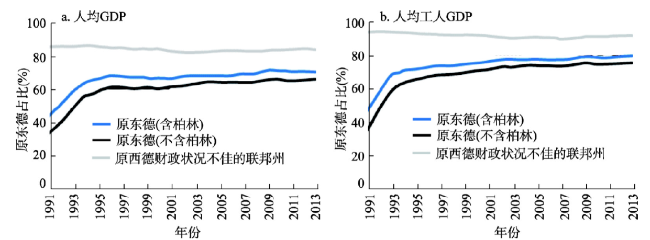
Fig. 5 Comparison of gross domestic production per capita and employee after the unification of Germany(West Germany = 100%)图5 德国统一后东西部人均GDP和人均工人GDP对比(原西德=100%) |
The authors have declared that no competing interests exist.
| [1] |
[
|
| [2] |
[
|
| [3] |
|
| [4] |
[
|
| [5] |
|
| [6] |
[
|
| [7] |
[
|
| [8] |
[
|
| [9] |
[王沪宁. 国家主权. 北京:人民出版社, 1987.]
|
| [10] |
|
| [11] |
|
| [12] |
[
|
| [13] |
[
|
| [14] |
[
|
| [15] |
|
| [16] |
|
| [17] |
|
| [18] |
|
| [19] |
|
| [20] |
|
| [21] |
|
| [22] |
|
| [23] |
[
|
/
| 〈 |
|
〉 |