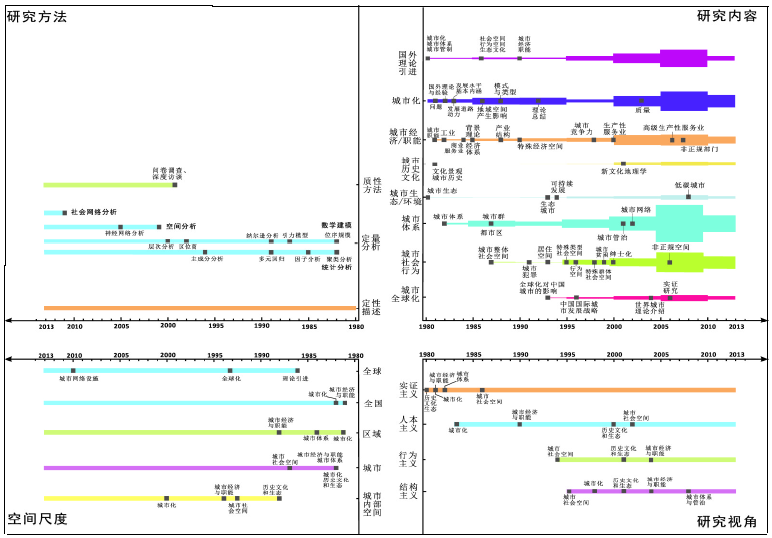
薛德升, 王立. 1978年以来中国城市地理研究进展. 69(8): 1117-1129 XUE Desheng, WANG Li. Progress of urban geography research in China since the 1980s. Acte Geographica Sinica, 69(8): 1117-1129
Progress of urban geography research in China since the 1980s
XUE Desheng, WANG Li
Center for Urban and Regional Studies, Sun Yat-sen Unviersity, Guangzhou 510275, China
Fund:Key Program of National Natural Science Foundation of China, No.41130747; International Joint Program of National Natural Science Foundation of China, No.41320104001
Abstract
Built on a database composed of major books and journals published in mainland China, this study examines and summarizes the development of urban geography in post-reform China for the last decades. It applies the methods of literature quantitative analysis to interrogate the modality of recent urban geography and its studies within China's mainland. The findings include: first, along with China's miracle economic growth the community of urban geography also sees a remarkable prosperity in the last years. In particular, the topics and contents of this field witness a sustained expansion and evolvement. Moreover, its research methods are becoming more and more scientific and standardized, while the scale of these studies is turning from macroscopic to microscopic level. Along with a remarkable increase of both topics and interdisciplinary approaches, the perspectives of urban geography studies turn to be even diversified. It is found that state policy and hot-spot topics have significant impacts upon the development or direction of urban geography research. In addition, the impacts of Western theory or schools upon the research in China's mainland are also prominent. We argue that the emphasis of both theoretical studies and their applications is a key feature of post-reform China's urban geography research, among which urbanization and urban system are two key directions. After a comparative analysis of our case with recent development of urban geography in the West and other contexts such as South Africa or Brazil, say the global south, we suggest that the future study of Chinese cities should further expand a global perspective, critically import western theories, explore new theories as well as interdisciplinary approaches, and further follow the academic standard of international communities.
Keyword:
urban geography; literature quantitative analysis; globalization; urbanization; urban system
YuHongjun, NingYuemin. Introduction of Urban Geography. Hefei: Anhui Science and Technology Press, 1983. [于洪俊, 宁越敏. 城市地理概论. 合肥: 安徽科学技术出版社, 1983. ][本文引用:1]
[2]
XuXueqiang, Chu DavidK Y. The Modern Urban Geography. Beijing: China Architecture & Building Press, 1988. [许学强, Chu DavidK Y. 现代城市地理学. 北京: 中国建筑工业出版社, 1988. ][本文引用:1]
ChaiYanwei, LiuZhilin, LiZhengrong, et al. Temporal and Spatial Structure of Chinese Cities. Beijing: Peiking University Press, 2002. [柴彦威, 刘志林, 李峥嵘等. 中国城市的时空间结构. 北京: 北京大学出版社, 2002. ][本文引用:1]
[13]
YaoShimou, ChenZhenguang, ZhuYingming. Chinese Megalopolises. Hefei: China Science and Technology University Press. [姚士谋, 陈振光, 朱英明. 中国城市群. 合肥: 中国科学技术大学出版社, 2006. ][本文引用:2]
ZhouYixing. Chinese urban geography: Evaluation and prospect. Human Geography, 1991, 6(2): 54-58. [周一星. 中国的城市地理学: 评价和展望. 人文地理, 1991, 6(2): 54-58. ][本文引用:1][CJCR: 1.459]
[17]
GuChaolin, XuHaixian. Reforming and opening comes 20 years, research progress of Chinese urban geography. Scientia Geographica Sinica, 1999, 19(4): 320-331. [顾朝林, 徐海贤. 改革开放二十年来中国城市地理学研究进展. 地理科学, 1999, 19(4): 320-331. ][本文引用:1][CJCR: 2.779]
NingYuemin. Building urban geography with Chinese characteristics: Research progress on Chinese urban geography. Human Geography, 2008, 23(2): 1-5. [宁越敏. 建设中国特色的城市地理学: 中国城市地理学的研究进展评述. 人文地理, 2008, 23(2): 1-5. ][本文引用:1][CJCR: 1.459]
[20]
XuXueqiang, YaoHuasong. Research review and prospect of Chinese urban geography for 10years. Economic Geography, 2009, 29(9): 1412-1420. [许学强, 姚华松. 百年来中国城市地理学研究回顾及展望. 经济地理, 2009, 29(9): 1412-1420. ][本文引用:1]
[21]
YuTaofang, LvLachang, LiuYungang, et al. Research progress and prospect on Chinese urban geography. Scientia Geographica Sinica, 2011, 30(12): 1488-1497. [于涛方, 吕拉昌, 刘云刚等. 中国城市地理学研究进展与展望. 地理科学进展, 2011, 30(12): 1488-1497. ][本文引用:1][CJCR: 2.779]
[22]
WuYouren. About the problem of China's socialist city. Population and Economics, 1980, (1): 19-26. [吴友仁. 关于我国社会主义城市化问题. 人口与经济, 1980, (1): 19-26. ][本文引用:1]
[23]
LiangHuashan, FengGuangbiao. Urbanization and urban development policy in Japan. Progress in Geography, 1982, 1(3): 36-40. [梁华山, 冯广标. 日本的城市化和城市发展政策. 地理译报, 1982, 1(3): 36-40. ][本文引用:1][CJCR: 1.959]
[24]
GuoHongyan. Understand ing of the urbanization problem in Southeast Asia. Urban Planning Review, 1985, (2): 18-23. [郭彦弘. 对东南亚地区城市化问题的理解. 城市规划, 1985, (2): 18-23. ][本文引用:1][CJCR: 0.1793]
[25]
YaoShimou, WuChucai. A special form of rural urbanization in China: On Chinese urban-rural population. Acta Geographica Sinica, 1982, 37(2): 155-163. [姚士谋, 吴楚材. 我国农村人口城市化的一种特殊形式: 试论我国的亦工亦农人口. 地理学报, 1982, 37(2): 155-163. ][本文引用:1][CJCR: 2.937]
[26]
ZhouYixing. The exploration of regularities in the relationship between GDP and urbanization. Population and Economics, 1982, (1): 28-33. [周一星. 城市化与国民生产总值关系的规律性探讨. 人口与经济, 1982, (1): 28-33. ][本文引用:1]
[27]
ChenYanguang. Modelling the relationships between urbanization and economic development levels with three functions, Scientia Geographica Sinica, 2011, 31(1): 1-6. [陈彦光. 城市化与经济发展水平关系的三种模型及其动力学分析. 地理科学, 2011, 31(1): 1-6. ][本文引用:1][CJCR: 2.779]
ZhouYixing. The argument of spatial differences in the process of China's urbanization. Urban Planning, 1983, (2): 17-21. [周一星. 论我国城镇化的地域差异. 城市规划, 1983, (2): 17-21. ][本文引用:1][CJCR: 0.7705]
XueFengxuan, YangChun. Urbanization under the influence of foreign investment: A case study of Pearl River Delta. Urban Planning, 1995, (6): 21-27. [薛凤旋, 杨春. 外资影响下的城市化: 以珠江三角洲为例. 城市规划, 1995, (6): 21-27. ][本文引用:1][CJCR: 0.7705]
NingYueming. New Process of urbanization: Dynamics and features of urbanization in China since 1990, Acta Geographica Sinica, 1998, 53(5): 88-95. [宁越敏. 新城市化进程: 90年代中国城市化动力机制和特点探讨. 地理学报, 1998, 53(5): 88-95. ][本文引用:1][CJCR: 2.937]
[34]
LvYuyin. Institution reform and the process of urbanization: System analysis on the skewed development of urbanization in China. Urban Problems, 1995, 14(2): 2-5. [吕玉印. 体制变革与城市化进程: 中国城市化偏态发展的制度分析. 城市问题, 1995, 14(2): 2-5. ][本文引用:1][CJCR: 0.997]
[35]
YanXiaopei, LinChusheng. Urbanization in the third world: A reappearance of the course of urbanization in western countries? A theoretical exploration. Human Geography, 1994, 9(2): 31-37. [闫小培, 林初升. 第三世界城市化: 西方城市化过程的重现?理论探讨. 人文地理, 1994, 9(2): 31-37. ][本文引用:1][CJCR: 1.459]
[36]
CuiGonghao, Ma LaurenceJ C. Urbanization from below in China: Its development and mechanisms. Acta Geographica Sinica, 1999, 44(2): 106-115. [崔功豪, 马润潮. 中国自下而上城市化的发展及其机制. 地理学报, 1999, 44(2): 106-115. ][本文引用:1][CJCR: 2.937]
[37]
ChaiYanwei, ZhouYixing. The characteristics, mechanisms and tendency of suburbanization of residence in Dalian City. Scientia Geographica Sinica, 2000, 20(2): 127-132. [柴彦威, 周一星. 大连市居住郊区化的现状、机制及趋势. 地理科学, 2000, 20(2): 127-132. ][本文引用:1][CJCR: 2.779]
[38]
CaoGuangzhong, ChaiYanwei. On the urban internal structure transformation and suburbanization in Dalian city. Scientia Geographica Sinica, 1998, 18(3): 234-241. [曹广忠, 柴彦威. 大连市内部地域结构转型与郊区化. 地理科学, 1998, 18(3): 234-241. ][本文引用:1][CJCR: 2.779]
[39]
XieShouhong, NingYuemin. Urbanization and suburbanization--the dual engine to spatial change of Chinese metropolis under transitional era: A case study of Guangzhou. Planing Review, 2003, 27(11): 24-29. [谢守红, 宁越敏. 城市化与郊区化: 转型期都市空间变化的引擎: 对广州的实证分析. 城市规划, 2003, 27(11): 24-29. ][本文引用:1]
[40]
MaoQizhi. The stand ards and quotas for the urbanization in rural areas of China. Urban Studies, 1995, (3): 35-38. [毛其智. 我国乡村城市化建设标准及量化指标. 城市发展研究, 1995, (3): 35-38. ][本文引用:1][CJCR: 0.718]
LiShuangcheng, ZhaoZhiqiang, WangYanglin. Urbanization process and effects of natural resource and environment in China: Research trends and future directions. Process in Geography, 2009, 28(1): 63-70. [李双成, 赵志强, 王仰麟. 中国城市化过程及其资源与生态环境效应机制. 地理科学进展, 2009, 28(1): 63-70. ][本文引用:1]
[45]
LiuXiaoli, FangChuanglin. Progress and prospect of study on carrying capacity of resource and environment of city clusters. Process in Geography, 2008, 27(5): 35-42. [刘晓丽, 方创琳. 城市群资源环境承载力研究进展及展望. 地理科学进展, 2008, 27(5): 35-42. ][本文引用:1]
ZhangXiaolei, DuHongru. New type of urbanization in arid zone of China: Regional characteristics and strategical choice of sustainable development path. Bulletin of Chinese Academy of Sciences, 2013, (1): 46-53. [张小雷, 杜宏茹. 中国干旱区城镇化发展现状及新型城镇化路径选择. 中国科学院院刊, 2013, (1): 46-53. ][本文引用:1]
[48]
LinBinyao. On research direction of Chinese urban continued development. Urban Planning Forum, 1994, (6): 10-17. [林炳耀. 城市化与城镇布局. 城市规划汇刊, 1994, (6): 10-17. ][本文引用:1][CJCR: 1.465]
[49]
GuWenxuan. Construct experimental unit of small towns, promote development of rural urbanization. Urban Studies, 1995, (3): 39-42. [顾文选. 搞好小城镇建设试点, 推动乡村城市化发展. 城市发展研究, 1995, (3): 39-42. ][本文引用:1][CJCR: 0.718]
[50]
GuChaolin, PangHaifeng. Evolution of Chinese urbanization spaces: Kernel spatial approach. Scientia Geographica Sinica, 2009, 29(1): 10-14. [顾朝林, 庞海峰. 建国以来国家城市化空间过程研究. 地理科学, 2009, 29(1): 10-14. ][本文引用:1][CJCR: 2.779]
[51]
ZhouGanzhi. Explore the path of urbanization with Chinese characteristics. Urban Planning International, 2009, (Suppl. 1): 6-8. [周干峙. 探索中国特色的城市化之路. 国际城市规划, 2009, (S1): 6-8. ][本文引用:1][CJCR: 0.7705]
ZhangPingyu. Urban regeneration: Theory and practice of the new type urbanization in China. City Planning Review, 2004, (4): 25-30. [张平宇. 城市再生: 我国新型城市化的理论与实践问题. 城市规划, 2004, (4): 25-30. ][本文引用:1][CJCR: 1.381]
[54]
YeShunzan. Regional urban system construction in our country. Urban Problems, 1988, (4): 18-22. [叶舜赞. 我国区域城镇体系建设浅议. 城市问题, 1988, (4): 18-22. ][本文引用:1][CJCR: 0.997]
[55]
XuXueqiang. The evolution and forecast of China's town scale system. Journal of Sun Yat-sen University: Social Science Edition, 1982, (3): 40-49. [许学强. 我国城镇规模体系的演变和预测. 中山大学学报: 哲学社会科学版, 1982, (3): 40-49. ][本文引用:1][CJCR: 0.2082]
[56]
SunPanshou, YangTingxiu. The functional classification of the cities and towns of the three provinces in Southwestern China. Geographical Research, 1984, 3(3): 17-28. [孙盘寿, 杨廷秀. 西南三省城镇的职能分类. 地理研究, 1984, 3(3): 17-28. ][本文引用:1]
[57]
ChenZhongnuan, GanQiaolin. A study on urban function classification of the four provinces in southern China. Tropical Geography, 2001, 21(4): 291-294. [陈忠暖, 甘巧林. 华南沿海4省区城市职能分类探析. 热带地理, 2001, 21(4): 291-294. ][本文引用:1][CJCR: 0.6872]
[58]
ZhouYixing, YangQi. A review on the urban-size hierarchy of China and the territorial types of the hierarchy on provincial level. Acta Geographica Sinica, 1986, 41(2): 97-111. [周一星, 杨齐. 我国城镇等级体系变动的回顾及其省区地域类型. 地理学报, 1986, 41(2): 97-111. ][本文引用:1][CJCR: 2.937]
ZhouYixing, HuZhiyong. Looking into the network structure of Chinese urban system from the perspective of air transportation. Geographical Research, 2002, 21(3): 276-286. [周一星, 胡智勇. 从航空运输看中国城市体系的空间网络结构. 地理研究, 2002, 21(3): 276-286. ][本文引用:1]
[61]
ZhenFeng, LiuXiaoxia, LiuHui. Regional urban network influenced by information technology: New directions of urban studies. Human Geography, 2007, 21(2): 76-80. [甄峰, 刘晓霞, 刘慧. 信息技术影响下的区域城市网络: 城市研究的新方向. 人文地理, 2007, 21(2): 76-80. ][本文引用:1][CJCR: 1.459]
[62]
ZhenFeng, WangBo, ChenYingxue. China's city network characteristics based on social network space. Acta Geographica Sinica, 2012, 67(8): 1031-1043. [甄峰, 王波, 陈映雪. 基于网络社会空间的中国城市网络特征: 以新浪微博为例. 地理学报, 2012, 67(8): 1031-1043. ][本文引用:1][CJCR: 2.937]
[63]
WangMingfeng. The emerging of the network of network cities: The impact of internet on global urban system. City Planning Review, 2004, (8): 26-32. [汪明峰. 浮现中的网络城市的网络: 互联网对全球城市体系的影响. 城市规划, 2004, (8): 26-32. ][本文引用:1][CJCR: 1.381]
LuXu, MaXueguang, LiGuicai. Spatial pattern of regional city network based on international advanced producer services' layout in Pearl River Delta. Economic Geography, 2012, 32(4): 50-54. [路旭, 马学广, 李贵才. 基于国际高级生产者服务业布局的珠三角城市网络空间格局研究. 经济地理, 2012, 32(4): 50-54. ][本文引用:1]
[67]
ZhaoMiaoxi, LiuZheng. Research on China's city network based on production service industry. City Planning Review, 2012, (9): 23-28. [赵渺希, 刘铮. 基于生产性服务业的中国城市网络研究. 城市规划, 2012, (9): 23-28. ][本文引用:1][CJCR: 1.381]
[68]
WangCong, CaoYouhui, ChenGuowei. Study on urban network of Yangtze River Delta region based on producer services. Geographical Research, 2014, 33(2): 323-335. [王聪, 曹有挥, 陈国伟. 基于生产性服务业的长江三角洲城市网络. 地理研究, 2014, 33(2): 323-335. ][本文引用:1]
[69]
YangYongchun, LengBingrong, TanYiming, et al. Review on world city studies and their implications in urban systems. Geographical Research, 2011, 30(6): 1009-1020. [杨永春, 冷炳荣, 谭一洺等. 世界城市网络研究理论与方法及其对城市体系研究的启示. 地理研究, 2011, 30(6): 1009-1020. ][本文引用:1]
[70]
ChenYingxue, ZhenFeng, WangBo, et al. Chinese city network structure in the cyberspace based on social network analysis. Economic Geography, 2013, 33(4): 56-63. [陈映雪, 甄峰, 王波等. 基于社会网络分析的中国城市网络信息空间结构. 经济地理, 2013, 33(4): 56-63. ][本文引用:1]
[71]
FangChuanglin, SongJitao, ZhangQiang, et al. The formation, development and spatial heterogeneity patterns for the structures system of urban agglomerations in China. Acta Geographica Sinica, 2005, 60(5): 827-840. [方创琳, 宋吉涛, 张蔷等. 中国城市群结构体系的组成与空间分异格局. 地理学报, 2005, 60(5): 827-840. ][本文引用:1][CJCR: 2.937]
[72]
MiaoChanghong, WangHaijiang. The analysis on developmental situations of China's urban agglomerations. Urban Studies, 2005, (4): 11-14. [苗长虹, 王海江. 中国城市群发展态势分析. 城市发展研究, 2005, (4): 11-14. ][本文引用:1][CJCR: 0.718]
[73]
ChenWen, WangJue. Assessment and measurement of spatial integration in the Changjiang River Delta. Scientia Geographica Sinica, 2013, 33(8): 902-908. [陈雯, 王珏. 长江三角洲空间一体化发展格局的初步测度. 地理科学, 2013, 33(8): 902-908. ][本文引用:1][CJCR: 2.779]
[74]
ZhangJingxiang; WuFulong. From merger of administrative region to regional governance: Case study of Yangtze River Delta. City Planning Review, 2004, (5): 25-30. [张京祥, 吴缚龙. 从行政区兼并到区域管治: 长江三角洲的实证与思考. 城市规划, 2004, (5): 25-30. ][本文引用:1][CJCR: 1.381]
[75]
WangShijun, SongYang, FengZhangxian, et al. Pattern and progress of large urban agglomerations and urban flows intensity in Northeast China. Scientia Geographica Sinica, 2011, 31(3): 287-294. [王士君, 宋飏, 冯章献等. 东北地区城市群组的格局、过程及城市流强度. 地理科学, 2011, 31(3): 287-294. ][本文引用:1][CJCR: 2.779]
[76]
GaoFeng, NingYuemin. A revised approach to defining metropolitan area in China. World Regional Studies, 2007, 16(1): 58-64. [高丰, 宁越敏. 中国大都市区界定探讨: 基于"五普"分县数据的分析. 世界地理研究, 2007, 16(1): 58-64. ][本文引用:1][CJCR: 0.7654]
[77]
WangXingzhong. Daily urban system of city and the delimitation of inland key cities in China: A case study of Xi'an. Human Geography, 1995, 10(1): 1-13. [王兴中. 中国内陆中心城市日常城市体系及其范围界定: 以西安为例. 人文地理, 1995, 10(1): 1-13. ][本文引用:1][CJCR: 1.459]
[78]
FengJian, ZhouYixing. The social spatial structure of Beijing metropolitan area and its evolution: 1982-2000. Geographical Research, 2003, 22(4): 465-483. [冯健, 周一星. 北京都市区社会空间结构及其演化 (1982-2000). 地理研究, 2003, 22(4): 465-483. ][本文引用:1]
YangWuyang. The retailing and services center and network of Beijing: Then, now and long before. Acta Geographica Sinica, 1994, 49(1): 9-17. [杨吾扬. 北京市零售商业与服务业中心和网点的过去、现在和未来. 地理学报, 1994, 49(1): 9-17. ][本文引用:1][CJCR: 2.937]
[81]
YanChongmin, NingYuemin. A short view on the reform and development of Shanghai Central Business District. Urban Problems, 1992, (4): 28-32. [严重敏, 宁越敏. 略论上海市中心商务区的改造与发展. 城市问题, 1992, (4): 28-32. ][本文引用:1][CJCR: 0.997]
[82]
YanXiaopei, ZhongYun. Characteristics of external function of producer services of regional centers case of Guangzhou, China. Scientia Geographica Sinica, 2005, 60(5): 27-33. [闫小培, 钟韵. 区域中心城市生产性服务业的外向功能特征研究: 以广州市为例. 地理科学, 2005, 60(5): 27-33. ][本文引用:1][CJCR: 2.779]
[83]
NingYuemin. The study on the location of the industrial service and the office building in Shanghai. City Planning Review, 2000, (8): 9-12. [宁越敏. 上海市区生产服务业及办公楼区位研究. 城市规划, 2000, (8): 9-12. ][本文引用:1][CJCR: 1.381]
[84]
LinZhangping, YanXiaopei. Analysis on the change of the spatial pattern of financial service industry in Guangzhou during the transition period. Acta Geographica Sinica, 2006, 61(8): 818-828. [林彰平, 闫小培. 转型期广州市金融服务业的空间格局变动. 地理学报, 2006, 61(8): 818-828. ][本文引用:1][CJCR: 2.937]
[85]
YanXiaopei. Information sector and world urban system. Economic Geography, 1995, 25(3): 18-24. [阎小培. 信息产业与世界城市体系. 经济地理, 1995, 25(3): 18-24. ][本文引用:1]
[86]
WangYanrong, LiuJie. Study on the classification of science and technology and educational urban function and spacial distribution in China. Scientia Geographica Sinica, 2001, 21(2): 183-187. [王言荣, 刘洁. 中国城市科教职能等级划分及空间分布研究. 地理科学, 2001, 21(2): 183-187. ][本文引用:1][CJCR: 2.779]
[87]
LinGeng, XuXueqiang. Forming mechanism of spatial structure of commercial types in Guangzhou City. Acta Geograpgica Sinica, 2004, 59(5): 754-762. [林耿, 许学强. 广州市商业业态空间形成机理. 地理学报, 2004, 59(5): 754-762. ][本文引用:1]
[88]
ShiYishao, WangSiyi. Retrospect and prospect of overseas commercial geography abroad. World Regional Studies, 2013, 22(3): 92-100. [石忆邵, 王思怡. 国外商业地理学研究的近期进展及趋向. 世界地理研究, 2013, 22(3): 92-100. ][本文引用:1][CJCR: 0.7654]
[89]
ZhangJingxiang, ZhuXigang, LiuRongzeng. City competition management and planning. City Planning Review, 2002, (8): 19-22. [张京祥, 朱喜钢, 刘荣增. 城市竞争力、城市经营与城市规划. 城市规划, 2002, (8): 19-22. ][本文引用:1][CJCR: 1.381]
NingYuemin, LiJian. The shifting function of Shanghai: A perspective from the global manufacturing system. World Regional Studies, 2007, 16(4): 47-54. [宁越敏, 李健. 上海城市功能的转型: 从全球生产系统角度的透视. 世界地理研究, 2007, 16(4): 47-54. ][本文引用:1][CJCR: 0.7654]
[92]
LiZhigang, WuFulong, GaoXiangdong. Polarization of the global city and socio-spatial differentiation in Shanghai. Scientia Geographica Sinica, 2007, 27(3): 304-311. [李志刚, 吴缚龙, 高向东. “全球城市”极化与上海社会空间分异研究. 地理科学, 2007, 27(3): 304-311. ][本文引用:1][CJCR: 2.779]
[93]
XuXueqiang, HuHuaying, YehA G O. A factorial ecological study of social spatial structure in Guangzhou. Acta Geographica Sinica, 1989, 44(4): 385-399. [许学强, 胡华颖, 叶嘉安. 广州市社会空间结构的因子生态分析. 地理学报, 1989, 44(4): 385-399. ][本文引用:1][CJCR: 2.937]
[94]
MengYanchun, CaoGuangzhong. A study of the structure, location and traif of “Zhejiangcun” in the south of Beijing. Human Geography, 1997, 12(4): 9-14. [孟延春, 曹广忠. 北京南部“浙江村”的结构、定位和特征研究. 人文地理, 1997, 12(4): 9-14. ][本文引用:1][CJCR: 1.459]
WeiLihua, YanXiaopei. Unbalanced and segmented urban social space in suburbanization: A case of metropolis Guangzhou of China. City Planning Review, 2006, 30(5): 55-60. [魏立华, 闫小培. 大城市郊区化中社会空间的“非均衡破碎化”: 以广州市为例. 城市规划, 2006, 30(5): 55-60. ][本文引用:1][CJCR: 1.381]
[97]
ZhuYu, LinLiyue. Mobility patterns of floating population and their social protection: Moving from 'urban inclusion' to 'social inclusion'. Scientia Geographica Sinica, 2011, 31(3): 264-271. [朱宇, 林李月. 流动人口的流迁模式与社会保护: 从“城市融入”到“社会融入”. 地理科学, 2011, 31(3): 264-271. ][本文引用:1][CJCR: 2.779]
ZhangWenzhong, LiuWang, LiYejin. Housings’ spatial distribution and residents' preference on housing location in Beijing. Geographical Research, 2003, 22(6): 751-759. [张文忠, 刘旺, 李业锦. 北京城市内部居住空间分布与居民居住区位偏好. 地理研究, 2003, 22(6): 751-759. ][本文引用:1]
[100]
WangXingzhong. The study of urban residential spatial structure's evolution and social areas' division. Urban Problems, 1995, 14(1): 15-20. [王兴中. 城市居住空间结构的演变与社会区域划分研究. 城市问题, 1995, 14(1): 15-20. ][本文引用:1][CJCR: 0.997]
[101]
WuQiyan, CuiGonghao. The differential characteristics of residential space in Nanjing and its mechanism. City Planning Review, 1999, 23(12): 23-26. [吴启焰, 崔功豪. 南京市居住空间分异特征及其形成机制. 城市规划, 1999, 23(12): 23-26. ][本文引用:1][CJCR: 1.381]
[102]
ZhouSuhong, LinGeng, YanXiaopei. The relationship among consumer's travel behavior, urban commercial and residential spatial structure in Guangzhou. China. Acta Geographica Sinica, 2008, 63(4): 395-404. [周素红, 林耿, 闫小培. 广州市消费者行为与商业业态空间及居住空间分析. 地理学报, 2008, 63(4): 395-404. ][本文引用:1][CJCR: 2.937]
[103]
ZhouChunshan. Analysis on characteristics, causes and influential aspects of urban population migration in China. Urban Planning Forum, 1996, (4): 17-21. [周春山. 中国城市人口迁居特征、迁居原因和影响因素分析. 城市规划汇刊, 1996, (4): 17-21. ][本文引用:1][CJCR: 1.465]
[104]
JiaoHuafu, HuJing. Spatial match between employment and housing in Wuhu City, Anhui Province of China. Scientia Geographica Sinica, 2011, 31(7): 788-793. [焦华富, 胡静. 芜湖市就业与居住空间匹配研究. 地理科学, 2011, 31(7): 788-793. ][本文引用:1][CJCR: 2.779]
[105]
ChaiYanwei, ShenJie. Travel-activity based research frame of urban spatial structure. Human Geography, 2006, 21(5): 108-112. [柴彦威, 沈洁. 基于居民移动—活动行为的城市空间研究. 人文地理, 2006, 21(5): 108-112. ][本文引用:1][CJCR: 1.459]
[106]
ChaiYanwei, LiChangxia. The spatial characteristics of shopping behavior of the Chinese urban elderly: A case study of Beijing, Shenzhen and Shanghai. Acta Geographica Sinica, 2005, 60(3): 401-408. [柴彦威, 李昌霞. 中国城市老年人日常购物行为的空间特征: 以北京、深圳和上海为例. 地理学报, 2005, 60(3): 401-408. ][本文引用:1][CJCR: 2.937]
[107]
YangKa. Residents' commuting space in new towns of Chinese metropolises: A case study in Nanjing. Urban studies, 2010, 17(2): 42-46. [杨卡. 大都市郊区新城通勤行为空间研究: 以南京市为例. 城市发展研究, 2010, 17(2): 42-46. ][本文引用:1][CJCR: 0.718]
YuanYuan, WuFulong, XuXueqiang. The spatial pattern of poverty and deprivation in transitional Chinese city: Analysis of area-based indicators and individual data. Acta Geographica Sinica, 2009, 64(6): 753-763. [袁媛, 吴缚龙, 许学强. 转型期中国城市贫困和剥夺的空间模式. 地理学报, 2009, 64(6): 753-763. ][本文引用:1][CJCR: 2.937]
[110]
LiuYuting, WuFulong, HeShenjing, et al. Typology, features and mechanism of urban low-income neighborhoods under market transition: A case study of Nanjing. Geographical Research, 2006, 25(6): 1073-1082. [刘玉亭, 吴缚龙, 何深静等. 转型期城市低收入邻里的类型、特征和产生机制: 以南京市为例. 地理研究, 2006, 25(6): 1073-1082. ][本文引用:1]
[111]
DuDebin, TangJianzhong. Modeling the criminal's local choices in urban areas. Geographical Research, 1995, 14(3): 26-32. [杜德斌, 汤建中. 城市犯罪区位选择的数学模拟. 地理研究, 1995, 14(3): 26-32. ][本文引用:1]
ZhouShangyi, WuLiping, YuanWeichao. The relation of land scape representation power and local culture succession. Human Geography, 2010, 25(5): 1-5. [周尚意, 吴莉萍, 苑伟超. 景观表征权力与地方文化演替的关系: 以北京前门—大栅栏商业区景观改造为例. 人文地理, 2010, 25(5): 1-5. ][本文引用:1][CJCR: 1.459]
[118]
ZhangYun, WangBin, ZhuHong. The spatial characteristics and the diffusion of foreign religious in a port city: A case study of the protestant churches in Fuzhou. Progress in Geography, 2011, 30(8): 1065-1072. [张芸, 王彬, 朱竑. 外来宗教在口岸城市的空间分布及扩散特征: 以福州市基督教教堂为例. 地理科学进展, 2011, 30(8): 1065-1072. ][本文引用:1][CJCR: 1.959]
[119]
LiFan, ZhuHong, HuangWei. Change and social-cultural spatial differentiation in clan cultural land scape in Foshan from the Ming Dynasty to early Republic of China: A perspective of ancestral halls. Scientia Geographica Sinica, 2009, 29(6): 929-937. [李凡, 朱竑, 黄维. 从祠堂视角看明至民国初期佛山宗族文化景观的流变和社会文化空间分异. 地理科学, 2009, 29(6): 929-937. ][本文引用:1][CJCR: 2.779]
[120]
LinZhenming, XiaBing. Analysis of sustainable development ability of the urban ecosystem in Guangzhou city in the perspective of entropy. Acta Geographica Sinica, 2013, 68(1): 45-57. [林珍铭, 夏斌. 熵视角下的广州城市生态系统可持续发展能力分析. 地理学报, 2013, 68(1): 45-57. ][本文引用:1][CJCR: 2.937]
[121]
YuKongjian, WangSisi, LiDihua, et al. Ecological baseline for Beijing's urban sprawl: Basic ecosystem services and their security patterns. City Planning Reviews, 2010, (2): 19-24. [俞孔坚, 王思思, 李迪华等. 北京城市扩张的生态底线: 基本生态系统服务及其安全格局. 城市规划, 2010, (2): 19-24. ][本文引用:1][CJCR: 1.381]
LiWangming, YeXinyue, SunYu. The assessment of urban human settlements: A case study of Hangzhou. Economic Geography, 1999, 19(2): 39-44. [李王鸣, 叶信岳, 孙于. 城市人居环境评价: 以杭州城市为例. 经济地理, 1999, 19(2): 39-44. ][本文引用:1]
[124]
ZhangWenzhong. Study on intrinsic meanings of the livable city and the evaluation system of livable city. Urban Planning Forum, 2007, (3): 30-34. [张文忠. 宜居城市的内涵及评价指标体系探讨. 城市规划学刊, 2007, (3): 30-34. ][本文引用:1][CJCR: 1.465]
[125]
GuoXiurui, YangJurong, MaoXianqiang. Calculation and analysis of urban ecological footprint: A case study of Guangzhou. Geographical Research, 2003, 22(5): 654-552. [郭秀锐, 杨居荣, 毛显强. 城市生态足迹计算与分析: 以广州为例. 地理研究, 2003, 22(5): 654-662. ][本文引用:1]
[126]
GuChaoliin, TanZongbo, LiuWan, et al. A study on climate change, carbon emissions and low-carbon city planning. Urban Planning Forum, 2009, (3): 38-45. [顾朝林, 谭纵波, 刘宛等. 气候变化、碳排放与低碳城市规划研究进展. 城市规划学刊, 2009, (3): 38-45. ][本文引用:1][CJCR: 1.465]
[127]
LiLixun. City internationalization and international city. Urban Problems, 1994, (4): 39-41. [李立勋. 城市国际化与国际城市. 城市问题, 1994, (4): 39-41. ][本文引用:1][CJCR: 0.997]
[128]
CaiJianming. Comprehensive reviews on the concept of "world city". Urban Planning Overseas, 2001, (6): 32-35. [蔡建明. “世界城市”论说综述. 国外城市规划, 2001, (6): 32-35. ][本文引用:1]
XueDesheng, HuangHemian. Two debates and two trends: Review on world city research. Progress in Geography, 2013, 22(8): 1177-1186. [薛德升, 黄鹤绵. 关于世界城市研究的两场争论及其对相关研究的影响. 地理科学进展, 2013, 22(8): 1177-1186. ][本文引用:1][CJCR: 1.959]
[131]
GuChaolin, ChenLu, DingRui, et al. Globalization and restructuring China's national urban systems. Scientia Geographica Sinica, 2005, 25(6): 6641-6654. [顾朝林, 陈璐, 丁睿等. 全球化与重建国家城市体系设想. 地理科学, 2005, 25(6): 6641-6654. ][本文引用:1][CJCR: 2.779]
XueDesheng, HuangGengzhi, WengXiaoli, et al. Urban globalization process of China's cities since the Early 1980s. Acta Geographica Sinica, 2010, 65(10): 1155-1162. [薛德升, 黄耿志, 翁晓丽等. 改革开放以来中国城市全球化的发展过程. 地理学报, 2010, 65(10): 1155-1162. ][本文引用:1][CJCR: 2.937]
[134]
LiZhigang, XueDesheng, DuFeng, et al. The local response of transnational social space under globalization in urban China: A case study of African enclave in Guangzhou. Geographical Reasearch, 2009, 28(4): 920-932. [李志刚, 薛德升, 杜枫等. 全球化下“跨国移民社会空间”的地方响应: 以广州小北黑人区为例. 地理研究, 2009, 28(4): 920-932. ][本文引用:1]
[135]
MeiLin, XueDesheng, KraasF. Urban internationalization under joint actions of transnational institutions and locals: The case study of Bonn, Germany. Acta Geographica Sinica, 2014, 69(2): 156-168. [梅琳, 薛德升, KraasF. 跨国机构与地方共同作用下的城市全球化: 德国波恩的案例研究. 地理学报, 2014, 69(2): 156-168. ][本文引用:1][CJCR: 2.937]
[136]
ChaiYanwei, et al. Thoughts and Method on Urban Geography. Beijing: Science Press, 2012. [柴彦威等. 城市地理学思想与方法. 北京: 科学出版社, 2012. ][本文引用:1]
This paper reviews the process of Chinese Urban Geography.Urban Geography, as an new branch of Human Geography in China, have developed and expanded very quickly since 1978.Researches, research contentsand research approaches have made great progresses.Chinese urban graphical research fields include: (1) City -regional Study; (2) Urban planning; (3) Urbanization; (4) Urban system; (6) Urban development policies; (7)Urban spatial structure; (8) Sustainable cities.Urban social geography, urban modernization, urban governance and digital city will be new research fields in the Chinese near future.
Department of Urban and Resource Sciences Nanjing Uinversity Nanjing 210093, China
Based on a thorough review, this paper firstly identifies three stages in the evolutional process of China's regional planning practice, and describes the various planning contents and characteristics in each stage. Following this, the paper further explores the current situation that some governmental sectors compete for the authorization in spatial planning, and analyzes the fundamental reasons behind. By identifying the great opportunities and bright prospects for regional planning in China, the paper puts forward a series of concrete suggestions for its development, with an emphasis on such issues as regulating the planning system, reforming the planning management organizations, constituting the planning regulations and laws, improving planning contents, enhancing spatial control, etc.
Institute of Geographic Sciences and Natural Resources Research, CAS, Beijing 100101, China
ChenYanguang. Modelling the relationships between urbanization and economic development levels with three functions, Scientia Geographica Sinica, 2011, 31(1): 1-6. [陈彦光. 城市化与经济发展水平关系的三种模型及其动力学分析. 地理科学, 2011, 31(1): 1-6. ]
Three functions can be employed to model the relations between the level of urbanization and that of economic development. The first is a logarithmic function, the second is the power function, and the third is the logistic function. The logistic model of the relationships between urbanization and economic development levels is equivalent in mathematics to the exponential model of the relationships between urban-rural ratio (URR) and per capita products such as GDP and GNP. The exponential model is a logit model since URR is defined as the ratio of the urban to the rural population. The logarithmic model suggests that economic variables are control variables of urbanization associated with economic development, the logistic model indicates urban variables are control variables of evolution of regional systems, and the power-law model implies that the ratio of urban variables to economic variables control the system development.The basic dynamical equations of the three models are derived, and the results showed physical properties of the three kinds of systems. The similarities and differences between the different kinds of dynamics are revealed by drawing a comparison between the three models. Among these models, the logistic function presented in this work is applied to the 31 administrative areas of China including provinces, autonomous regions and municipalities directly under the Central Government. The examples based on the data from 2000 to 2008 illustrated how to estimate the parameters of the models for the aims of scientific explanation and prediction. In practice, the models can be used to judge whether or not urbanization keeps in step with economic development in a region.
Department of Geography, College of Urban and Environmental Sciences, Peking University, Beijing 100871
The coordination between the levels of urbanization and economic growth is very important to realize rural-urban and regional development as a whole. But China's urbanization level lags behind economic growth level seriously. This paper aims to probe into the economic factors that contribute to the lag and to make quantitative analysis on its force. This topic has been discussed extensively by scholars using the general model with the panel data of cross-country in the world. The empirical growth literature has been documented that the estimate of panel data approach is more robust than that of cross-sectional approach in cross-country studies. First, we divide countries into low-income group, middle-income group and high-income group, then we select 70 countries and data between 1982 and 1997 which are offered by World Bank's World Development Report, and then we construct a world model which will affect urbanization level. By using the standard analysis tool-panel analysis in transnational economic empirical analysis, we found that in the period of low and middle-income, per capita GDP has the greatest effect on urbanization. Since the tertiary industry is the main force of urbanization, the secondary industry should be the original force of urbanization. In the period of high and middle-income, the force of tertiary industry has the greatest effect while in the period of high-income, the force of higher education and international trade becomes outstanding. Based on the world model, we construct a model which includes the factors that will affect China's urbanization level. By using the fourth and fifth census data and other official statistic data, we make a quantitative analysis on the economic factors which contribute to the lag of China's urbanization and found that the elasticities of per capita GDP, secondary industry ratio, tertiary industry ratio, international trade and higher education to urbanization are 0.420, 0.196, 0.197, 0.103 and 0.048 respectively. Finally, through the comparison between different countries, we found that the force of each economic factor in China is the same as that in the world, which means that the evaluation result of the two models is robust on the one hand, and that China's urbanization is in conformity with the general law of world's urbanization on the other hand. However, further analysis shows that the force of economic growth, secondary industry, tertiary industry and higher education are relatively laggard in China. Among them, the difference of tertiary industry's elasticity to urbanization is most evident, being only 43.8% of the world, and the next is secondary industry ratio, higher education level and international trade, which are 56.3%, 56.4% and 71.5% respectively. And the economic growth's elasticity to urbanization is 76.3% of that in the world. The main reason for this phenomenon is the close relationship with China's unique urbanization mode. The bottom-up urbanization,motivated by township enterprises as well as foreign investment results in the decentralization of non-agricultural industries and population. Therefore, China should promote the upgrade of tertiary industry and develop higher education vigorously by improving the agglomeration ability of secondary industry, repeal urbanization system and policy obstacle, thereby realize the coordinated development between urbanization and economic growth.
Center for Urban and Regional Studies, Zhongshan University, Guangzhou 510275, China
China’s cities belong to the clustered pattern, examining them by Kolmogorov-Ami-nov formula and the Lorenz curve. The highest density of cities and towns has happened in Shanghai municipality: 56.77 cities and towns per 10,000 km 2 . Zhejiang and Jiangsu Provinces occupy second and third places, according to the density of urban settlements: 17.06 and 11.67 cities and towns per 10,000 km 2 respectively. The lowest density indexes of cities and towns are found in Xizang Autonomous Region and Qinghai: 0.08 and 0.12 respectively, the density of cities and towns is regularly reducing from East to West in China. The provincial variation of the density of cities and towns can be explained by the regression techniques. A correlation coefficient of 0.87 has been obtained by the regression analysis of the density of cities and towns, in which the population density as independent variable. In provinces and autonomous regions, the greater the population density, the greater the density of cities and towns. A multiple correlation coefficient is 0.96, which was found by multiple regression analysis of the density of urban settlements with the gross industrial and agricultural output value, per capita industrial output, the index of the railway length, per rural person grain output, and population density as independent variables. These five variables can explain 92% of the provincial variation of the density of urban settlements.Because the urbanization is measured by the proportion of urban population to the Provincial total ones, the urbanization level of those provinces with concentration of unban settlements and urban population seems to be not so high. Mostof the relatively high urbanized provinces and autonomous regions are located in Northeast, North and Northwest China, while the provinces with moderate and lower urbanization level are found in the East, Central and South provinces. Variables of population density, size of area, and industrial-agricultural output ratio, per capita industrial output, per capita agricultural output, per capita total production output can be used a for reflection of provinces’ population and economic characteristics respectively. Two factors are identified by factor analysis "with varimax rotation. The first factor is industrialization that measures the levels of industrialization and productivity and the second faetor-ispoptulation density that reflects the general population distribution characteristics of a province or an autonomous region. As these two factors are orthogonal each other, it suggests that there is not direct relationship between the industrialisation level with population size or density in every province or aut. region. A multiple correlation coefficient of 0.863 has been obtained by multiple regression analysis between urbanization level with the factor scores of industrialization level and population density as independent variables. These two factors could explain 74.5% of the provincial variation of urbanization level. The urbanization level of a province oir an autonomous region is related positively with industrialization level but negatively with population density. The industrial distribution policy encourages urbanization for the less densely populated Northeast, North and Northwest provinces and autonomous regions. To a certain extent, the control of urban population discourages urbanization for the densely populated East.There is big variation in the primacy index of the provinces in China. It ranges from 1,009 in Auhui to 10.23 in Qinghai (in 1982). The provinces and autonomous regions with high primacy index are mainly concentrated in the Northwest and Southwest regions of China, except Guangdong an Hubei provinces. The indexes of provinces and aut. regions in West China have increased since liberation, but in recent years, they have begun to fall in some provinces and autonomous regions. Most of the Northeast, East, North, and Central South provinces have moderate or low primacy indexes, which have declined since liberation. The provincial variation of the
Contemporary China’s urbanization has evolved along two lines: the growth of cities following urban economic development and population concentration, and rural urbanization based on the growth of towns in rural areas. The latter,conceptualized as “urbanization form below” has been propelled by the rise of rural enterprises, resulting in rapid rural employment transformation and the growth of towns. Rural urbanization since the reforms has developed rapidly. In 1995, the share of the designated towns’ nonagricultural population accounted for 9 5% of the nation’s total population, an increase of 5 3 percentage points over that of 1978. This nonagricultural population was 12 5% of the total rural population which was 7 5 percentage points higher than 1978. It constituted 42 5% of the total nonagricultural population of all cities and towns for the nation, rapidly catching up with the share of urbanization contributed by cities. Urbanization from below has been driven by the activities of rural governments and peasants. Three stages of development can be recognized. After the initial period of growth during 1978~1983, it experienced rapid take off during 1984~1988. It entered a period of expansion since 1990. However, the level of rural urbanization has lagged far behind the level of rural nonagriculturalization as well as the nation’s urbanization level in general. As rural enterprises will remain the mainstay of the China’s rural economy for a long period of time, they will continue to cause rural labor transformation and rural urbanization. But with increasing economic liberalization in urban economy and industries moving out the cities, the fact meaning of “urbanization from below” will have to be broadened to include all domestic and overseas forces affecting town growth that are non state in nature.
1. Department of Urban & Resources Science, Nanjing University, Nanjing 210093; 2. Department of Geography and Planning, University of Akron, Akron, Ohio, USA 44325
ChaiYanwei, ZhouYixing. The characteristics, mechanisms and tendency of suburbanization of residence in Dalian City. Scientia Geographica Sinica, 2000, 20(2): 127-132. [柴彦威, 周一星. 大连市居住郊区化的现状、机制及趋势. 地理科学, 2000, 20(2): 127-132. ]
Suburbanization is the new characteristics of contemporary Chinese urbanization, that remarked the internal structure of Chinese cities has changed to sparse multi-core structure from single core. Based on a questionnaire survey of Dalian citizens during July 1995, this thesis studies the characteristics, mechanisms and tendency of suburbanization of residence in Dalian City. The questionnaire investigation are made in four residential areas which are typical in period of construction, type of housing and mode of population growth respectively. Chunhai area which located in the old inner city is a typical worker residential area; Zhongcun area which was constructed in 1950’s is also a worker resident-tial one; The other two areas locate in the suburban area, but Linmao area is a cadre residential area and Paoya is a mixed resiential area with both workers and cadres (Fig. 2). Questionnaires were distributed through "street offices" to 400 households mainly composed of working couples and 357 adequate responses were collected and used in the study. Based upon the analyze of mobility, spatial patterns and causes of migration, the authors draw out the status quo and the micro mechanism of the surburbanization of residence. All of the candidates migrate 2. 11 times in average, with almost half of candidates migrate only once, which proves that the residents in Dalian City show a lower mobility. This characteristic of migration is tightly correlative with the causes of moving, that is, most of the migration in the research areas results from the achievement of home from DANWEI (working unit). There is a long way to go before Dalian City get into the stage when the resients are voluntarily to migrate to suburban area, because only about ten percent of candidates migrate voluntarily by house-purchasing or by pooling money to build houses. But what we should pay attention to is that the ratio of voluntary migration is rising in newly constructed residential area, such as Paoya. In the view of the spatial pattern of migration, the type of moving from the core area to the suburban areas is dominate. The tendency of suburbanization of residence can be drawn out from the investigation of intention of residential migration towards the suburban areas and the analyze of its potential motives. About 86 percent of candidates prefer to the core and the adjacent areas if possible, and none of them want to move to the outer suburban towns or villages. Therefore, Dalian City will suffer a hard time to guide residents to live scattered. In the future, the most important potential motives for Dalian City’s residents to migrate towards suburban areas consist of the dissatisfaction with the housing itself and its environment. In shore, Dalian City has already had some signs of suburbanization of residence since 1980s’ the renewal of the old city. The main characteristics of such suburbanization are most of the intra-urban migrations be forced or organized by DANWEI(working unit) and government but not voluntary for the residences themselves, and the destinations are the inner suburbs instead of the outer, then it can be said that now, Dalian City is in a transitional period of the urban internal residence structure. The process of moving from the older built-up area to inner suburb can be seen the first stage of suburbanization of residence. According to the master plan of the city, the process would be continuing till about 2010. When the constructions of newer residential areas in inner suburb be completed in future, the destinations of intra-urban migration should be the new city proper, and the distances of such moving will be prolonged and most migrations will be voluntary. The author considered that the new process would begin roughly at 2010 is the second stage of suburbanization of residence in Dalian City.
Deportment of Urban and Environmental Science, Peking University, Beijing 100871
Urban internal structure can be regarded as the spatial reflection of social and economic activities in urban area. According to the model of spatial changes of population and economic activities, the process of urbanization can be divided into three stages: typical urbanization stage in which agglomeration is the main power, initial suburbanization stage in which agglomeration and dispersion are also important, and typical suburbanziation stage in which dispersion is the dominant character. Accompanied with these urbanization stages there are three types of urban internal structure: one center and mixed land-use pattern, transformation pattern from one center to multiple nucleus and multiple nucleus, specialized land-use pattern.Dalian City was selected as a case in this paper, and the land-use maps of 1980 and 1989 were collected. According to the land-use patterns in different periods, the urban area can be divided into three zones. After discussing the transformation of land-use structure of Dalian City since the 1980’ s by analyzing the changes of the degree of mixed land-use in every zone, the model of urban internal structure for Dalian City is summarized. The conclusion is that Dalian City is in a transitional period of urban internal structure, and suburbanization in Dalian City is the result of the urban internal structure’s transformation.
Department of Geography, Peking University, Beijing 100871
XieShouhong, NingYuemin. Urbanization and suburbanization--the dual engine to spatial change of Chinese metropolis under transitional era: A case study of Guangzhou. Planing Review, 2003, 27(11): 24-29. [谢守红, 宁越敏. 城市化与郊区化: 转型期都市空间变化的引擎: 对广州的实证分析. 城市规划, 2003, 27(11): 24-29. ]
Defining the urbanization as the process of labour force transferring from traditional industry to modern industry as well as moving from rural area to urban area, the author sug-gested that urbanization could be realized through three channels.
Department of Geography, Peking University, Beijing 100871
LiShuangcheng, ZhaoZhiqiang, WangYanglin. Urbanization process and effects of natural resource and environment in China: Research trends and future directions. Process in Geography, 2009, 28(1): 63-70. [李双成, 赵志强, 王仰麟. 中国城市化过程及其资源与生态环境效应机制. 地理科学进展, 2009, 28(1): 63-70. ]
The urbanization process in China is characterized by excessive development, significant regional difference, and obvious urban-rural dual structure, resulting in significant eco-environmental impacts on urban ecosystems. Those impacts include cultivated land loss,water scarcity, energy shortage, environmental pollutions, and increased ecological footprint in urban area, which are the main causes for retrogressive succession of ecosystem structures, processes and functions. Presently, related researches on urbanization process and corresponding eco-environmental effects focus on urban heat island,urban land use/land cover, urban hydrological effects, urban biodiversity, and urban water and soil resources, and show specific features and trends such as particular emphasis on single urbanization factor, single city case,and single scale descriptive analysis, especially those lacking of multi-scale researches on dynamical mechanisms of urban spatio-temporal development. Therefore,authors propose some perspective research issues on urban processes and their eco-environmental effects, and they can be concluded to three development directions: (1) analyzing multi-scale dynamical mechanisms of urbanization process in China and spatio-temporal patterns and characteristics; (2) explaining interactional mechanisms between physical and human process under urbanization effects; and (3) predicting future development trends and risk assessment of urbanization in China under different scenarios of the constraints imposed by natural resources and eco-environmental conditions.
1. College of Urban and Environmental Sciences,Peking University,Beijing 100871,China; 2. The Key Laboratory for Environmental and Urban Sciences,Shenzhen Graduate School,Peking University, Shenzhen 518055,China
During the past 50 years, there were many changes in the study on spatial structure of Chinese urban distribution, such as the spatial inequality of cities’distribution, spatial aggregation of cities, spatial interaction of urban system and so on.Traditional approach, composed of qualitative analysis and simple data statistical analysis, can not describe the evolution of spatial structure of urban system efficaciously.As a useful method the Kernel spatial approach could be handled by the ‘non-sophisticated’.According to this paper the density of Chinese cities has obvious inequality which has been enlarging since 1949, and the spatial pattern of urban system has extended southwest with the obvious movement of concentrated areas.The intensity of spatial accumulation had been weaker from 1949 to 1985, stronger from 1985 to 1994 and weaker from 1995 to 2003.The model of spatial pattern of Chinese urban system was "slightly aggregative" before 1978, "random" from 1978 to 1985, "slightly aggregative" from 1985 to 1992, and "intensely aggregative" from 1992 to 2003.
1. Department of Urban Planning, Tsinghua University, Beijing, 100084; 2. Academy of Urban Planning and Design of Zhejiang Province, Hangzhou, Zhejiang 310007
ZhangPingyu. Urban regeneration: Theory and practice of the new type urbanization in China. City Planning Review, 2004, (4): 25-30. [张平宇. 城市再生: 我国新型城市化的理论与实践问题. 城市规划, 2004, (4): 25-30. ]
ChenZhongnuan, GanQiaolin. A study on urban function classification of the four provinces in southern China. Tropical Geography, 2001, 21(4): 291-294. [陈忠暖, 甘巧林. 华南沿海4省区城市职能分类探析. 热带地理, 2001, 21(4): 291-294. ]
ZhouYixing, YangQi. A review on the urban-size hierarchy of China and the territorial types of the hierarchy on provincial level. Acta Geographica Sinica, 1986, 41(2): 97-111. [周一星, 杨齐. 我国城镇等级体系变动的回顾及其省区地域类型. 地理学报, 1986, 41(2): 97-111. ]
The study of the urban-size hierarchy of China is important to the national urban development policy. In this paper, the cities and towns in China are divided into 17 classes according to their sizes. The change of urban-size hierarchy of China during 1964-1980 is analysed and some unexpected trends in the change are explained. The conclusions are: (1) The medium-size and small-size cities grew most rapidly and their status in urban-size structure rose greatly during the 16 years; (2) The growth of large cities, specially super-large cities, was under control on the whole some people hold different views: (3) Small towns have always been on the decline. However, the causes for the declining of small town have been trend basically disappeared and they are on the revival.After analysing a great deal of data, the authors introduce three indices to describe the urban-size hierarchy on provincial level, e.g. the size of primacy city, the ratio of primacy city in provincial urban population and the imbalance index of (provincial urban-size structure. These indices are better than "primacy level" or "rank-size distribution model" in reflecting the characterisics and differences of urban-size hierachy on provincial level.Through the step-by-step discriminate analysis, the 1980’s urban-size hierachies of the 26 regions on provincial level are classified into six types:Type I Beijing-Tianjin-Hebei, Jiangsu-ShanghaiType II Liaoning, Heilongjiang, Shandong, Sicilian, GuangdongType III Hubei, ShaanxiType IV Hunan, Inner Mongolia, Henan, Lilin, Anhui, Fujian, Zhejiang, Jiangxi, GuangxiType V Xinjiang, Shanxi, Yunnan, Guizhou, GansuType VI Qinghai, Xizang (Tibet), NingxiaThe characteristics of each type and the evolution trend of each region from 1964 to 1980 are described, and some regularities in the evolution trend are found.Through related analysis between the hierarchical types and 17 variables, it is discovered that the territorial type of urban-size hierarchy on the provincial level has the closest relationship with three variables: the total urban population, the number of staff and workers and the number of industrial labours of the region; and has some generally relations with the following variables: the development level of industry and commerce, the density of transportation network and the population density, etc; but has nodirect relation with the urbanization level and the agricultural level.On the basis of above analyses, the authors have developed a evolutional model of urban-size hierarchy on the provincial level.In the last part of the paper, the authors present the following views on the urban development policy of China: (1) We should view the large cities of China against the background of dynamic development of the urban-size hierarchy all over the country. Any lopsided view not in accordance with the fact would make us unprepared mentally for the comimg trend of rapid growth of cities. (2) China is one of the countries which has the largest geographical differences. There are also striking territorial differences among provincial urban-size hierarchies. The policy of urban development should not be the same for all regions, but should be varied according to regional conditions. (3) As the development of regional urban-size hierarchy is from lower types to higher types, stage by stage, the policy of urban development should be changed according to the stages of development of urban system from time to time.
In reviewing the theory and methodology of urban system planning (USP), the authors regard the modern system theory (including systematology, information theory, cybernetics, dissipative structure theory, synergetics and catastrophe theory) and the urban-region theory as the fundamental theories of USP, a new branch of the planning science.The paper discussed mainly the following problems:1.Basic concept and goals of the USP.Urban system study is one of main contents in urban geography and urban planning. USP deals with the socio-economic interrelations between town and town, town and the system, the system and its outer environment, which will be organized reasonably in a region.The whole efficiency of the urban system and the general goal of the regional socio-economic development with optimal social,economic,environmental efficiency could be obtained by means of principles of the general system theory and the urban-region theory.2. The mechanism of the urban system development.The natural characteristics of interrelation between city and region are aggregate effect and diffuse effect.These effects run through the whole process of forming and development of urban system.It is just the mechanism with which urban system is developed and perfected.3. Basic standpoints of the USP.The final goal of USP is optimal economic, social, and environmental efficiency in regional development.Thus, basic standpoints of USP are the unity of economic view and environmental view.By the economic view we mean planning urban system by means of regional economic development.By the environmental view we mean planning urban system by means of residential environment.4. Basic contents of the USP. They include: (1)study of cityes and towns as nodes of an urban system, and (2)study of relation among nodes in the system.Specifically, theyare: (1) the territorial spatial structure-concentration and decentralization;(2)urbanrank-size structure-urban hierarchy and urban rank-size distribution; (3) urban functioncombination structure-urban pattern organization and urban function coordination; and(4) urban networks structure-urban linkages and networks planning.5.The programme and flow chart of the USP.USP is a main content in territorial renovation and regional planning,but the programme of USP is different from that of urban planning or region planning.Generally speaking, these programme are: (1) historical analysis of urban system forming; (2) study of present condition of urban system; (3) analysis of regional development condition and restrictive factors; (4) urban system planning; (5) division of urban economic regions and their development; (6) specific policies and measures, to put urban system planning into practice.
Department of Geo-ocean Science, Nanjing University
ZhouYixing, HuZhiyong. Looking into the network structure of Chinese urban system from the perspective of air transportation. Geographical Research, 2002, 21(3): 276-286. [周一星, 胡智勇. 从航空运输看中国城市体系的空间网络结构. 地理研究, 2002, 21(3): 276-286. ]
Air transportation is a unique and increasingly important perspective in studying spatial structure of urban system This paper illustrates the framework of urban system by analyzing structural features of air transportation network based on the data of the amount of airport passenger transportation and the number of weekly flights (1)Since open to the outside world, the nodes in China's air transportation network increased quickly accompanied with the expansion of air transportation network scale which presents positive correlation with the scale rank of urban system (2) On the whole, dispersion dominates the evolution of airport's spatial structure But in the variant periods and zones, the newly built airports and the increase of transportation capacity of the existing airports exert different influences on the expansion of air transportation network (3) Network linkage intensity differs in various provinces But the eastern coastal zone is still the core region of domestic and international airline linkage in which the international hub function of Beijing Tianjin Hebei and Jiangsu Shanghai is distinctive while Guangdong mainly acts as home hub (4) The capital city of a province is still of vital essence to this province's outward connection, but more and more developed cities of some provinces have partly substituted the capital cities (5) The spatial distribution of intensity and tightness of air network linkage separate from each other, which manifest that the spatial network structure of China's urban system is still in the process of dynamic evolution (6) The factors such as the change of airline structure, the airline linkage with foreign countries and the cooperation and competition of domestic airport cities will all influence urban system structure in future
Department of Urban and Environmental Science, Peking University, Beijing 100871,China
ZhenFeng, WangBo, ChenYingxue. China's city network characteristics based on social network space. Acta Geographica Sinica, 2012, 67(8): 1031-1043. [甄峰, 王波, 陈映雪. 基于网络社会空间的中国城市网络特征: 以新浪微博为例. 地理学报, 2012, 67(8): 1031-1043. ]
The change of urban regional spatial structure influenced by information technology has become a hotspot of research at home and abroad. This study tries to analyze China's city network characteristics from the social network space perspective by using Sina microblog as an example. The result shows that China's city network based on the micro-blog social space has a clear hierarchical structure and level distinction. Firstly, the result shows the existence of regional characteristics, performance as a visible regional development pattern which contains "Three Main-regions and Four Sub-regions" according to the analysis of the level distinction in the city network and the connection rate between cities. Specifically speaking, the three main regions contain the Beijing-Tianjin-Hebei region represented by Beijing, Pearl River Delta region represented by Guangzhou and Shenzhen, and the Yangtze River Delta region represented by Shanghai, Hangzhou and Nanjing. The four sub-regions contain Chengdu-Chongqing region, west coast of the Taiwan Straits region represented by Fuzhou and Xiamen, Wuhan region represented by Wuhan and Changsha, Northeast China represented by Shenyang, Harbin and Changchun. Secondly, the result shows there is a significant difference of the network links among Eastern, Central and Western China. Links within Eastern China and the links between Eastern, Central and Western China constitute almost all of the current network systems. It is also found that the high-level cities have an absolute dominance in the city network pattern, and that Beijing is the contact center in China's city network, with an overwhelming advantage. Shanghai, Guangzhou and Shenzhen are the sub-contact centers in the China's city nework.
1. School of Architecture and Urban Planning, Nanjing University, Nanjing 210093, China; 2. Human Geography Research Center, Nanjing University, Nanjing 210093, China; 3. College of Geographic and Oceanographic Sciences, Nanjing University, Nanjing 210093, China
WangMingfeng. The emerging of the network of network cities: The impact of internet on global urban system. City Planning Review, 2004, (8): 26-32. [汪明峰. 浮现中的网络城市的网络: 互联网对全球城市体系的影响. 城市规划, 2004, (8): 26-32. ]
Based on the research of city centrality and economic core areas of China and the analysis of foreign trade freight flow, railway passenger flow, railway freight flow, transmigrant flow and letter flow, this paper summarizes the characteristics of domestic and foreign hinterlands of the economic core areas. (1) Beijing-Tianjin Area, the Yangtze River Delta and the Pearl River Delta have become more and more dominant in China's regional economy since the reform and opening up started in 1978. (2) The Central-and-Southern Liaoning Area has been dropped behind by the other three core areas in economic development. The North-East China has degraded from first-class into second-class UERs. (3) As China's economy being gradually integrated into the world, there is a huge steering effect on domestic economic linkages of China's. (4) The distributions of the three core areas' hinterlands in domestic and foreign linkages are different, which reflect their different functional divisions in economic linkages. (5) The foreign economic linkages of Shandong and Fujian provinces almost depend completely on their own foreign ports, including Qingdao, Xiamen and Fuzhou. (6) The foreign economic linkages of frontier provinces bordering foreign countries are playing an important role in their economic development through landway channel.
1. Geographic Science Research Center, Peking University, Beijing 100871, China; 2. China Academy of Urban Planning and Design, Beijing 100037, China
Starting from the introduction and comparison of the two most classic English textbooks and two Chinese ones in the field of urban transport, we explored, in the first section, the core definitions accessibility, mobility, equity, residential pattern, and employment pattern, etc. Any approach to measurement of demand for personal travel usually rests upon the closely interrelated concepts of mobility and accessibility. Mobility levels and constraints upon the extent to which particular journeys are made depend upon personal factors such as health and financial resources and upon the range of transport facilities that are available. Any person will experience a life cycle with quite different opportunities and requirements for travel at each stage. We focused our discussion of the second part upon the topic of the linkage between urban transport and urban spatial transition, including that between urban transport and urban morphology & spatial structure, and that between urban transport and land use. Land use and transportation are mutually dependent. The characteristics of the transportation system determine accessibility, or the ease of moving from one place to another. Accessibility in turn affects the location of activities, or the land use pattern. The location of activities in space, together with the transportation resources connecting them, affects daily activity patterns, which in turn result in travel patterns. Land use and transportation are part of the larger urban system: the collection of people, institutions, and infrastructure that together form the urban space economy. We discussed the urban travel research in the third section, including the aggregate and disaggregate travel models, studies of urban logistics and urban freight transport. Facilities for the transport of people and freight within urban area vary widely. The greater share of personal travel is now carried out by private means of transport although public passenger rail and bus undertaking are still of importance for commuter movements. In the next part we reviewed the study of urban transport policy and other involved research. Urban transport is part of the daily rhythm of life. Mobility is a fundamental human activity and need, but is restricted by the friction of distance. As a complex industry in terms of land use, employment and functions, urban transport is a major factor interlinked with the environment and with the spatial distribution and development of all other forms economic and social activity. Geographical theories, methods and perspectives contribute significantly towards an understanding of transport problems and their eventual solution. We compared the urban transport research in domestic and outside China before the conclusion. There are two main reasons explain why urban transport geography important. First, urban transport industries, facilities, infrastructures and networks occupy substantial areas of geographical space, constitute complex spatial systems and provide substantial numbers of widely spread jobs. Second, urban geography is concerned with interrelationships between phenomena in a spatial patterns, and transport is frequently one of the most potent explanatory factors.
School of Geography and Planning, Sun Yat-Sen University, Guangzhou, Guangdong 510275
WangCong, CaoYouhui, ChenGuowei. Study on urban network of Yangtze River Delta region based on producer services. Geographical Research, 2014, 33(2): 323-335. [王聪, 曹有挥, 陈国伟. 基于生产性服务业的长江三角洲城市网络. 地理研究, 2014, 33(2): 323-335. ]
In the process of globalization, urban network has become research frontier of domestic and foreign scholars. By using research tools of western academics, this article analyses urban network development characteristics of the Yangtze River Delta region based on producer services from three aspects, which are hierarchy structure, network mode and functional characteristics. Studies have shown that urban network of the Yangtze River Delta region based on producer services has a significant hierarchy structure, but not entirely in conformity with the existing urban hierarchy characteristics, in which cities like Kunshan and Yiwu play the role of important network center. Meanwhile, the network connection between cities also shows significant sequence relationship by importance, and the network of producer services between three core node cities(Shanghai, Nanjing and Hangzhou) forms the most important network links of the Yangtze River Delta region. From the influence sphere of the three core nodes, Shanghai network has the most remarkable directivity and is most widely covered, while that of Nanjing and Hangzhou is no longer merely confined to within their own province area. The development trend of flat structure is increasingly significant. The core area with a "Z"-shaped one by traditional Shanghai, Nanjing, Hangzhou and Ningbo has turned to spread to the northern region of Nantong, Yangzhou and southern part of Shaoxing and other regions. According to the different network characteristics formed by different types of producer services, 11 departments could be classified into three types:perfect type, flat type, and professional type. The network formed by banking and finance,insurance and IT functions reveals prominent hierarchy phenomenon, and develops a relatively complete network, so it is called the perfect type. Cities covered by real estate,securities, logistics functions has more functions, but its hierarchy phenomenon is not obvious, and the distribution of the functional center is more scattered, thus it is known as the flat type. The distribution of network function center formed by accounting, law, advertising,management consulting, design and service functions is more concentrated, at the same time,in addition to the function center, the service value of other node cities is very small,therefore it is called a professional network.
1. Nanjing Academy of Social Sciences, Nanjing 210018, China; 2. Nanjing Institute of Geography and Limnology, CAS, Nanjing 210008, China; 3. Jiangsu Institute of Urban Planning and Design, Nanjing 210036, China
YangYongchun, LengBingrong, TanYiming, et al. Review on world city studies and their implications in urban systems. Geographical Research, 2011, 30(6): 1009-1020. [杨永春, 冷炳荣, 谭一洺等. 世界城市网络研究理论与方法及其对城市体系研究的启示. 地理研究, 2011, 30(6): 1009-1020. ]
The focus on world cities is always a hot issue in urban studies in global vision. However, the research methods for world cities in the mainstream field are gradually changing over time. To clarify its history, we divide studies on world cities into three periods, that is, stage of world cities with attributes but without relations, stage of world cities in network society, overly new stage of world city network in global environment. With rapid development in information technology and communications and deepened involvement in global integration, advanced producer services (APS) play an increasingly important role in economic and social relations between any two world cities. Meanwhile, new developments in other sources of retrieving data and introducing new approaches from other disciplines into world cities studies reveal that it is a new spring called stage of world city network for academic research in this field. The leading scholar, Peter J. Taylor, and his colleagues develop an interlocking network model when they obtain data from the survey in APS. We claim that new improvements in traditional urban system studies are obviously seen if theoretical and analytical methods in world city network are introduced. In detail, the improvements and implications are: (1) the transformation from attributes to relations, that is relation data instead of attribute data in retrieving basic sources; (2) new stage from hierarchy to network, that is linkages and cooperation instead of orders and hierarchies; (3) the research objectives from closed urban systems to open ones; (4) innovative research methods, that is network approaches instead of comparison of statistical data.
1. College of Resources and Environment, Lanzhou University, Lanzhou 730000, China; 2. Key Laboratory of Western China's Environment Systems of the Ministry of Education, Lanzhou University, Lanzhou 730000, China
FangChuanglin, SongJitao, ZhangQiang, et al. The formation, development and spatial heterogeneity patterns for the structures system of urban agglomerations in China. Acta Geographica Sinica, 2005, 60(5): 827-840. [方创琳, 宋吉涛, 张蔷等. 中国城市群结构体系的组成与空间分异格局. 地理学报, 2005, 60(5): 827-840. ]
The Structures Systems of Urban Agglomerations (SSUAs) in China are the spatial and synthetic polymers coupled organically by Urban Agglomerations with different development degrees, grades, political relationship, formative reasons and spatial locations through various flows of substance, power, information and knowledge. Based on the synthetic analysis of the SSUAs at home and abroad, it is found out that world SSUAs are in the process of formation, the functions with different grades for Urban Agglomerations are fabricating profoundly now through new international division of labor and region, and at the same time, although Urban Agglomerations are in the incipient phase as a whole, they are the most vigorous strategic strong point and growth pole with the greatest potential in the economic development framework in the future, and they will dominate the economic development orientation in China. The paper identifies three grades according to the calculating results using of model subject to the index of development degree for Urban Agglomerations in China. The first grade group constitutes Urban Agglomerations on the Yangtze River Delta, Pearl River Delta and of capital Metropolitan Coordinating Region. The second grade consists of 11 Urban Agglomerations in Shandong Peninsula, Chengdu and Wuhan metropolitan coordinating regions. The third grade group is composed of 14 Urban Agglomerations in the central Yunnan Province and the north Tianshan Mountains. Further analyses indicate that there are great differences among the 28 Urban Agglomerations, but such differences are reasonable to some degree. They have showed some characteristics of regional heterogeneities including different development phases, non-equilibrium in overall distribution, regularities in regional heterogeneous pattern, distinct disintegration and heterogeneity in inter-conglomeration. Based on the above analyses, the paper suggests that future studies should focus on the theoretical studies of the multi-dimension, regularity and phase subject of the SSUAs in China, enhance studies on the differences in heterogeneity and competitiveness in the formation and development of the SSUAs and reinforce research on their internationalization, globalization and dynamic monitoring.
Institute of Geographic Sciences and Natural Resources Research, CAS, Beijing 100101, China
The globalization process, increasing the intensity of competition between cities, favors the regional integration process in the metropolitan system. The regional integration is a spatial unbalanced process, i.e., economic production becomes more concentrated, living standards diverge before converging, and labor division becomes more specialized. In this article, complex components for assessing the transformation of regional integration are selected, with consideration of the following four dimensions, i.e., density, distance, specialization and division. Based on empirical analysis, an overview of spatial development in Changjiang River Delta is presented. The results show that: 1) Development density increases, which mainly benefits from the agglomeration effect of population and capital. But this evolution accompanies with the core agglomeration and peripheral dispersion. 2) Transportation accessibility enhances. By means of shortening the trans-regional physical distance of trade flow, the trade costs between cities has been reduced. 3) The industrial specialization level improves, and it also promotes the division and cooperation between regions. However, industries, mainly about the secondary industry and tertiary industry, represent different spatial patterns: the secondary industry transfers from "core" to "periphery" regions, while the tertiary industry aggregates into the core cities. 4) A multi-level and multi-model regional governance system has been establishing. In conclusion, the degree of regional integration in Changjiang River Delta has been enhanced since the early 20th century, which is mainly droved by regulation effect of market. Simultaneously, the governmental preference utility also has motivated the local governments to accelerate the urban construction and the development of heavy and chemical industry, which directly leads to the urban sprawl and spatial dispersion of industries, and then precipitates the regional integration as well. However, the regional protectionism and institutional obstacle of population mobility, as well as the barriers of technology communication and capital flow, have impeded the regional integration in the Changjiang River Delta. For the sake of the competiveness in this area, multi-level regional governance interacted with various governance patterns from the state to city should be formed in the future.
1. Nanjing Institute of Geography and Limnology, Chinese Academy of Sciences, Nanjing, Jiangsu 210008, China; 2. University of Chinese Academy of Sciences, Beijing 100049, China
ZhangJingxiang; WuFulong. From merger of administrative region to regional governance: Case study of Yangtze River Delta. City Planning Review, 2004, (5): 25-30. [张京祥, 吴缚龙. 从行政区兼并到区域管治: 长江三角洲的实证与思考. 城市规划, 2004, (5): 25-30. ]
WangShijun, SongYang, FengZhangxian, et al. Pattern and progress of large urban agglomerations and urban flows intensity in Northeast China. Scientia Geographica Sinica, 2011, 31(3): 287-294. [王士君, 宋飏, 冯章献等. 东北地区城市群组的格局、过程及城市流强度. 地理科学, 2011, 31(3): 287-294. ]
The urban agglomerations in Northeast China group grew up in the special historical period, under a special economic background, and its unique structure and function has been the regional labor division of the old industrial bases in Northeast China, even controled the economy development in Northeast China. According to the connotation of urban agglomeration, cities group and urban agglomeration group, this paper pointed out there currently exist objectively three large urban agglomerations, namely, urban agglomerations of Central Southern Liaoning, Central Jilin and Harbin-Daqing-Qiqihar in Northeast China. According to the formation, development process and the present situation, Central Southern Liaoning has already developed into a mature urban agglomeration, while Central Jilin and Harbin-Daqing-Qiqihar are still in intermediate stage of urban group development. Thus it has been formed a spatial structure with'an agglomeration and two groups’in Northeast China. By the analysis on the urban extroversion meritorious energy and urban flows intensity in three large urban agglomerations in Northeast China, it was found that there is not any city’s location quotient for the main extrovert service of the urban agglomeration being greater than 1. And their development levels were lower than that of domestic advanced urban agglomeration. The future development should focus on urban agglomeration organization structure, network development pattern, function division and complementary, development relationship coordination, etc., and further control and optimization are needed. Central Southern Liaoning should strengthen the benefit mechanism and efficiency mechanism when the heavy industry and equipment manufacturing continuously develop; Central Jilin should consolidate industrial relation, sticking to the development of automobile industry and emerging industries; Harbin-Daqing-Qiqihar should lay emphasis on resources-substitute industry and emerging industries.
College of Urban and Environment Science, Northeast Normal University, Changchun, Jilin 130024, China
FengJian, ZhouYixing. The social spatial structure of Beijing metropolitan area and its evolution: 1982-2000. Geographical Research, 2003, 22(4): 465-483. [冯健, 周一星. 北京都市区社会空间结构及其演化 (1982-2000). 地理研究, 2003, 22(4): 465-483. ]
Based on data of the fifth census of Beijing in 2000 and of the second census in 1982, methods of Factor Analysis and Cluster Analysis are used to analyze the social spatial structure of Beijing Metropolitan Area and its evolution. In 1982, the main components of social space in Beijing Metropolitan Area include: population of workers and cadres, agricultural population, population of intellectuals, and population of the mining workers; and four types of social areas are identified: (1) high population density, worker areas, (2) intellectual areas, (3) government cadre areas, and (4) mining worker areas. The authors also find that, in 2000, the main components of social space in Beijing Metropolitan Area include the following: population of ordinary workers, agricultural population, temporary population, population of intellectuals and national minorities, and housing condition; and six types of social areas are identified: (1) high density and crowded areas, (2) intellectual and national minority areas, (3) areas of low population density and large living space, (4) temporary population areas, (5) areas of urban population in the outer suburb, and (6) agricultural areas. The authors also extract the model of the social spatial structure of Beijing Metropolitan Area in 1982 and 2000, respectively. In a word, the main components, types and models of social areas, and the forming mechanisms of the social spatial structure of Beijing Metropolitan Area in 2000 changed much, comparing with those in 1982. The model of the social spatial structure of Beijing Metropolitan Area in 1982 is very simple, which shows typical homogeneity as a whole, while the social spatial structure in 2000, which mainly exhibits a zonal pattern, accompanying with a multi-nuclear and a sectoral one, tends to be complex, and shows typical heterogeneity. Finally, the authors put forward a model of interlaced mechanism of the evolution of social spatial structure at the macroscopical, medium and microcosmic levels, and think that it is this kind of mechanism that propelled the social spatial structure of Beijing Metropolitan Area to change from one in the planned economy to one in the market transition.
Department of Urban and Regional Planning, Peking University, Beijing 100871, China
s: Shanghai is one of the most important industrial centers in China Since the implementation of reform and open policies, with the market economic system gradually being built up, the industrial spatial structure in Shanghai has turned out the following pattern The labor intensive urban industry will be located primarily within the inner ring road, technology intensive industry between the inner ring and outer ring roads, and capital intensive "pillar" industries, which include heavy industries and chemical industries, primarily in the exurbs beyond the outer ring road Accordingly, as one moves outward from the city center, the degree of labor intensity and the efficiency of industrial production per unit of land will gradually decline, while capital intensive production, the contribution to the city's overall economy and the influence to the environment gradually increases It thus performs an obvious circularity structure Conventionally, Weber's industrial location theory mainly analyzed the effect of raw material and fuel, market, transportation cost and agglomeration to the location of industries from the static view However the layout of industry in Shanghai has shown that it is not sufficient to analyze the location of industry only from static view It's very important to discuss it in a dynamic way In addition, with the development of new industries, there are still some other important factors besides the above-mentioned four, such as rent at different ranks and modern transportation implement will also deeply effect the industrial location in Shanghai Furthermore, as one of the relatively developed metropolises in developing country, employment has taken a more and more important role in the economic and social development in Shanghai, and thus the influence of employment in the layout of industry is more obvious For the improvement of industrial allocation, Shanghai should greatly enhance the efficiency of industrial land, emphatically establish the industrial parks affiliated to the central government or the municipal government, and sharply decrease the quantity and area of parks affiliated to the villages or towns government Shanghai should also rationally construct some manufacture basements Hi industries should be mainly developed in Jinqiao, Zhangjiang, Waigaoqiao (in Pudong) and Caohejin (in Puxi) In the region out of outer ring road, the pillar industries such as motor vehicles manufacturing, steel industry, petrochemical, power generating electricity equipment and fittings manufacturing will be developed mainly in Baoshan, Jinshan, Minhang, Songjiang, Jiading, Kangqiao and Pudong New Area In addition, Shanghai government should formulate some relevant policies to stimulate the modification of industrial allocation First of all, the government should try to change the development mode of township enterprises and to accelerate their shift to the industrial parks affiliated to the central government or the municipal government through multiple means and thus realize the target of each town (village) possessing one industrial spot Secondly, there should be some policies to strengthen the relationship among universities, research institutes and enterprises, and thus accelerate the industrialization of research results Finally, enterprises should positively take part in the plan of infrastructure in the exurb and thus strengthen the coordination between infrastructure plan and industry layout plan All the above policy advices are very important for sustainable development of industry in Shanghai
Department of Geography, East China Normal University, Shanghai 200062, China
YangWuyang. The retailing and services center and network of Beijing: Then, now and long before. Acta Geographica Sinica, 1994, 49(1): 9-17. [杨吾扬. 北京市零售商业与服务业中心和网点的过去、现在和未来. 地理学报, 1994, 49(1): 9-17. ]
The transformation of Beijing’s retailing and services center and relevent network underwent four generations:1. Dadu (as the capital of Yuan dynasty) was planned according to an ancient code >which stipulated that. the imperial courts should occupy the city core and the marketing places could only be located backward. So the main Commercial district of Dadu was situated betwen the central point. Grand Canal tail and "Bell and Drum Towers".It was the first generation of retailing and servises center of Beijing. 2. During Ming and Qing dynasties. Beijing’s city walls got some changes. The city trade center moved from the Towers Bazaar to the Front-court and then to Qianmen. When an outer city surrounding the Tributary marketing areas was built up.Qianmen began to be Beijing’s retailing and services center of the second generation. (3) At the end of Qing Dynasty and Republic of China. owing to the Dongjiaomin lane was opened up for foreign diplomatic corps. Wangfujing street soon became flourishing and became another retailing center of Beijing. So as to Beijing was from a single center to twin ones. which formed the third generation of Commerce.As a regional or countrywide commercial center. Beijing has gone thorugh 760 years. Since the establishment of P. R. China. Beijing’s areal structure of commercial activities has occured gigantic changes due to the growth of population. the extension of metropolitan area, the improvement of road network and communication facilities etc. . The author is engaged in Beijing’s retailing and services study over ten years. His principal discoveries are as follows: 1 . The retailing and services center and network of Beijing city. no matter when or where. in addition to the Forbidden city occupying a central position. fully accords with Christaller’ s central place model. To be sure. the present hexagonal structure of Beijing’s trade distribution is more perfect than the past ones. 2. Accompanied by the prolongation of Changan Street. a new force suddenly coming to the fore──that is the rise of Xidan business district. Since the middle of 1960s. Xidan became another new municiple trade center in addition to Wangfujing and Qianmen. Three high-level centers constituted a city core or CBD triangle of the metropolis which center on the Tian An Men Square. This triangle made up a situation of tripartite confrontation and formed the second special case of Beijing’s down town of the fourth generation.At the end of this paper, the author would like to introduce his prediction on Beijing’s commercial center for next century. The basic points are Beijing will possess an unitary commercial center (CBD) at the beginning of 2000s and the rational location of the newly CBD should be Xidan inevitably. This conclusion is drawn by:1. Xidan is situated the center of the planning region──a roughly circular area of 750-900km 2 . Moreover. the accessibility of Xidan central place is higher than that of any of the others inside the city.2. The author initiated making use of the Varignon’ s theorem in order to inquire into the urban central point considering residential distribution.The author had some people solve above mentioned simultaneous equations and obtain the Varignon’s center of Beijing metropolis from the data of 112 zonelets. This center drops onto Gangwashi. to the north of Xidan crossroad only 1. 2km. which is becoming one of the components in Xidan trade district. By the way, the gravity center of Beijing is situated to the northwest of Xidan 2.3km.3. The external transportation is a decisive factor for the growth of any metropolis, especially for a state capital. Beijing has already been the general hubs of railroad and airline network in China.Its floating and temporary population surpasses 1000 thousand. most of whom come via railroad terminals. There exist three passenger rail stations in the metropolitan region Beijing Station. Beijing South Station and Beijing North Station. A bigger passenger terminal──Beijing West Station will be built up in 1990s. The author
Department of Geography, Peking University, Beijing 100871
NingYuemin. The study on the location of the industrial service and the office building in Shanghai. City Planning Review, 2000, (8): 9-12. [宁越敏. 上海市区生产服务业及办公楼区位研究. 城市规划, 2000, (8): 9-12. ]
LinZhangping, YanXiaopei. Analysis on the change of the spatial pattern of financial service industry in Guangzhou during the transition period. Acta Geographica Sinica, 2006, 61(8): 818-828. [林彰平, 闫小培. 转型期广州市金融服务业的空间格局变动. 地理学报, 2006, 61(8): 818-828. ]
The institutional preconditions, behavior bases and the relationship between finance and urban space development have been emphasized when people pay more attention to the spatial dimension of urban finance during the progress of tertiarisation. The case studies on the change of spatial pattern of financial industry (SPFI) at the urban scale are scarce in China. Based on the second-hand data from 'the tertiary industry census'(1984), 'the basic units census'(1996, 2001), other socio-economic statistics and the first-hand data from field survey, this paper investigated the progress and causes of the change of SPFI during the transition period by using a set of combined methods, such as comparison, description and interpretation, both quantitatively and qualitatively. The results show that: (1) There are two co-existing processes of the movement of the financial service industry during the transition period, including concentrating in the central districts from periphery districts and spreading to the new districts from the central districts. The initial spatial pattern as 'highly concentrating in Yuexiu District' has transformed to the current pattern as 'multi-spot concentrating in the central districts'. The generation of financial service industry comparatively agglomerative spots showed a 'South to North, and West to East' spatio-temporal movement process. (2) The systematic transition of socio-economic institutions and the evolvement of financial regulations were the preconditions of the variation of spatial pattern of financial service industry. The behavior of financial institutions was the micro-behavior base. And the expansion of urban space was the spatial tensile force. The economic effect of urbanization agglomeration widened the differentiation in financial service industry in each administrative division. The construction of office buildings in turn in an agglomerative form attracted the financial institutions to cluster at certain spots. (3) Dissimilar to the conditions of the cities of the Western countries, the headquarters location centre of high order financial services did not exist in Guangzhou, neither obvious decline of CBD nor 'abandoned' urban space could be discerned during the research period in Guangzhou.
1. School of Geographical Sciences, Guangzhou University, Guangzhou 510006, China; 2. Guangzhou Development Institute, Guangzhou University, Guangzhou 510006, China; 3. Centre for Urban & Regional Studies, Zhongshan University, Guangzhou 510275, China
WangYanrong, LiuJie. Study on the classification of science and technology and educational urban function and spacial distribution in China. Scientia Geographica Sinica, 2001, 21(2): 183-187. [王言荣, 刘洁. 中国城市科教职能等级划分及空间分布研究. 地理科学, 2001, 21(2): 183-187. ]
Using Anlytical Herarchy Process and the multi-index weighted averages method, the authors have calculated the composite evaluating index of the science and technology and educational urban function in China, according to which Chinese cities of science and technology and educational function have been grouped into 4 main categories and 6 sub-categories by applying the Nelson classification measure supplementarily.The object of study is 209 Chinese cities in 1995. In order to stress the science and technology and educational function of some cities, the authors have chosen 85 cities which have Master's degree authorities as the evaluated samples.The evaluating index consists of 5 variables of the 85 cities.Two of them represent the science and technology function.They are the members of scientific and technical staff and the staff members of the professional titles above middle rank.The other three variables represent the educational function.They are the members of the students in colleges and universities, the members of enrolled Masters, and the key discipline members of institutes of higher learning,which had been promulgated by the State Council academic degree committee. The general spatial features of Chinese cities of science and technology and educational function show that whether the quantity or the functional intensity decreases progressively from the east to the west in China and most of the cities center on the areas around Bohaisea and East China.The authors have found some existing problems. 1)The functional grade difference of the 85 cities is large. 2) The middle-sized and small cities of science and technology and educational function relatively develop slowly. 3)Some cities'science and technology and educational functions are not fit in with the their development.The relavent suggestions also have been given. It is necessary to speed up the development of the science and technology and educational enterprises in the middle and in the east in China.The local states should strengthen the investment and policies, encourage the science and technology and educational strength in the east to join the west development,attract talented persons in order to promote their development strength and competition capacity. All these measures will benefit narrowing the development gap between the west and the east in China.
Focused on the influencing factors, such as industry, land use, behavior, traffic, history, and culture, the dissertation explores the formed mechanism of commercial types in Guangzhou and evaluates the benefits of its spatial structure under multi factors. The paper defines the study concepts. Based on the quantity, structure and distribution of land supply in Guangzhou, the paper analyzes the relationship between urban land expansion and spatial structure of commercial types. It is concluded that there is spatial accrete characteristic between commerce and real estate, and the degree of integration affects the developmental level of spatial structure of retail. The paper explores the effect of traffic network on spatial structure of commercial types. Urban external traffic arteries mostly affect the spatial structure of wholesale business, and the internal traffic lines combined with real estate generally lead to the expansion of spatial structure of retail. The authors consider that the demand and tendency of consumers cause the differentiation of function about spatial structure of retail. The paper probes into the relationship of history, culture and spatial structure of commercial types in Guangzhou. It is concluded that the core-fringe structure of traditional business streets, modern shopping centers and storage marketplaces in built-up area of Guangzhou is gradually appearing. Finally, the authors summarize the forming mechanism of spatial structure of commercial types by all factors, and evaluate its benefit.
Center for Urban and Regional Studies, Zhongshan University, Guangzhou 510275, China
The article takes ten cities of Shanxi province for the objects of study: Xian, Tongchuan, Baoji, Xianyang, Weinan, Hanzhong, Ankang, Shangluo, Yulin and Yanan. It selects 4 aspects, such as the level of social and economic development, living standard, external economic and connection, infrastructure and transportation, 24 indexes all together and uses SPSS16.0 software with principal component analysis to study the competitiveness of the cities, obtaining the competitiveness scores. It selects distance index, time index and accessibility coefficient by the principle of shortest distance to measure the accessibility, getting the spatial pattern of the accessibility caused by different speeds and the numbers of cities that can be connected within hours. At last, it analysises the competitiveness scores, the level of accessibility and the relation between them. The spatial pattern of urban competitiveness and the level of accessibility takes Guanzhong region as the center showing "core-external" trend, and the cores are Xian and Xianyang, the competitiveness and the level of accessibility reduce progressively from the cores to surroundings. The level of accessibility and competitiveness enhances each other and achieves virtuous circle.
Human Geography Institute, Xi’an International Studies University, Xi’an, Shaanxi 710128
NingYuemin, LiJian. The shifting function of Shanghai: A perspective from the global manufacturing system. World Regional Studies, 2007, 16(4): 47-54. [宁越敏, 李健. 上海城市功能的转型: 从全球生产系统角度的透视. 世界地理研究, 2007, 16(4): 47-54. ]
LiZhigang, WuFulong, GaoXiangdong. Polarization of the global city and socio-spatial differentiation in Shanghai. Scientia Geographica Sinica, 2007, 27(3): 304-311. [李志刚, 吴缚龙, 高向东. “全球城市”极化与上海社会空间分异研究. 地理科学, 2007, 27(3): 304-311. ]
Sociospatial polarization of Post-Fordist cities,especially the ‘global cities’,has undergone a decade of intensive debates.It is debatable that whether the sociospatial polarization in global cities will be paradigmatic to other globalizing cities on lower level of the global city hierarchy.It is argued that social stratification under market-oriented reform in urban China is producing a new urban space.Therefore,this paper examines the emerging sociospatial restructuring in Shanghai,one of the most ‘globalizing’ cities of transitional urban China.Using data of the 5th national census,this study finds out important evidence of sociospatial differentiation on the subdistrict level in terms of attributes of employment sectors such as primary sector,secondary sector,and service sector,as well as migrant status and educational attainments.However,no social polarization is found.Although the social structure is largely stratified along the lines of global cities,Shanghai at this stage did not present evident tendency of polarization.No severe sociospatial differentiation is identified.The reason is attributed to the specific developmental status of Shanghai,it is at the preliminary stage of post-industrialization.In addition,it is found that social legacy has largely kept in effect in Shanghai,as workers still live near to their working places,especially intellectuals.It indicates that historical legacy in the socialist era is still shaping socio-spatial structure.The impact of the state is also highlighted.As a state project,Shanghai is restructured by policies of the central government.Just as Tokyo and Soul,Shanghai also shows the ambitious of the developmental state to mould a domestic city to the global status.It is argued that the global city debates should pay more attention to different social and political contexts.
1. Sun Yat-Sen University, Guangzhou, Guangdong 510275; 2. Cardiff University, United Kingdom, CF10 3WA; 3. East China Normal University, Shanghai 200062
Previous researches on poverty under Chinese state socialism placed a disproportionate emphasis on rural areas. As a result of the social economic restructuring after the implementation of economic reform, the urban social space in China has been undergoing a remarkable transformation and reorganization in recent years. While some social groups become rich earlier, some others are losing their advantages in the social economic system. They are suffering deterioration in living qualities, and form the so-called "urban poor" or "new urban poverty" in transforming urban society. The presence, the living status, the social behavior, and most importantly, the spatial distribution of such a special group of people are playing more and more important roles in the construction of urban space and urban landscapes in China. This article stresses the urban poverty under political transition and economic transformation. This research aims to examine the spatial distribution of urban poverty in China from the perspective of social geography through the case study on Nanjing City. The data used includes government records on social assistance recipients, as well as materials gathered from questionnaire survey and interviews in poor communities. We argue that the "social equity" has disappeared since the economic reform and the ensuing urban transformation in 1984. The economic transition occurring in China is creating new sources of urban poverty populations, which are significantly different from the traditional urban poor comprised of the "three nos" in the socialist era. In this paper we explore the linkages between the transitional nature of state economy and the new urban poverty in mainland China.This paper also analyzes the causes and mechanism of urban poverty. The research shows that the spatial distribution of urban poverty is both different from the "slum" aggregation in other third world countries, and different from the regionally concentrated rural poverty in China. We argue that the decentralized and stochastic spatial pattern of urban poverty in China is driven and precipitated by the state housing allocation policies during the past 50 years. It is suggested that with further implementation of housing reform and commercialization of housing market, urban poverty will exhibit greater spatial concentration, with poor households moving toward the urban fringe areas and gradually forming poor communities outside the urban center. Based on the case study of Nanjing City, we propose a theoretical framework addressing the changes in the structure of economy, current welfare system, and social spatial organization of urban populations to understand the growth of new urban poverty in China. The changing composition and spatial distribution of urban poverty population are discussed.
1. Department of Urban and Resource Sciences, Nanjing University, Nanjing, Jiangsu 210093; 2. Department of Geography, University of Southampton, Southampton, UK
WeiLihua, YanXiaopei. Unbalanced and segmented urban social space in suburbanization: A case of metropolis Guangzhou of China. City Planning Review, 2006, 30(5): 55-60. [魏立华, 闫小培. 大城市郊区化中社会空间的“非均衡破碎化”: 以广州市为例. 城市规划, 2006, 30(5): 55-60. ]
ZhuYu, LinLiyue. Mobility patterns of floating population and their social protection: Moving from 'urban inclusion' to 'social inclusion'. Scientia Geographica Sinica, 2011, 31(3): 264-271. [朱宇, 林李月. 流动人口的流迁模式与社会保护: 从“城市融入”到“社会融入”. 地理科学, 2011, 31(3): 264-271. ]
Based on a survey of the floating population and subsequent in-depth interviews in Fuzhou City, China, this paper examines the complexity and diversity of mobility patterns of the floating population and its implications for their social protection in China. The results show that while a small proportion of the floating population want to settle down in the cities, a substantial proportion of them will return to their hometowns or remain mobile in the near future; and that members of the floating population have different social protection needs from local urban residents and among themselves. The paper identifies three major limitations of the current approach of urban inclusion in meeting the floating population’s needs for social protection, namely its incompatibility with the highly mobile nature of the floating population, its neglect of the floating population’s of social protection arising from their mobile nature, and its neglect of the floating population’s diversified needs caused by their differentiation in their final migration destinations. Based on the above analysis, the paper suggests that the current approach of urban inclusion should be expanded under the conceptual framework of social inclusion, so that the floating population’s distinctive and diversified needs for social protection can be better met. The paper also explores the conceptual and policy implications of the above analysis, focusing on the limitation of the conceptual framework of urban inclusion and exclusion in guiding the discussion of social protection for the floating population and using the conceptual framework of social inclusion and exclusion for such a purpose, and some practical issues such as the portability of social protection programs and their institutional basis and financing mechanism.
School of Geography, Fujian Normal University, Fuzhou, Fujian 350007, China
The study takes the office clusters in Beijing as the survey areas, selects the green lands, the traffic, the commercial facilities and the overall environment around companies as the four subjective evaluation indexes, and uses the questionnaires to survey and analyze the satisfaction for the office buildings. The study suggests that the overall satisfaction is good for the offices in Beijing; the highest satisfaction is for commercial facilities, and the most lowest satisfaction is for the green lands. From the six surveyed districts, we find that districts of Chaoyang, Fengtai and Dongcheng are the top three districts for office activity satisfaction. Haidian District is also qualified. According to the spatial analysis of the office activity satisfaction, the satisfication in the north is higher than in the south. These features are consistent with the distribution of office clusters in Beijing. Cities need a more comfortable living and working environment, and workplace occupies more than 1/3 of the life time. This study will help the urban planning and construction with the perspective of residents' satisfaction and happiness. First we should place emphasis on the comprehensive planning of the office space in Beijing. Second, we should establish the office space with Chinese characteristics and Beijing features based on the local cultures. Finally, we should focus on the balanced development between the northern and southerm parts of Beijing.
1. The College of Arts and Science of Beijing Union University, Beijing 100191, China; 2. College of Environment and Planning, Capital Normal University, Beijing 100048, China
ZhouSuhong, LinGeng, YanXiaopei. The relationship among consumer's travel behavior, urban commercial and residential spatial structure in Guangzhou. China. Acta Geographica Sinica, 2008, 63(4): 395-404. [周素红, 林耿, 闫小培. 广州市消费者行为与商业业态空间及居住空间分析. 地理学报, 2008, 63(4): 395-404. ]
The study on spatial pattern of both urban commercial and residential places is one of the important fields in urban geography. The analysis on micro-behavior has become one of the more frequently used methods in recent years. In order to better understand the characteristics and the relationship between urban commercial and residential space, a case study in Guangzhou is done, and the data based on a questionnaire with 1428 people involved from eight typical communities are collected. The analysis shows that firstly, people's travel mode, trip distance and multi-objective traveling are closely realted with type of communities, location, service around, and urban commercial space. Secondly, the hierachical system of urban commercial space clearly exists. The traditional shopping center is one of the most attractive centers, followed by the new shopping centers formed in the 1980s. However, the type of the consumers attracted is different. The sub-centers and service area around the neighborhoods also play an important role in daily shopping service. Thirdly, because of the mismatch between commercial supply and consumer's demand, some of the residents living in the Danwei (work place) residential areas regularly visit the traditional commercial centers in the inner city. Finally, due to the lack of shopping supply, people in commercial housing area and the economic affordable housing area in the peripheries can go shopping nearby but have to go to the commercial centers for regular shopping, which increases their expenses. Thus analyzing the distribution pattern of people's shopping travel is one of the means for understanding the characteristics and developing dynamic pattern of urban structure.
School of Geography Science and Planning, Centre for Urban & Regional Studies, Sun Yat-sen University, Guangzhou 510275, China
Employment and housing space are two major functional zones in city.The spatial relationship between them affects traffic flow, commuting distance and cost directly.Meanwhile, it is also an important factor that affected the city layout.So it draws more scholars’attention.At abroad, scholars undertake researches from the aspects of urban spatial structure and the relationship between each core elements, spatial match between employment and housing space, the evaluation of urban comprehensive effect and so on.At home, scholars began this research from the late 1980s.Their research contents mainly focus on the influence of the match between employment and housing space to the traffic, the spatial pattern of employment-housing influencing the problem of urban employment, the spatial organization of employment-housing and the development mode of urban land, spatial mismatch issues and so on.The research areas are mainly concentrated in first-level cities, but rarely in the medium-sized cities which are in rapid growth stage on the central and western China.As one of the core cities along the Changjiang River in Anhui Province exerting industrial transfer, and an A-class port city in China with National Economic and Technical Development Zone, Wuhu City is a very typical medium-sized city.The city scale expanded rapidly in the past decade, whose adjustment of urban functional partition has been strengthened, and the boundary between each function is more clear.The urban residents’demand of housing construction is more urgently in Wuhu City, consequently, its urban land increases nervously, house prices ascendes gradually, and urban traffic pressure emerges.So it is particularly essential to study the spatial match between employment and housing.This paper uses deviation index to analyze the changing characteristics of spatial match between employment and housing from the macroscopic level in Wuhu City.At the same time, the urban residents’commuting time, distance, mode and cost are analyzed from microscopic level based on the survey data from questionnaires.The results indicate that:1) the employment and housing spatial match degree tends to decline; 2) services employment is the leading function in core area, and manufacturing employment in the northern Wuhu and living in the southern Wuhu, which brings residents and employed population flowed from different districts; 3) the average commuting distance and time is about 4 km and 25 min, and residents always choose electric car or bus; and 4) at present, the satisfaction degree of the residents about employment and housing spatial match is reasonable, but still needs to improve.
College of Territorial Resources and Tourism, Anhui Normal University, Wuhu, Anhui 241003, China
ChaiYanwei, LiChangxia. The spatial characteristics of shopping behavior of the Chinese urban elderly: A case study of Beijing, Shenzhen and Shanghai. Acta Geographica Sinica, 2005, 60(3): 401-408. [柴彦威, 李昌霞. 中国城市老年人日常购物行为的空间特征: 以北京、深圳和上海为例. 地理学报, 2005, 60(3): 401-408. ]
Based on questionnaire survey on the daily shopping behaviors of the Chinese urban elderly, this paper compares the spatial structures of shopping behavior of the elderly in Beijing, Shenzhen and Shanghai. The authors also point out the general spatial characteristic of shopping behavior of the elderly in Chinese cities on a large scale. By aggregate analysis, it is indicated that the spatial characteristics of shopping behaviors of the Chinese urban elderly according to the distance decay law and its decrease ratio declines with the increase of distance. Based on comparable analysis, the authors find that the shopping behaviors of the elderly in Beijing decline firmly according to the increase of distance; the shopping behaviors of the elderly in Shenzhen decline in a fluctuating way with the increase of distance, expressing a spatial structure of "leapfrog concentration"; and the number of shopping activities of the elderly in Shanghai decreases most quickly. These differences have close relations to the development level of urban commercial establishments.
Department of City and Regional Planning, Peking University, Beijing 100871, China
YangKa. Residents' commuting space in new towns of Chinese metropolises: A case study in Nanjing. Urban studies, 2010, 17(2): 42-46. [杨卡. 大都市郊区新城通勤行为空间研究: 以南京市为例. 城市发展研究, 2010, 17(2): 42-46. ]
YuanYuan, WuFulong, XuXueqiang. The spatial pattern of poverty and deprivation in transitional Chinese city: Analysis of area-based indicators and individual data. Acta Geographica Sinica, 2009, 64(6): 753-763. [袁媛, 吴缚龙, 许学强. 转型期中国城市贫困和剥夺的空间模式. 地理学报, 2009, 64(6): 753-763. ]
In transitional China, part of urban population has experienced poverty along with the adoption of a market-based economy and the deepening reform of social welfare system since the 1990s. However, the current literature, which is mainly concentrated on economic dimension and absolute poverty, neglects multiple dimensions of new urban poverty and the comparison of absolute and relative poverty. Based on a brief review of western literature on poverty and deprivation, this paper provides a hypothesis that there exists a combination of urban poverty and deprivation in inner city and a separation in outer city in transitional socialist countries. This paper takes Guangzhou as a case study for spatial analysis. Firstly, the MLSP (Mninimum Living Standard Programme) recipients data and fifth census data are used to calculate comprehensive socres of multiple deprivations on the sub-district scale by factor analysis, and to educe new pattern by overlapping the spatial distribution of poverty and deprivation. One of the new patterns is poverty-concentrated and mutiple-deprived area mainly located in inner city, and the others are poverty-based area without deprivation and deprivated area without poverty which are mainly located in outer city. Secondly, in order to avoid ecological fallacy and prove the hyphothesis entirely, this paper analyzes individual data from a survey on six cities and eighteen neighbourhoods. This paper sets a threshold of deprivation at individual level by factor analysis and index judgement. Poor families in deprivated condition are mainly from neighbourhoods located in inner city, and the location quotient of poor families without deprivation is higher than the average level in workers, village in outer city, and the location quotient of deprived families without poverty is higher in rural migrants, enclave in outer city. Thirdly, this paper argues that the mechanism of this new spatial pattern of urban poverty and deprivation is rooted in the uneven outcome of spatial policies both in socialist and transitional China. The uneven policies, consisting of housing policy, construction policy and regeneration policy, resulted in different living conditions of registered urban poor and rural migrants, which led to spatial pattern different from that of Western countries under market economy.
1. Department of Urban and Regional Planning/Center for Urban and Regional Research, Sun Yat-sen University, Guangzhou 510275, China; 2. School of City and Regional Planning, Cardiff University, CF10, 3WA, Cardiff, UK
LiuYuting, WuFulong, HeShenjing, et al. Typology, features and mechanism of urban low-income neighborhoods under market transition: A case study of Nanjing. Geographical Research, 2006, 25(6): 1073-1082. [刘玉亭, 吴缚龙, 何深静等. 转型期城市低收入邻里的类型、特征和产生机制: 以南京市为例. 地理研究, 2006, 25(6): 1073-1082. ]
Although there is a dispute about whether the spatial concentration of poverty is a major cause of social problems,concentrated poverty' was a rapidly spreading phenomenon in many western cities has come to a broad consensus.Since the market transition of economic system in the early 1990s,urban poverty has become a prominent social problem and attracted some attention among Chinese officials and academics.However,there have been few studies on the spatial features of urban poverty.The purpose of this paper is to examine the spatial distribution of urban poverty in transitional China and in turn to explore the typology,features and creation mechanism of low-income neighborhoods.The research reveals that,the spatial distribution of urban poverty is dispersed at a city-wide level but concentrated in specific neighborhoods.Specifically,three types of low-income neighborhoods have emerged in urban China,which are the old-city dilapidated residence,the degraded worker's village and rural migrants' enclaves.The research further argues that the emergence of low-income neighborhood is rooted in the state-led urban development policy and the socialist housing provision system,and is intensified by the housing marketization and real estate-led urban development.Based on the analysis and field survey of typical low-income neighborhoods in Nanjing city,the spatial distribution of poverty and the features of low-income neighborhoods are examined,and the creation mechanism of low-income neighborhoods is validated.Further discussion indicates that low-income neighborhoods in urban China are different from the slum or ghetto in advanced Western cities.
1. School of Geography,University of Southampton,Southampton,SO17 1BJ,UK)( 2. School of Urban and Regional Planning,Cardiff University,Cardiff,CF10 3WA,UK)( 3. School of Geography and Planning,Sun Yat-sen University,Guangzhou 510275, China
Based on a review of the mutation of gentrification in the west, this paper examines the mechanism and consequences of China’s emerging gentrification under the background of market transition. Prawing on a detailed anlaysis of China’s political economic transformation in the post-reform era, this study shows that strong state intervention plays an important role in promoting China’s gentrification. This can be seen from three aspects. First, the state stimulates and accommodates the consumption demands of the emerging middle class through launching land and housing reforms. Second, to create optimal conditions for capital circulation, the state makes policy interventions and invests heavily in environment beautification and infrastructure construction. Third, the state mobilizes the most important resources, e.g. land and resettlement housing, to tackle the problem of fragmented property rights and to facilitate gentrification. Under market transition, China’s gentrification resembles its western counterparts, and shows two distinctive characteristics: the state plays a predominant role throughout the gentrification process; the social interests of low-income groups have been overwhelmed by the economic interests of local government and real estate developers. This particular form of state-sponsored gentrification in China is motivated by the pursuit of economic growth and urban development, at the cost of large-scale residential displacement. At the end of this paper, the authors elaborate the negative effects of gentrification in Chinese cities, and discuss possible solutions to overcome these adverse consequences.
1. Department of urban and Regional Planning, school of Geography and planning. Sun-san University, Guangzhou, Guangdong 510275; 2. State key Laboratory of Subtropical Building Science, School of Architecture, South China university of Technology, Guangzhou, Guangdong 510614
ZhouShangyi, WuLiping, YuanWeichao. The relation of land scape representation power and local culture succession. Human Geography, 2010, 25(5): 1-5. [周尚意, 吴莉萍, 苑伟超. 景观表征权力与地方文化演替的关系: 以北京前门—大栅栏商业区景观改造为例. 人文地理, 2010, 25(5): 1-5. ]
ZhangYun, WangBin, ZhuHong. The spatial characteristics and the diffusion of foreign religious in a port city: A case study of the protestant churches in Fuzhou. Progress in Geography, 2011, 30(8): 1065-1072. [张芸, 王彬, 朱竑. 外来宗教在口岸城市的空间分布及扩散特征: 以福州市基督教教堂为例. 地理科学进展, 2011, 30(8): 1065-1072. ]
The religious landscape study in cities is an important part of religious and cultural geography. Church, as the core of religion cultural landscape studying, is also the focus of religious geography researches, and its time and space distribution and changes can often reveal the formation and diffusion mechanism of urban religious landscapes. The paper, by extracting geographical information on religious cultural landscape such as basic spatial data of different historical periods and churches from historical literature, establishes a historical GIS database for Fuzhou. Based on it, the paper takes the Protestant churches as a clue in the interpretation of important spatial meanings connoted in the temporal-spatial changes occurred in religious cultural landscape in a port city by the means of spatial analysis and historical analysis. The results show that, before 1860, there was a small number of Protestant churches in Fuzhou and they were mainly distributed in the Minjiang River estuary and along the river sides, that is, Chating and Cangqian areas; after 1860, the churches in Fuzhou was located in along the two sides of the Minjiang River and in the old town (Gulou District); after the period of the Republic of China, along with the improvement of traffic condition, the newly-built Protestant churches began to spread quickly outward; after the founding of the People's Republic of China (PRC), the distribution of churches in Fuzhou showed a shrinking trend. The way of Protestant missions in Fuzhou was constantly changing from the traditional way of preaching to the way of using modern media, complemented by publishing religious books and newspapers and establishing schools and hospitals. These schools and hospitals promoted the development of modern health care and education in Fuzhou.
1. School of Geographical Science, Fujian Normal University, Fuzhou 350007, China; 2. College of Geography Science, South China Normal University, Guangzhou 510631, China
LiFan, ZhuHong, HuangWei. Change and social-cultural spatial differentiation in clan cultural land scape in Foshan from the Ming Dynasty to early Republic of China: A perspective of ancestral halls. Scientia Geographica Sinica, 2009, 29(6): 929-937. [李凡, 朱竑, 黄维. 从祠堂视角看明至民国初期佛山宗族文化景观的流变和社会文化空间分异. 地理科学, 2009, 29(6): 929-937. ]
Since the Ming Dynasty, co-existence of two types of clan cultural landscape, eight Tu aboriginal clan cultural landscape and immigrant clan cultural landscape, has gradually formed in Foshan and influenced the development of urban spaces in Foshan.The paper, by extracting geographical information on cultural landscape such as the ancestral halls and basic spatial data of different historical periods from ancient maps and historical literature, establishes a historical GIS database for Foshan.Based on it and a review of historical literature, the paper takes the perspective of the ancestral halls in the interpretation of socio-cultural spatial meanings connoted in the temporal-spatial changes occurred in clan cultural landscape in Foshan from the Ming Dynasty to early Republic of China by the means of landscape reconstruction, map revisualization, spatial analysis and landscape analysis.The paper finds that:(1)most of the ancestral halls during the Song and Yuan Dynasties were concentrated along the shores of Datangchong , south of Foshan, which indicates that immigrants pouring into Foshan in the Song Dynasty were usually settled down at first in the southern part;(2)ancestral halls in Foshan in the Ming Dynasty increased quickly in number and displayed a south-to-centre tendency in the expansion of gathering space, which resulted in the primary spatial patterns of the ancestral hall landscape, with Jinlan, Dongtou, Shanxia Pu in the south and Zumiao, Huangsan Pu in the centre;(3)since the Qing Dynasty, there has seen little change in the general spatial patterns of the ancestral hall landscape, though cracks from the inside of eight Tu aboriginal clans sped up the expansion of the ancestral hall landscape of the aboriginal clans in space;the phenomenon of the spatial complementation and alternation in the ancestral hall landscape of the aborigines and of the immigrants illustrates that with the entrance of a large number of immigrants, the traditional blood tie space was broken and geographical and business related factors were more emphasized, which just coped with the macro-tendency of urbanization in Foshan.
1. Tourism Department, Foshan University, Foshan, Guangdong 528000; 2. School of Geography and Planning, Sun Yat-Sen University, Guangzhou, Guangdong 510275; 3. College of Geography Science, South China Normal University, Guangzhou, Guangdong 510631
LinZhenming, XiaBing. Analysis of sustainable development ability of the urban ecosystem in Guangzhou city in the perspective of entropy. Acta Geographica Sinica, 2013, 68(1): 45-57. [林珍铭, 夏斌. 熵视角下的广州城市生态系统可持续发展能力分析. 地理学报, 2013, 68(1): 45-57. ]
The research has been carried out in three steps. Firstly, the evaluation index system of sustainable development ability of the urban ecosystem was formed based on the structures and functions of the urban ecosystem and the entropy change of the urban socio-economic ecosystem. Secondly, the sustainable development ability assessment model for the urban ecosystem was built up based on information entropy. Lastly, through combining the time series variation of the evaluation indicators with the entropy weights, this paper analyzed its influence on the sustainable development ability of the urban ecosystem in Guangzhou, and then put forward some countermeasures to promote the urban ecosystem sustainable development in Guangzhou. The main conclusions of this study could be summarized as follows: (1) The urban ecosystem developed in an orderly and healthy direction with the effective control over the urban environmental pollution problems in Guangzhou between 2004 and 2010. Meanwhile the requirements of the socio-economic ecosystem on the natural ecosystem continuously grew with the rapid socio-economic development in the city. (2) On the whole, the sustainable development ability of the urban ecosystem had been on an upward trend in Guangzhou during the study period. What's more, the ability of the urban natural ecosystem to support the urban socio-economic ecosystem continuously showed an increasing trend and the improvement of ecological environment enhanced the harmony and vitality of the urban ecosystem in Guangzhou.
1. Guangzhou Institute of Geochemistry, CAS, Guangzhou 510640, China; 2. Graduate University of Chinese Academy of Sciences, Beijing 100049, China; 3. School of Marine Sciences, Sun Yat-sen University, Guangzhou 510275, China
ZhangWenzhong. Study on intrinsic meanings of the livable city and the evaluation system of livable city. Urban Planning Forum, 2007, (3): 30-34. [张文忠. 宜居城市的内涵及评价指标体系探讨. 城市规划学刊, 2007, (3): 30-34. ]
GuoXiurui, YangJurong, MaoXianqiang. Calculation and analysis of urban ecological footprint: A case study of Guangzhou. Geographical Research, 2003, 22(5): 654-552. [郭秀锐, 杨居荣, 毛显强. 城市生态足迹计算与分析: 以广州为例. 地理研究, 2003, 22(5): 654-662. ]
Human is dependant on biosphere, which provides steady supplies to human life, including not only economic activities and resources used on life, ecological aggradations capacity of assimilating waste materials, but also many non consuming life supporting services This consumption and affecting extent of human activities on natural ecosystems is called “Ecological Footprint(EF)” EF is a new prevailing method to quantify the stress on natural ecosystems from human activities in recent years To introduce EF analysis into urban ecosystem research is a new idea and direction, for it can quantify the pressure and effect of urban economic activities on natural ecosystems, by which we can judge the health situation of urban ecosystems Numerous papers dealing with EF have been published in China in recent years, but few of them on urban EF studies This paper estimated the present EF and analyses the trends of change in the past 5 years by taking Guangzhou city as a case.The results indicated that, Guangzhou's EF and carrying capacity in 2000 are 2.5 ha/cap and 0.2 ha/cap respectively And during 1995 2000 EF per ten thousand yuan GDP tends to decrease, while EF per capita tends to increase This shows that Guangzhou economic development model is transferring from extensive to intensive, but policy makers should focus on improving use efficiency of resources, calling for saving pattern in human production and consumption, and trying lessening EF in the future ecological construction, which can make Guangzhou step toward eco city and achieve sustainable development
1. Institute of Environmental Sciences, Beijing Normal University, Beijing 100875, China;2 College of Enviromnental and Energe Engineeing, Beijing University of Technology, Beijing 100022, China
On the condition of globalization world, cities have uprised and global urban hierarchy has formed, and this is a remarkable phenomenon in current economic and urban development. Study on world city has been emphasized by both foreign and domestic researchers since 1980s. In this article the authors firstly divide the process of research on world city into three phases, including the early research phase (before the 1980s), the world city theory formation phase(in the 1980s, the main sign is the publication of Friedmann’s World City Hypothesis)and the world city theory development phase (from the 1990s to the present). Meantime, the authors also conclude the main present schools and trends of the world city research as follows: 1) Sassen’s global city hypothesis; (2) the Los Angeles school, including scholars such as Scott, Soja, Davis, Jameson et al; (3) the study on the information technology revolution and world city development by Castells, Batten,Warf, Hepworth, Lanvin et al; (4)the study on world city network mutual function by Taylor, Walker, Catalano, Hoyler et al; (5) the study on the world city of developing country and area. Then, the paper in detail introduces and explains the main ideas of overseas scholars research on world city’s concept, functions, classifications, formation mechanism, world city network mutual function et al. At last, the authors simply analyze Chinese scholars’ research process and present situation on world city and some thought of constructing world city in China.
1. Institute of Urban and regional development research, East China Normal University, Shanghai 200062,China; 2. Dept. of resources environment and tourism management, Hengyang Normal University 421008, China
This paper provides a review on the progress of world city research in the past 30 years. It attempts to argue that, in the 21st century, the focus of world city literature has shifted from proving the links between economic globalization and urban restructuring to revealing different pathways in world city formation. Two debates took place around 2000 have become turning points in the academic trajectory: (1) debate on world city types and driving forces led by Hill and Kim; (2) debate on world city history led by Abu-Lughod. This paper is organized into three sections. First, it briefly reviews the classical theories alongside with some early criticisms. In the 1980s, the world city theories founded by Friedmann and Sassen have caused a paradigm shift in urban studies. Cities have been seen as basing points of the new international division of labor. Although the classical theories are still the foundation of current research, scholars have criticized them for overemphasizing the economic factors, exaggerating the generality of New York model and neglecting historical analysis. Because of lacking solid empirical bases, these early criticisms have not challenged the classical theories radically. Secondly, it introduces the two debates and two following trends in detail. Based on the study of Tokyo and Seoul, Hill and Kim have led the first debate. As the important role of developmental state, they designated the two Asian cities as state-centred global cities, which were in sharp contrast to the market-certred ones, such as New York and London. Friedmann and Sassen have responds to their arguments and admitted that, the classical theories neglected the role of state. The second debate is about history of world cities. Through investigating the evolution of three American cities in a long-term, Abu-Lughod has explored their unique responses, called "personality", to globalization. Her historical-comparative method has opened up an important new theoretical perspective and aroused interest on historical analysis. As a result of the two debates, the discussions in this field have already been moved forward. Researches on "world city politics" and "world city history" have become two major trends in this new century. Finally, based on the reviews, it states some inspirations for world city research in China. With the rising of China, Chinese cities will play more important roles in the world. The research should not just follow the classical theories, but reveal the nature of Chinese modes, which will help to find the right way and enrich the world city theories.
Center for Urban and Regional Studies, Sun Yat-sen University, Guangzhou 510275, China
The paper reviews global city theory with some comments and examines the establishment of Chinese global city.First,the paper traces the history and analyses the paradigm of global city theory:Peter Hall is regarded as early pioneer of modern study of global city,the world city hypothesis created by John Friedmann is of great significance in the study of global city theory,Sassen has established a new view by case study of great city in the world,such as London,New York,Tokyo.The study of global city has turned to the paradigm of interaction of local and globalization from Maxims of political economics.Second,the paper reviews the main division patterns of world city system and gives some comments.World city hypothesis give a skeleton of world city,but lack the case study.Sassen failed to gave the division pattern of world city,but with her ideas of producer service as an important dynamics,Taylor and Walker give their division pattern of world city from the view of producer service,though their disadvantage were not located each city in the network of world city.Equipped with the information as the global force,Finnie worked out the division pattern of world city from World Telecom and information,but this may only showed the position of cities in the world of Telecom and information.Smith and Timberlake tried to identify the world city in the economic networks of cities in the world,but they just used the air passage to survey the connection of cites,the result may just reflected the city importance in the airline.Abrahamson established the world city pattern using the synthesized index of culture and economy,which may more show the nature of world city system.Nowadays,world city system studies have tended to use synthesized indexes of culture and economy instead of single one,however,it confronted many difficulties,such as,how to choice indexes to accurately present the nature of world city,how to survey some indexes such as the information and culture,how to evaluate the weight of each index,how to get more data and materials among the cities in the world,all of questions require to be solved in the later study of world city and also show some tendency of study of world city.Lastly,based on retrospect and comments of world city theory,the paper has some suggestions on the establishment of Chinese international or global city.With the development of Chinese economy,entry of WTO,China have speeded up its international urbanization,especially coastal area,government has great passion to establish the global city.It possible to build up the global city in the nesr future in China,but,Chinese global city establishment should rely on Chinese reality,and abide by the law of world city hierarchy,and steadily promote the establishment of global city,so as to display more roles in the world city networks.
Department of Geographical Science, Guangzhou University, Guangzhou, Guangdong 510006
XueDesheng, HuangGengzhi, WengXiaoli, et al. Urban globalization process of China's cities since the Early 1980s. Acta Geographica Sinica, 2010, 65(10): 1155-1162. [薛德升, 黄耿志, 翁晓丽等. 改革开放以来中国城市全球化的发展过程. 地理学报, 2010, 65(10): 1155-1162. ]
Cities have been greatly influenced by the wave of globalization during the past half century, which has made the World City and Global City into a world popular research heat topic. Most existing research has focused on the about 50 cities on the top of the world city system before the end of the 1980s, only very recently extended to the 220 major cities, while most cities in the developing countries are neglected out of the World City Map. Regarding the driving forces of the World City/Global City, the economic function, particularly the producer services of these cities at the global level, in which the roles transnational corporations play, have been over emphasized. The questions are naturally and automatically arising: Are the other cities besides the top ones influenced by globalization? Are those average cities also experiencing the process of globalization? In which ways and at what levels are those general cities globalizing or globalized? In order to seek answers to these questions, Taking all the cities in China at prefectural level and above as research objects, we constructed an evaluation indicator system, and explored the change of the urban globalization levels of each Chinese city based on the data covering the years of 1984, 1990, 1995, 2000, 2004 and 2007. We found that: (1) all China's cities has witnessed the rise of their urban globalization levels during the last more than 2 decades. (2) The major cities such as Shanghai, Beijing, Shenzhen and Guangzhou have seen the most rapid development of urban globalization. So not only the world top cities but also the average Chinese cities have been experiencing the process of globalization. We have also found that manufacturing function has been a very important driving force of many world factory cities in the course of their globalization process in China.
Center for Urban and Regional Studies, Sun Yat-Sen University, Guangzhou 510275, China
LiZhigang, XueDesheng, DuFeng, et al. The local response of transnational social space under globalization in urban China: A case study of African enclave in Guangzhou. Geographical Reasearch, 2009, 28(4): 920-932. [李志刚, 薛德升, 杜枫等. 全球化下“跨国移民社会空间”的地方响应: 以广州小北黑人区为例. 地理研究, 2009, 28(4): 920-932. ]
After a successful market reform featured by opening-up, urban China is facing a tremendous sociospatial restructuring in recent years. The rise of a new type of social space, i.e., ethnic enclaves has been remarkable. Taking Xiaobei of Guangzhou City as a study case, this paper examines the response of local residents and communities. Method of triangulation is mainly used, along with both quantitative analysis such as questionnaire and logistics regression and qualitative analysis of semi-structured interviews, focus group and so on. As shown by the empirical study, a negative representation of African communities has been constructed in Guangzhou. Attitudes of local residents surveyed upon African enclaves do not show a consistent result of either acceptance or exclusion. Through a logistic regression, it is found that in terms of the variables of age, gender, educational attainments, the length of living time or religions, no variables can stand out to be significant. Employment, however, is important, while traders, workers or those involved in service sectors mainly put a positive attitude towards Africans, in contrast to professionals, self-employed or students. Moreover, interviews of traders in Xiaobei further disclose that interactions between local residents and Africans are an important determinant of the relations, which, however, are purely economic-based rather than cultural or social based. According to a study of local media reports and website, it is found that the local state-owned newspapers produce a negative impact upon the representation of African enclaves. Critical comments upon criminal cases of African immigrants already engender an invisible wall between local residents and African communities. Based on the sprawl of information on the net, such negative attitudes towards African immigrants soared. Therefore, this indicates a transition of Xiaobei from initiative concentration of African traders to negative segregation. The future of such African communities is under question.
Center for Urban &|Regional Studies, SUN Yat-Sen University, Guangzhou 510275, China
MeiLin, XueDesheng, KraasF. Urban internationalization under joint actions of transnational institutions and locals: The case study of Bonn, Germany. Acta Geographica Sinica, 2014, 69(2): 156-168. [梅琳, 薛德升, KraasF. 跨国机构与地方共同作用下的城市全球化: 德国波恩的案例研究. 地理学报, 2014, 69(2): 156-168. ]
As a dynamic process, urban system develops through actions of exogenous and endogenous actors. Transnational institutions are significant exogenous actors, whose critical efforts for urban globalization deserves more attentions. In the case of Bonn, institutional milieu and situation is created by the power and policies of the federal, state and local government, which is indispensable for embedding of transnational actors. Under the common appeal of establishing international cooperation with government, companies, local people and also non-human actors, transnational institutions such as UN institutions, NGOs, science and research institutions have settled down in Bonn with positive translation and produced interactive effect with them, which creates firmly "seamless" actor network for urban development of globalization. Different intentions and behavioral patterns also reshape urban space, which becomes the way to investigate maturity of the actor network in Bonn. In fact, Bonn has experienced: (1) spatial reconstruction from politics to international cooperation; (2) spatial agglomeration with hub-spoke model. UN institutions as hubs and others diffuse regularly; (3) at first, resources, information and locations of actors are diverse, which shapes unequal power space through the operation of network hubs; With the process of rejection, conflict, negotiation and accordance at last, urban spatial function advances with progressive maturity of the actor network. Through establishing theoretical connection between ANT and urban study while combining transnational institutions within urban globalization research, on the one hand it is broadening the approach of urban study, on the other hand it is also the way to explore more through the interaction of multi-actors during the urban development process of globalization.
1. School of Urban and Environmental Sciences, Central China Normal University, Wuhan 430079, China; 2. Geography and Planning School of Sun Yat-Sen University, Guangzhou 510275, China; 3. Geography Institute of University of Cologne, Cologne 90531, Germany